
VAERS already catches only a fraction of vaccine harm. New research by Jessica Rose reveals the system is losing even more data to fixable flaws.
America’s vaccine safety system already catches only a fraction of the harm that occurs. That much has been known for years. VAERS is a passive reporting system, and most adverse events are never reported at all.
But what happens to the data that does make it in?
A new study by Jessica Rose, a computational biologist, immunologist, and IMA Senior Fellow, shows that VAERS is losing critical safety data from the inside. The system’s own infrastructure is so outdated and poorly maintained that real signals of harm are being buried by fixable data problems. When Rose cleaned the data and reassembled what had been scattered, she found safety signals for fetal loss and cardiac arrest that had been there all along, invisible to anyone using the system as designed.
“The main claim to fame here is that I pointed out some of the problems inherent in VAERS that most people, unless they’re using it as part of data analysis, wouldn’t really know about.” — Jessica Rose
📖 Read and Download the Full Paper
Minimizing Signal Loss and Optimizing Pharmacovigilance in VAERS (JIM Vol. 2, No. 2, 2026) — Author: Jessica Rose
👉 Visit the Journal of Independent Medicine to create a free account and download the full article.
What’s Broken in VAERS?
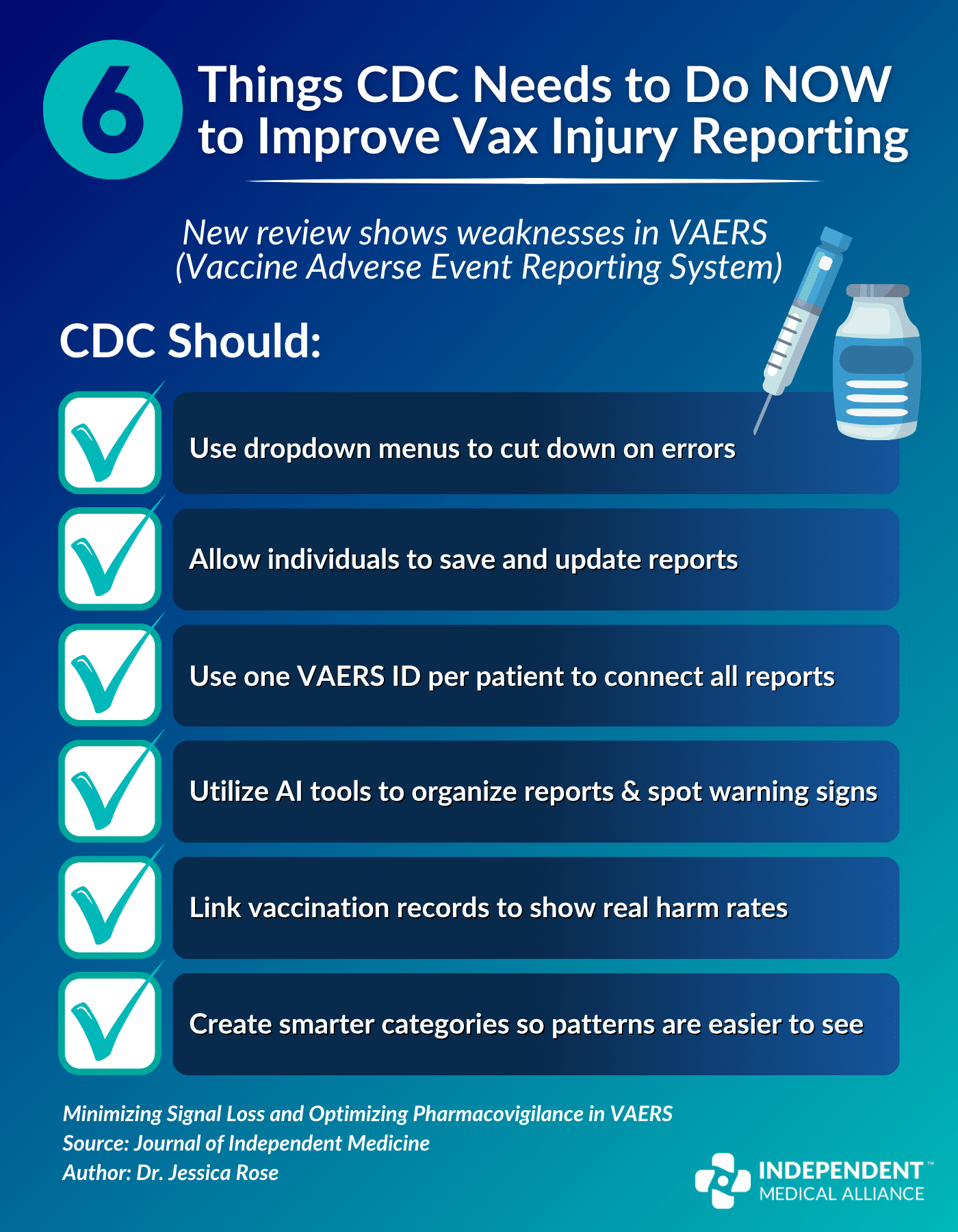
VAERS was built in the 1980s and has operated with the same basic infrastructure ever since. Reports are submitted through an online form that takes about 30 minutes to fill out. There are no pull-down menus. No standardized formats for vaccine lot numbers or dates. The form has session timeouts that can erase a report before it’s finished. And the system creates multiple IDs for the same patient rather than linking a serious reaction to a follow-up death report.
The people filing reports experience these problems every time they sit down to submit one. But the people relying on the data to detect harm may never realize what’s being lost.
Rose showed just how small the fixes can be. Two simple corrections to vaccine lot numbers (capitalizing letters and removing stray spaces) recovered 8,871 reports that had been invisible to analysis. Not because the data was missing. Because the system couldn’t recognize its own records.
What Data Got Buried?
So what fell through the cracks? Rose found safety signals that had been sitting in the data the entire time, invisible because of how the system organizes its own records.
Fetal loss following COVID-19 vaccination has never been flagged as a safety concern in the published literature. Claims about vaccines and fertility have been contested. But when Rose combined the eight different medical codes that all describe the same outcome (spontaneous abortion, fetal death, miscarriage, stillbirth, and others), the signal jumped 146%. It wasn’t missing. It was scattered across categories, each fragment too small to trigger an investigation on its own.
Cardiac arrest showed the same pattern. Nine related codes combined, signal jumped 38%. Also never flagged.
Meanwhile, the adverse events that have been flagged, like myocarditis and blood clots, happened to be coded under concentrated terms. Their signals stayed intact. The difference between a harm that got attention and a harm that got buried came down to how the codes were assigned.
To confirm her method, Rose used myocarditis as a known test case. She fed the cleaned data to Manus, an AI tool, which automated the full detection and causality pipeline in seconds and scored the myocarditis-vaccine link at 9.76 out of 10.
The same pattern of loss extends to the youngest patients. VAERS records infant age in months, but rounds the data in a way that collapses all infants under one month into a single bin. Using Hepatitis B birth-dose data, Rose found 62 death reports vanish when that rounding is applied. When the full precision is preserved, deaths peak on day 1 of life. The data was there. The system just couldn’t see it.

A System That “Could Work“
Rose isn’t calling for VAERS to be scrapped. She’s pointing out that the tools to fix it already exist.
AI tools like Manus can parse the free-text fields VAERS relies on, pulling structured data out of messy entries and flagging problems automatically. Pull-down menus would prevent the inconsistencies at the source. User accounts would let reporters save and update their work. A single ID per patient would link reactions to outcomes. And connecting VAERS to vaccination records would finally give researchers the denominator data they need to calculate how often harm actually occurs.
“If the entire structure isn’t changed, we can actually optimize it as it is, using these AI tools to parse out data from this free text.” — Jessica Rose
The system was built to protect the public. The data is being collected. The problem is what happens to it after it arrives. This study shows exactly where the losses occur and how to stop them.
The full study is available open-access at journalofindependentmedicine.org.
Related Reading
- Post: DARE-SAFE: A New Standard for Comparing Vaccine and Drug Safety
- Post: Tainted Vials: New Study Reveals Massive DNA Contamination in COVID Shots
- Post: How Did Regulators Miss DNA Contamination in mRNA Vaccines?
- Post: New Study: mRNA Vaccines Trigger 620% Heart Risk Surge in Young Men
- Journal: Journal of Independent Medicine
- Guide: COVID Vaccine Harm: What the Data Shows
More on: Dr. Jessica Rose | Journal of Independent Medicine | Medical Journals | Medical Research | VAERS