
Host: Dr. Joseph Varon | Guests: Dr. Peter McCullough, Nicolas Hulscher, and Dr. John Catanzaro
What does the data show when Moderna’s mRNA flu vaccine is evaluated using absolute measures of benefit and risk?
This week, host Dr. Joseph Varon, IMA President and Chief Medical Officer, is joined by Dr. Peter McCullough, Nicolas Hulscher, and Dr. John Catanzaro to examine their new reanalysis of FDA clinical trial data for Moderna’s mFLUSIVA (mRNA-1010).
The flu shot is a product that runs on trust. You trust your doctor, your doctor trusts the health authorities, and the authorities tell you to get one every fall. Nobody along that chain shows you what the data says. Your chance of catching influenza in any given year is 2 to 4% at most, and if you are 65, your chance of being hospitalized with it is about one in a thousand. The vaccine on offer has historically prevented fewer than half of the cases it targets, because manufacturers have to guess the strains months ahead. And yet, half the country still decides to roll up their sleeves.
Even the flu death toll you hear every winter is softer than it sounds. Here is how it gets counted, according to Dr. Peter McCullough: if a person tests positive for influenza at any point during flu season, and if they die of anything during that time, then they are officially tallied as a flu death. He cites estimates that only about 15% of those people died of the flu itself; most died of a bacterial pneumonia that set in afterward. That inflated number is what the television ads lean on, and what hospitals cite when they tell staff to take the shot or lose their privileges. Dr. McCullough has taken 40 flu shots for exactly that reason.
So when the FDA licensed an mRNA version of the flu shot in August, it got our attention. Flu vaccination had all of these problems before anyone touched the technology. Now it carries the same mRNA platform as the COVID-19 injections, and that platform has already shown everyone how many ways a novel product can go wrong. IMA urged caution the week it was approved, and Dr. Joseph Varon had warned against rushing mRNA flu platforms more than a year before that.
Now the three authors of a new paper in the Journal of Independent Medicine have re-run the FDA’s own trial data as plain head counts: how many people had to get the shot for one of them to be helped, and how many were harmed along the way. All three join Dr. Varon to walk through what they found.
📖 Read and Download the Full Paper
Reanalysis of FDA Clinical Data for mFLUSIVA (mRNA-1010) (Journal of Independent Medicine Vol. 2, No. 5, 2026)
Authors: Nicolas Hulscher, Peter A. McCullough and John A. Catanzaro

👉 Visit the Journal of Independent Medicine to create a free account and download the full article. The paper appears in the current issue alongside nine other original investigations.
Meet the Experts

Peter A. McCullough, MD
Internist, cardiologist, and trained epidemiologist; President, McCullough Foundation. One of the most widely published physicians in the country, Dr. McCullough’s recent work spans vaccine injury syndromes, spike protein-related illness, and neuropsychiatric disorders. He last joined the webinar to discuss his team’s review of autism risk factors.

Nicolas Hulscher, MPH
Lead author; epidemiologist and administrator, McCullough Foundation, Dallas, TX. Since 2023, Hulscher has contributed to more than 20 peer-reviewed studies spanning COVID-19 vaccine injury syndromes, H5N1 avian influenza, and autism spectrum disorder.

John A. Catanzaro, ND
CEO and co-founder, Neo7Bioscience. Dr. Catanzaro holds a Doctor of Naturopathic Medicine from Bastyr University and a doctorate in theology focused on science and medical ethics. His work uses patients’ molecular data to personalize care, and he contributed the paper’s analysis of the mRNA platform itself.

Joseph Varon, MD, FCCM, FCCP
Professor of Medicine; President and Chief Medical Officer, IMA; Editor-in-Chief, Journal of Independent Medicine. A critical care physician who treated patients on the front lines of COVID-19, Dr. Varon edits the journal that published the paper under discussion.
1. What 26.6% Efficacy Actually Buys
Every flu shot advertisement leads with an efficacy number. Here is what this one is made of.
The trial behind the approval, Study P304, gave 40,805 adults aged 50 and older either mRNA-1010 or a standard-dose flu shot. Nobody received a placebo. Confirmed flu illness occurred in 2.0% of the mRNA group and 2.8% of the comparator group. The advertised 26.6% describes that gap relative to the comparator. The gap itself is eight-tenths of one percentage point, or, as our August episode put it, about 8 fewer cases per 1,000 people vaccinated.
The authors turned every outcome into a simpler question: how many people had to receive mFLUSIVA instead of a standard shot to spare one person? The answer climbs with the severity of the outcome:
- 137 people to prevent one confirmed case of flu
- 1,003 people to prevent one visit to an ER, urgent care, or hospital
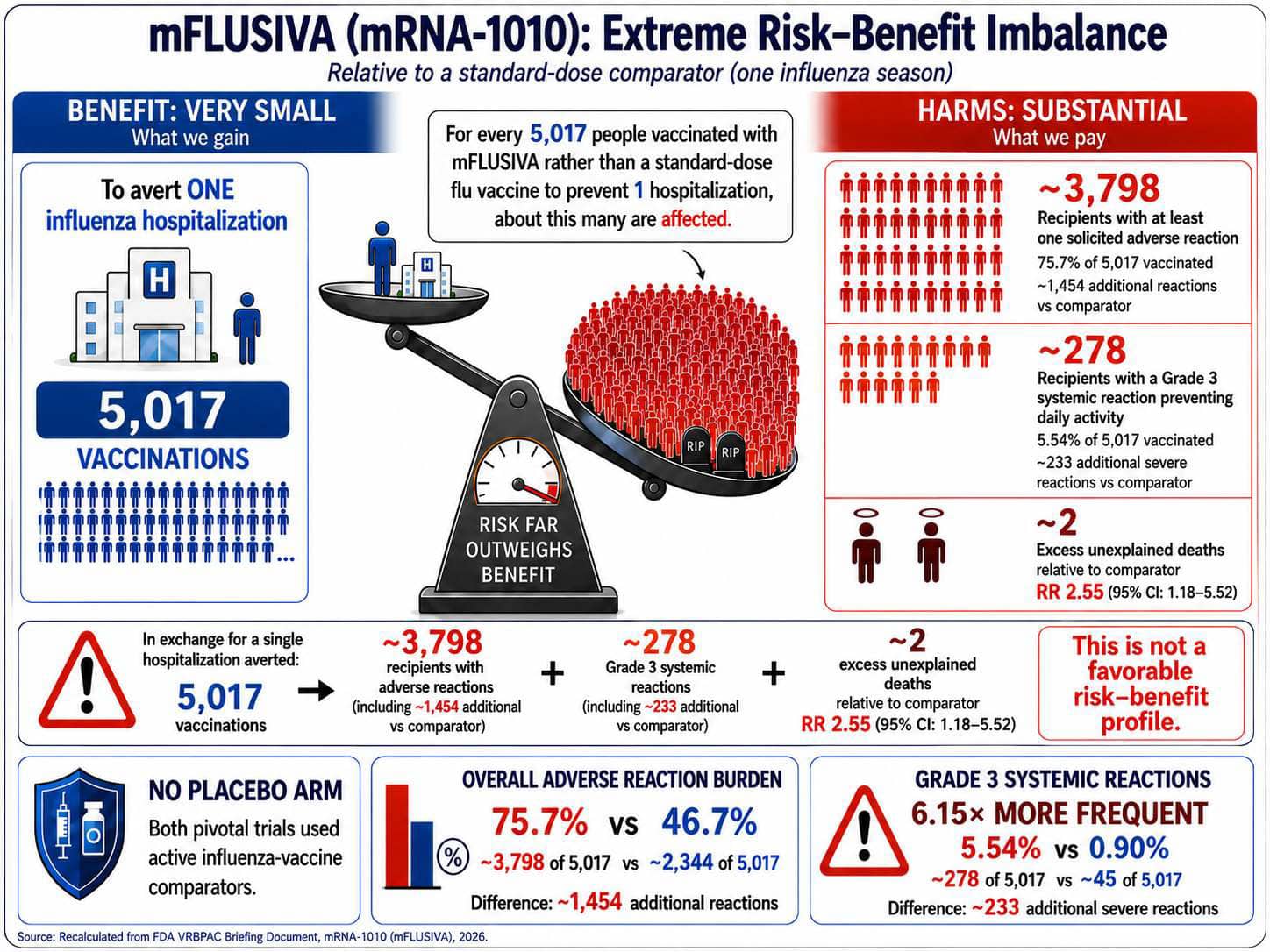
- 5,017 people to prevent one hospitalization (four in the mRNA arm versus eight in the comparator)
- No number at all for preventing a flu death, because the trial never measured whether anyone died of influenza
The benefit was smallest in the people it was supposed to protect most. Among adults 75 and older, it took 180 vaccinations to prevent one case, with uncertainty wide enough to include no benefit at all. For adults 65 and older, the approval rests on antibody levels rather than on whether anyone got sick, and the study meant to confirm a real benefit is not due until 2030.
None of this was hidden from the FDA. In February the agency refused to even review the application, because the comparison shot was not the one older adults are normally given. A week later it accepted an amended application, and no new efficacy data had arrived in between.
2. Three in Four Recipients Reacted
The FDA’s advisory committee was shown the benefit as a percentage and the harm as a list of symptoms, never both on the same scale.
Among the Study P304 participants whose side effects were tracked in detail, 75.7% of those who got the mRNA shot reported at least one, compared with 46.7% of those who got the standard shot. Grade 3 reactions, which the trial defined as severe enough to prevent daily activity, occurred in 5.5% versus 0.9%, six times as often. Every symptom the trial tracked was more common in the mRNA arm:
- Chills were 5.3 times more frequent, and Grade 3 chills were 15 times more frequent
- Fever was 6.7 times more frequent
- Grade 3 muscle pain was 11 times more frequent
Side effects usually fade with age as the immune system weakens. The gap did not: among recipients 65 and older, Grade 3 reactions were still 6.2 times more frequent.
The authors then did the arithmetic the committee never saw. For every hospitalization prevented, roughly 1,454 additional people had a side effect, and 233 had one severe enough to stop them going about their day.
“5,000 people had to take mFLUSIVA, Moderna’s mRNA flu shot, to theoretically prevent one flu hospitalization at the cost of nearly 4,000 adverse events, almost 300 grade 3 reactions preventing daily activity, and two unexplained deaths.” — Nicolas Hulscher
Those are totals. The 1,454 and 233 above are the additional reactions attributable to choosing mFLUSIVA over a standard shot. Nobody on the committee was asked whether 233 disabling reactions are a fair price for one averted hospitalization. The FDA called the profile “acceptable” and moved on.

3. Twenty-Three Deaths, One Autopsy
Every vaccine trial counts the deaths among its participants. What matters is what the trial does with them afterward.
Across both trials, 71,916 people in all, deaths from any cause were close to even: 102 in the mRNA group and 97 in the comparator. The imbalance is in one category. Deaths recorded as “unspecified cause” occurred in 23 mRNA recipients and 9 comparator recipients, two and a half times the rate, a gap too large to put down to chance.
The procedure that resolves an unexplained death is an autopsy. Across the entire program, exactly one was performed, in the comparator arm. In the FDA’s own words: “No autopsies were conducted in the mRNA-1010 group deaths.”
“When you have an unresolved mortality signal, that shouldn’t be approved for widespread human use.” — Nicolas Hulscher
Set against the benefit, that is about two excess unexplained deaths for every hospitalization averted. The paper does not claim the vaccine caused those deaths. What it establishes is that the trial left a safety signal twice the size of its benefit unresolved, and that it can never be resolved now, because the bodies were never examined.
4. Same Platform, Three New Proteins
If you followed the COVID-19 shots closely, this will feel familiar. If not, it explains why the reactions above are more than a bad day.
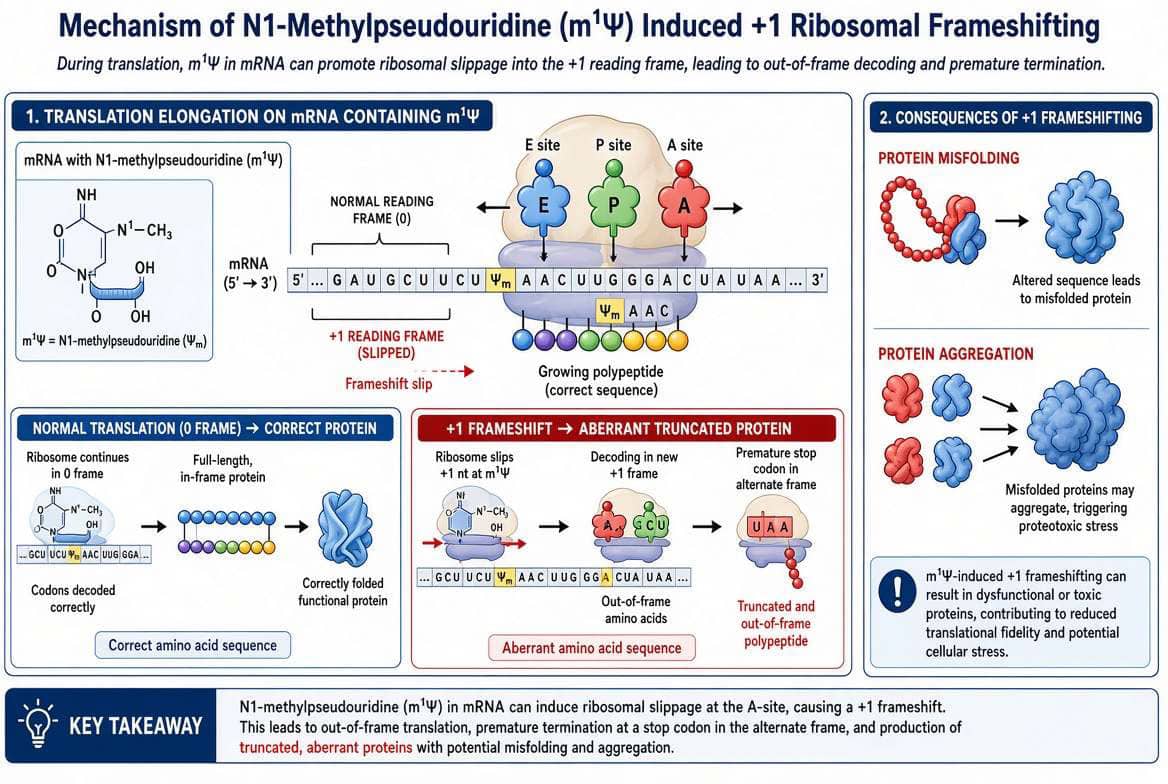
mFLUSIVA uses the same fat-based delivery particle and the same chemically modified mRNA as Moderna’s COVID-19 vaccine. Only the instruction inside has changed: instead of spike protein, your cells are told to build three influenza proteins called hemagglutinins. Dr. Catanzaro, who wrote the paper’s platform analysis, argues that two consequences follow. First, the modification that keeps the mRNA stable also makes the cell’s protein-building machinery slip, so it turns out misfolded fragments the cell has to clean up. Second, that cleanup is tolerable once, but with repeated doses the stress becomes chronic inflammation.
The protein matters as much as the platform. With the COVID-19 shots, the protein your cells were told to build was spike. With mFLUSIVA, it is hemagglutinin, the protein on the surface of the flu virus that lets it latch onto your cells, in three versions, one for each strain the shot covers. The paper points out that hemagglutinin is not a passive target for antibodies. It is a protein that fuses cells together and suppresses the immune cells that clear infections, and mFLUSIVA produces it in an amount nobody measured, for a length of time nobody measured, in tissues nobody identified.
“What they didn’t do is they didn’t tell us what’s the fate of the messenger RNA. How long does that stay in the body? Does it reliably produce all three hemagglutinins or not? Does it produce what’s called frameshifted proteins or fragments? They didn’t describe that.” — Dr. Peter McCullough
That gap matters because this product is annual. A 55-year-old who follows the label will receive 25 to 30 doses, and nothing in the evidence addresses repeated dosing.

5. What the Authors Would Do Instead
If you are over 50, someone is going to offer you this shot this month. Here is what the people who read the data do.
Hulscher described a local Fox segment already telling viewers to go and get mFLUSIVA.
“Not once did I hear a mention of any risks, not once.” — Nicolas Hulscher
The FDA approved the shot in August, but the CDC has not evaluated it. In September it said it would simply keep last year’s flu recommendations in place, and mFLUSIVA is not on them. The advertising, as Hulscher saw, is not waiting for the CDC.
Dr. Varon put a simpler question to the panel: setting mRNA aside, would any of you take the conventional flu shot? All three said no. Dr. McCullough’s reasons:
- A Cleveland Clinic study of roughly 52,000 healthcare workers found that those who took the flu shot had a 27% higher rate of flu that season than those who did not
- A placebo-controlled trial in teenagers found more non-influenza respiratory infections in the weeks after the shot
- Guillain-Barré syndrome, a form of paralysis, remains rare but is rising with universal flu vaccination
If you do catch the flu, Dr. McCullough pointed to the four approved antivirals, two of which, oseltamivir and baloxavir, are now generic. In his experience they work on the first day of symptoms and do almost nothing by day five, so have a prescription on hand before you get sick. The real killer is the bacterial pneumonia that can follow, and he treats it aggressively in older patients.
Can a pharmacy give you the mRNA formulation without telling you? Dr. McCullough said such a case is already in litigation. Ask what is in the syringe, and ask for the package insert.
“It’s not worth trading your life for an influenza vaccine.” — Dr. Peter McCullough
The flu shot is also not your only option. IMA’s site holds a deep library of resources on building immunity before the season starts, and the fastest ways to find them are an AI search of the site or a browse through our treatment guides.
Related Reading
- Peer-Reviewed Study: Reanalysis of FDA Clinical Data for mFLUSIVA (mRNA-1010)
- Journal: Journal of Independent Medicine Features Global Scientific Perspectives in New Issue
- Post: Independent Doctors Urge Caution After FDA Approves First mRNA Flu Shot
- Webinar: mRNA Flu Shots, the Childhood Vaccine Schedule, and the Fauci Files
- Post: The Risks of Rushing Bird Flu mRNA Shots
- Webinar: A New Review of Autism Risk Factors

More on: CDC | Dr. John A. Catanzaro | Dr. Joseph Varon | Dr. Peter McCullough | FDA | Influenza | mRNA | Nicolas Hulscher | vaccines