
Independent researcher Matthew Cormier explores what falling body temperature could tell us about immune defenses, metabolic health and the rise of chronic illness in his second Journal of Independent Medicine paper.
For generations, 98.6°F has been the number we reach for to decide whether a body is behaving normally. It no longer describes us. Long-term records show that average human body temperature has fallen nearly a full degree since the 1800s, to about 97.7°F today.
Over the same stretch, chronic illness became common. The paper cites estimates that 40–50% of U.S. children now meet criteria for at least one chronic condition, with comparable trends in adolescents and young adults. The leading explanation in the scientific literature treats the cooling as harmless, a byproduct of cleaner living and fewer lifelong infections.
In his second paper for the Journal of Independent Medicine, following his 2025 review of viral reactivation and autism, independent researcher Matthew Cormier asks whether it is a warning light instead. Reviewing 48 published studies, he argues that body temperature is a readout of the two systems that keep us alive, our metabolism and our immune defenses, and that a population growing colder may be losing ground on both.
In the video above, he describes the shift from the familiar benchmark:
“For over a century, the statistical average for human body temperature was 98.6 degrees Fahrenheit, but we’ve been seeing a steady decline, and the new average is 97.7 degrees Fahrenheit. We’re all getting colder.” — Matthew Cormier
📖 Read and Download the Full Paper
The Global Decline of Human Body Temperature: Evidence for a Metabolic and Immunological Crisis (JIM Vol. 2, No. 5, 2026) — Author: Matthew Cormier
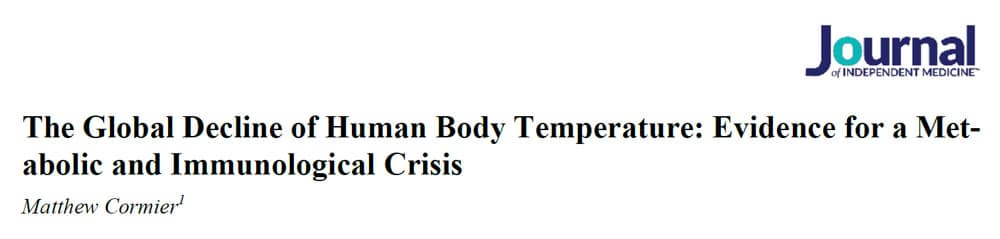
👉 Visit the Journal of Independent Medicine to create a free account and download the full article.
The 98.6°F Standard No Longer Holds
Anybody who has used a thermometer knows the 98.6 benchmark. It comes from a German physician named Carl Wunderlich, who published it in 1868 from one of the largest sets of patient temperatures ever collected, and it held as the clinical standard for more than a century.
It no longer holds. A 2020 analysis of American records stretching from Civil War veterans to present-day Stanford patients found a steady decline across every generation, adding up to roughly a degree. The paper also tests the obvious objections, from thermometer changes to air conditioning to heavier bodies, and shows that none of them is enough to explain the drop.
Nor is it only an American story. Cormier cites confirming data from Japan, Canada and Bolivia, and notes that the decline now shows up in children and middle-aged adults, historically the most thermally stable groups: a population-wide physiological change, not an aging society.
150 Years of Cooling in a Single Generation
A change spread across 150 years leaves room for many explanations. The Tsimane, an Indigenous forager-farming population in the Bolivian Amazon, leave far less.
When researchers began recording their temperatures in the early 2000s, the Tsimane sat right at Wunderlich’s 98.6°F. By 2018 they had fallen to about 97.7°F. The decline that took the industrialized world roughly 150 years took them 16, in villages with no air conditioning, grid electricity or running water. A shift that fast cannot be evolution. For Cormier, it points to something in the environment, in medicine or in behavior that can change human physiology within a single lifetime.
The same population, while it held 98.6°F, had the healthiest hearts ever recorded. Now that their temperature is falling, Cormier calls them one of the strongest available tests of his hypothesis: if temperature tracks metabolic health, their metabolic disease should rise as their temperature drops. The paper lays out the data.

Heat Is a Natural Defense
A fever is the body turning up its own thermostat on purpose, and vertebrates have been doing it for more than 600 million years, a measure of how much survival advantage it confers.
Keeping warm costs energy, but the warmth buys protection. Many organisms that thrive in the environment cannot survive at mammalian body temperatures. Cormier calls this a “thermal exclusion zone”: a biological barrier created partly by the heat we generate.
As he explains in his video:
“Heat is a natural defense against viruses, parasites, bacteria, and fungal infections.” — Matthew Cormier
The clearest case is fungi. Body heat alone shuts out most of them, and in the same years that human temperatures fell, invasive fungal infections roughly doubled, to an estimated 3.8 million deaths a year. The paper walks through similar findings for viruses, with a caveat Cormier is careful to make: the lab experiments involve far larger temperature swings than the real-world decline, and whether a smaller, sustained shift also weakens our defenses against infection, including persistent or chronic ones, is the question he wants tested.
It is also why temperature is a vital sign. As he says in the video, it is an accurate biomarker of both immune activity and metabolic function, and the immune side is only half the story.
What Rose While We Cooled
Keeping us warm is work, and that work connects temperature to the other half of Cormier’s argument: metabolic health.
Even at rest, the body burns energy to circulate blood, run organs and keep cells working, and most of that activity produces heat. That baseline burn is the basal metabolic rate, the body’s main furnace. The paper’s reasoning runs from disease to temperature: insulin resistance, muscle loss and metabolic syndrome all lower basal metabolic rate, so a population growing less metabolically healthy should generate less heat and register it as a falling average.
The paper then lays the temperature record alongside the metabolic one:
| What rose while temperature fell | The numbers cited in the review |
|---|---|
| Type 2 diabetes in the U.S. | 5.7 million diagnosed Americans (2.5%) in 1980 → 38 million (11.5%) by 2021 |
| Diabetes worldwide | 200 million people in 1990 → 830 million in 2022 |
| Prediabetes in the U.S. | About 2 in 5 adults |
| Metabolic health in the U.S. | Only about 12% of adults meet the criteria, leaving roughly 88% with some degree of impairment |
Cardiovascular disease, obesity and the metabolic contributors to Alzheimer’s disease have climbed over the same interval. In his video, Cormier widens the lens further, citing estimates that roughly half of children and 70% of adults now live with at least one chronic illness.
He is plain about what this does and does not show: parallel trends establish association, not causation. But the alignment is exactly what his hypothesis predicts, and it gives a vital sign we already measure a new job: making visible the metabolic strain beneath these numbers.
Not a Benign Decline: What’s Turning Down the Thermostat
There is a comfortable explanation for cooler bodies, and Cormier gives it its due: sanitation, antibiotics and vaccination reduced the lifelong infections our ancestors carried, and fewer infections meant less inflammation and less metabolic heat. On that account, cooling is progress.
Cormier grants that the story fits the 19th and early 20th centuries. After that, he argues, it breaks down: the paper lays out three problems with the “progress” reading and arrives at a different conclusion, that the temperature decline is “not the benign residue of conquered infection but a visible sign of compromised host physiology.”
If something is suppressing the body’s ability to make heat, what is it? The paper names two candidates that expanded over exactly the period temperatures fell: heavy metals such as cadmium, lead and arsenic, which have turned up in commercial baby foods at levels far above drinking-water benchmarks, and the disruption of the gut microbiome by antibiotics. Cormier does not claim a single cause. His model is several modest hits converging on the same physiology, and the mechanisms behind each are laid out in the paper. He closes his video with the stakes:
“The documented decline of human body temperature and the implications on the chronic illness epidemic represents an under-recognized public health concern.” — Matthew Cormier
Cormier’s paper brings the temperature records together with the biology of heat production and immune defense, and asks whether a vital sign we already measure has been telling us something for decades.
Read and download the full study at the Journal of Independent Medicine.
Related Reading
- Post: Journal of Independent Medicine Features Global Scientific Perspectives in New Issue
- Guide: What Is Metabolic Syndrome?
- Webinar: From A to Zinc, Part 1: What Your Body Is Really Missing
- Guide: Gut & Metabolic Support: Foundational Nutrients for a Healthier Gut
- Post: How Everyday Chemicals Disrupt Your Hormones—and How Bioremediation Can Fight Back