


Eat Well
Guide To Fasting And Healthy Eating
Intermittent fasting is one of the most powerful tools available for improving metabolic health, and it costs nothing. It can be adapted to virtually any lifestyle, combined with any dietary approach, and started at any age. The research behind it spans decades and continues to grow.
Yet most people have never been given a clear, practical guide to doing it safely. IMA’s Eat Well guide fills that gap. Backed by dozens of peer-reviewed references, it covers the science of fasting, what to eat and what to avoid, how to manage blood sugar, and how to get started with a sustainable fasting practice. It also includes dedicated guidance for women, whose hormonal cycles require a different approach to fasting than men’s.
This page highlights the key ideas. The full guide has the details, the data, and the practical steps.
🧬 Why Fasting Works for Metabolic Health
Fasting activates autophagy, the body’s built-in system for clearing out damaged cells, misfolded proteins, and foreign material. Think of it as cellular housekeeping: when you stop eating for a sustained period, your cells shift into cleanup mode, recycling worn-out components and using the raw materials to repair themselves. The discovery of autophagy’s mechanisms earned Yoshinori Ohsumi the 2016 Nobel Prize in Physiology or Medicine.
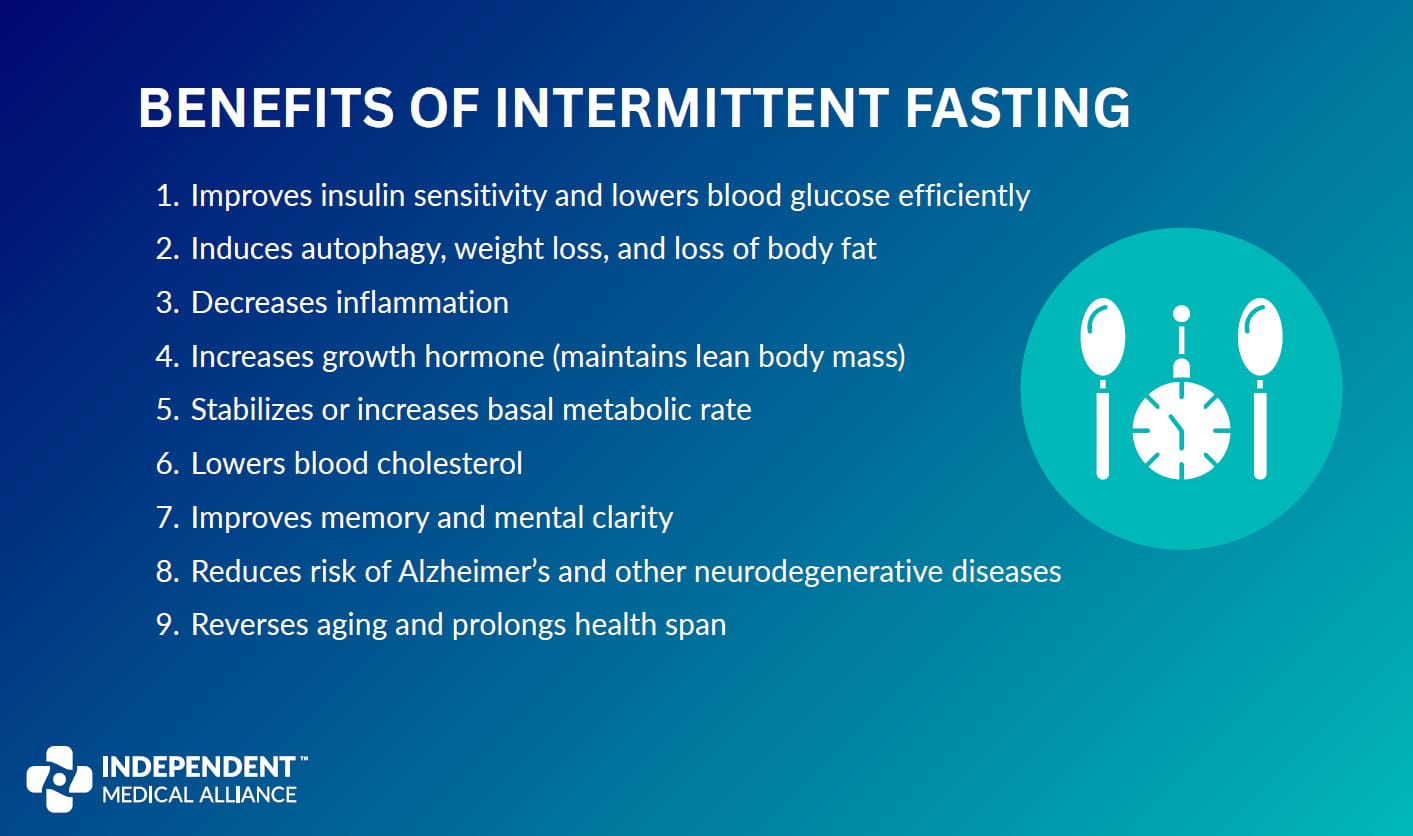
Intermittent fasting is one of the most effective natural triggers of this process, and autophagy accounts for many of fasting’s wide-ranging health benefits:
- Improves insulin sensitivity and lowers blood glucose
- Induces weight loss and loss of body fat
- Decreases inflammation
- Increases growth hormone (maintaining lean body mass)
- Stabilizes or increases basal metabolic rate
- Lowers blood cholesterol
- Improves memory and mental clarity
- Reduces the risk of Alzheimer’s and other neurodegenerative diseases
- May reverse aging and prolong health span
One critical distinction: fasting is not starvation. When the body is starving, it decreases metabolic rate and growth hormone to conserve energy. Intermittent fasting does the opposite, increasing both. This is one reason traditional “eat fewer calories and exercise more” approaches fail so often.
For those concerned about lingering effects of spike protein from COVID-19 infection or vaccination, IMA recommends intermittent fasting as one of the most effective ways to activate autophagy and support the body’s clearance of damaged and misfolded proteins.
🍽️ What the Guide Covers
The Eat Well guide goes well beyond “skip breakfast.” It’s a comprehensive, evidence-based resource covering the full landscape of fasting and healthy eating. Here’s what you’ll find inside:
- Healthy eating fundamentals: What happens when you eat, how insulin and insulin resistance work, the glycemic index, real food vs. processed food, and which cooking oils to use and avoid
- Flattening the glucose curve: Practical strategies backed by research, including eating foods in the right order, using vinegar before starchy meals, walking after eating, and avoiding fruit juices and distracted eating
- Getting started with fasting: Time-restricted eating as the most practical entry point, a progressive approach from a 12-hour eating window down to one meal a day, and multiple fasting methods (5:2, alternate-day, and extended fasts)
- Who should and shouldn’t fast: Clear guidance on contraindications, including children under 18, pregnancy, underweight individuals, and interactions with medications such as proton pump inhibitors and hydroxychloroquine
- Women and fasting: How to align fasting with menstrual cycle phases, a modified approach for premenopausal women, strategies for perimenopause and menopause, phytoestrogen-rich foods, and exercise recommendations
- Dealing with hunger: How ketosis naturally suppresses appetite over time, and practical tools like coffee with coconut oil, bone broth, and stevia (without erythritol)
The guide is fully referenced and is updated regularly as new evidence emerges.
⏱️ How to Get Started
Time-restricted eating is the most practical place to begin. The guide recommends starting gradually:
- Begin with a 12-hour eating window five days a week (for example, eating between 8 a.m. and 8 p.m., Monday through Friday)
- After a week or two, reduce the window by an hour or two and extend the schedule to seven days
- Most people aim for an 8-hour eating window, though some shorten it to four hours or less over time
- Some eventually work toward one meal a day
Don’t calorie count. Don’t obsess over food choices. The goal is to adopt a sustainable rhythm that gives your body regular breaks from eating.
A few principles that make a difference: avoid eating within three to four hours of bedtime (autophagy during sleep is critical for brain health), aim for 20 to 30 minutes of daily exercise, and consider using a continuous glucose monitor when starting out. A CGM provides real-time feedback on how your body responds to different foods, which varies significantly from person to person.
The full guide covers all of this in detail, including specific fasting methods, tips for managing hunger, and adaptations for women at every stage of life.
📚 Learn More
- Protocol: I-CARE Insulin Resistance
- Webinar: Intermittent Fasting for Health
- Webinar: Intermittent Fasting for Women
- Guide: Cancer Nutrition Guide
- Guide: Nutrition for Cancer Prevention
- Post: How I Reversed Type 2 Diabetes — Dr. Paul Marik
Recommended reading:
- The Complete Guide to Fasting by Jason Fung, MD
- The Real Meal Revolution by Tim Noakes, MD

This guide is meant solely for educational purposes. Never disregard professional medical advice because of something you have read on our website or in our publications. This guide is not intended to be a substitute for professional medical advice, diagnosis, or treatment regarding any patient. Treatment for an individual patient is determined by many factors and should rely on the judgment of a physician or qualified healthcare provider. Always seek their advice on any questions you may have about your medical condition or health.
Please note our full disclaimer at: imahealth.org/disclaimer