In 2020, Dr. Sabine Hazan’s lab became the first to sequence the complete SARS-CoV-2 genome from patient stool samples. The study was published, then retracted without cause years later. The Journal of Independent Medicine is setting the record straight.
In early 2020, nobody knew how SARS-CoV-2 spread. Not really. Respiratory droplets were the working assumption, but the full picture was wide open. Was it airborne? Could it survive on surfaces? And, a question most researchers hadn’t yet thought to ask: was it in the sewage?
Dr. Sabine Hazan was asking that question.
A GI specialist and founder of ProgenaBiome, a microbiome research laboratory in Ventura, California, Dr. Hazan had a hypothesis rooted in something basic: everything ends up in the gut. If patients were testing positive for SARS-CoV-2 by nasal swab, logic suggested the virus might be showing up further downstream. Her team began collecting fecal samples from COVID patients and running them through next-generation whole genome sequencing, not standard PCR fragment detection, but a full read of the virus’s complete genetic code.
What they found was unambiguous. The whole virus was there.
The study was published in a peer-reviewed journal. Then, roughly two years later, it was retracted with no documented scientific justification. It is now published in the Journal of Independent Medicine, Volume 2, Issue 1, 2026.
📖 Read and Download the Full Paper
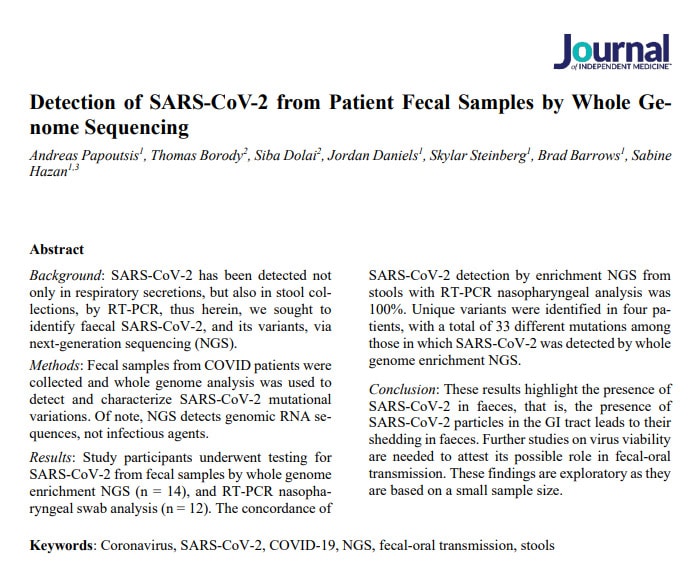
Detection of SARS-CoV-2 from Patient Fecal Samples by Whole Genome Sequencing (JIM Vol. 2, No. 1, 2026) Authors: Andreas Papoutsis, Thomas Borody, Siba Dolai, Jordan Daniels, Skylar Steinberg, Brad Barrows, and Sabine Hazan
👉 Visit the Journal of Independent Medicine to create a free account and download the full article.
About the Study
The research enrolled 14 patients from a GI clinic in 2020. Ten were symptomatic. Twelve also underwent concurrent nasal RT-PCR testing. All provided fecal samples analyzed by whole genome enrichment next-generation sequencing (NGS).
The distinction from standard testing matters. RT-PCR detects specific genetic fragments, essentially a fingerprint. Whole genome sequencing reads the entire viral code, all 30,000 base pairs. As Dr. Hazan explains:
“The whole entire virus, not just a PCR, was found in the stools.”
To conduct the analysis, the team:
- Collected fecal samples using standardized collection tubes
- Extracted and reverse-transcribed RNA
- Prepared sequencing libraries using Illumina’s enrichment panel
- Sequenced samples on Illumina’s NextSeq 550 system
- Mapped results against the Wuhan-Hu-1 reference genome
Two asymptomatic patients who tested negative by nasal swab also tested negative by fecal NGS. Three patients who received treatment before providing fecal samples tested negative by NGS as well. The authors are careful to note the sample size is too small to draw conclusions about treatment efficacy, but the signal warrants further investigation.
To the authors’ knowledge, this was the first published whole genome sequencing of SARS-CoV-2 from stool samples.
Key Findings
Dr. Hazan’s team identified several findings that continue to matter for how we understand and treat COVID today:
- 100% concordance between fecal NGS and nasal RT-PCR in untreated symptomatic patients: every positive nasal swab corresponded to a complete SARS-CoV-2 genome detected in stool
- 33 distinct mutations identified across the positive cohort, with unique viral variants in four patients, showing the virus was already diverging significantly from person to person in early 2020
- Viral persistence beyond acute infection: one patient in the study carried COVID in their stool for 45 days. ProgenaBiome has since documented patients carrying the virus in their stool for years
- Treatment signal: patients who received treatment before fecal sampling all tested negative by NGS, a finding too preliminary to be conclusive but too notable to ignore
That persistence finding has direct clinical implications:
“These patients are having COVID in their stools for years, which makes it important when you’re treating a long COVID patient to see whether the virus is still persisting, and whether you need to kill the virus to begin with.”
—Dr. Sabine Hazan
The mutation data raised a harder question. With 33 distinct genomic variants across just 14 patients, each carrying a slightly different viral profile, the study offered an early look at how rapidly SARS-CoV-2 was diverging in the wild, and what that might mean for any uniform response to it.
Why the Journal of Independent Medicine Exists
“Papers should never be retracted. Science, research, and medicine are founded on the work of multiple people, not just one person. We should not be erasing history. We should keep these publications alive. Thank you to the Journal of Independent Medicine for allowing us to safeguard these important papers.”
—Dr. Sabine Hazan
The Journal of Independent Medicine was built for exactly this: to publish rigorous research on its merits, free from pharmaceutical funding and institutional pressure. Dr. Hazan’s study belongs in the scientific record. It is there now, and it will stay there.
If you are a researcher with work that deserves to be evaluated on its science alone, the journal is accepting submissions.
👉 Submit Your Research to the Journal of Independent Medicine »
👉 Learn more about our upcoming 2026 special issues »
The Record Stands
Early pandemic research was produced under pressure, with small sample sizes and an incomplete picture of what the virus was doing. Some of it turned out to be wrong. Some of it turned out to be right and got pulled anyway.
Dr. Hazan’s team asked an important question, found a clear answer, and published it. The retraction didn’t change what the data showed. Read the study, evaluate it yourself, and ask the question Dr. Hazan is still asking: why was it removed in the first place?
Explore More Research:
- 📖 New Peer-Reviewed Study Asks: Were COVID Injections Engineered to Harm?
- 🧬 New Study Defines Mechanisms of Post-Vaccine “Turbo Cancer”
- 💉 Tainted Vials: New Study Reveals Massive DNA Contamination in COVID Shots
- 🔬 How Did Regulators Miss DNA Contamination in mRNA Vaccines? New Study Explains
- 🧠 New Peer-Reviewed Study Links COVID Vaccination to Cancer Signals
- 🦠 New Study Asks: Could Vaccine-Induced Viral Reactivation Trigger Autism?
These resources are free to download—but not free to create. Our medical journal, and every system of technology and review that powers it, requires significant time and resources to build and maintain. Please support our mission to continue sharing evidence-backed medical research with the world by donating today.