
Standard tests miss it. Doctors can’t explain it. New research points to mitochondrial dysfunction as a central driver of both long COVID and PACVS—and a path toward targeted treatment.
The pandemic may be over, but for millions, the suffering isn’t. Long COVID remains underdiagnosed and rarely treated. Post-Acute COVID-19 Vaccination Syndrome (PACVS) doesn’t even have an official diagnostic code, meaning the healthcare system has no way of accounting for it. Patients are left searching for answers, often unable to find doctors willing to treat them.
One reason: the symptoms don’t show up on standard tests. Persistent fatigue, cognitive impairment, and dysautonomia are described by patients, but their labs often come back “normal.”
A new review published in Biomolecules explains why. Mitochondrial dysfunction and oxidative stress are central drivers of these conditions. And recognizing that opens the door to targeted diagnosis and treatment.
This collaborative effort, co-authored by IMA President Dr. Joseph Varon, IMA Co-Founder Dr. Jose Iglesias, and Director of Research Matthew Halma, identifies mitochondrial reactive oxygen species (mtROS) as a pivotal mechanism underlying persistent symptoms, whether the spike protein exposure came from infection or vaccination.
“Our findings suggest that long COVID should be recognized as a mitochondrial disorder rooted in redox imbalance. By identifying specific biomarkers and imaging modalities to assess mitochondrial health, we can advance toward more personalized treatment approaches.” — Study Authors
📖 Read and Download the Full Paper
Mitochondrial Reactive Oxygen Species: A Unifying Mechanism in Long COVID and Spike Protein-Associated Injury: A Narrative Review Authors: Eunseuk Lee, Adaobi Amelia Ozigbo, Joseph Varon, Matthew Halma, Madison Laezzo, Song Peng Ang, Jose Iglesias
About the Study
The spike protein is the common thread linking Long COVID and PACVS. What hasn’t been clear is exactly how it causes persistent symptoms at the cellular level. This review answers that question.
Key findings:
- SARS-CoV-2 disrupts mitochondrial bioenergetics by compromising membrane integrity, elevating mtROS production, and impairing mitophagy
- These disruptions cause sustained immune activation and metabolic imbalance
- The same mechanisms apply whether spike protein exposure comes from infection or vaccination
- These alterations don’t appear on conventional diagnostics, explaining why patients keep getting told nothing is wrong
The review also addresses the diagnostic gap: approximately 0.9% of vaccine recipients may develop PACVS, and two-thirds visit four or more doctors before receiving a diagnosis.
“This review consolidates a growing body of evidence indicating that mitochondrial dysfunction plays a central role in persistent symptoms,” the authors write. “It opens avenues for new diagnostic and therapeutic strategies.”
Under the Microscope: The Cellular Energy Crisis
Mitochondria produce the energy that powers nearly every function in the body. When they’re damaged, the effects cascade: muscles fail to recover, cognition suffers, and the immune system stays stuck in overdrive.
The review details how spike protein disrupts mitochondrial function: impairing the electron transport chain, generating excess reactive oxygen species, blocking clearance of damaged organelles, and triggering inflammation through mitochondrial DNA leakage. This creates a self-perpetuating cycle that can persist long after infection or vaccination.
Critically, this damage doesn’t register on standard blood panels or imaging. It’s subcellular. That’s why emerging biomarkers matter: peroxiredoxin-3, circulating mitochondrial DNA, and Magnetic Resonance Spectroscopy are now revealing what conventional tests have missed.
But while the damage is hard to detect, its effects are systemic. The figure below illustrates how mitochondrial dysfunction ripples across the body, affecting the brain, heart, lungs, kidneys, liver, pancreas, and blood vessels.
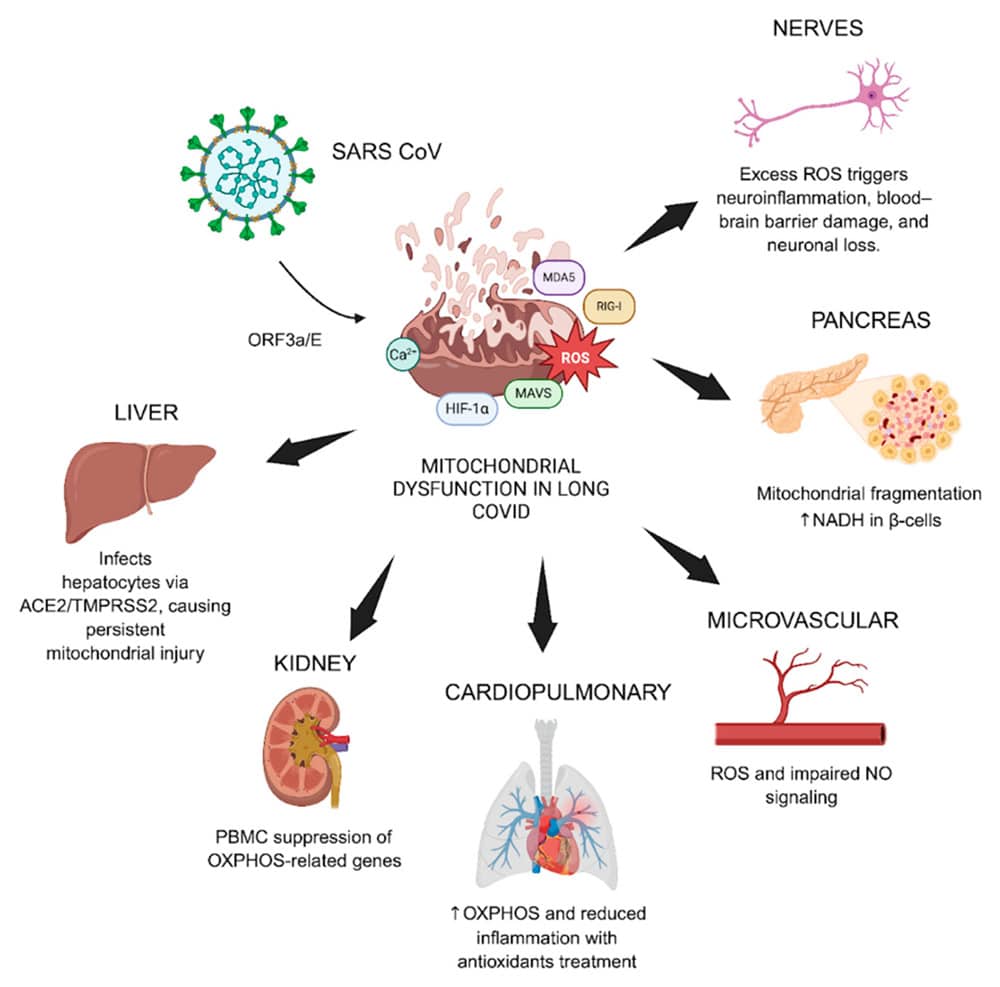
Figure 3: From the study, “This diagram illustrates how mitochondrial dysfunction contributes to long COVID by affecting multiple organ systems. In the kidney, suppression of OXPHOS genes during acute COVID predicts worse outcomes months later. In the pancreas, infected β-cells show mitochondrial fragmentation and metabolic stress, similar to what is seen in type 2 diabetes. In the heart and lungs, antioxidant treatments that target mitochondria improve energy production, reduce inflammation, and improve survival in animal models. In the blood vessels, excess mitochondrial ROS impairs nitric oxide signaling, leading to poor circulation and symptoms like dizziness and post-exertional fatigue. Together, these findings show that mitochondrial damage plays a central role in long COVID symptoms.”
Therapeutic Strategies: Restoring Mitochondrial Health
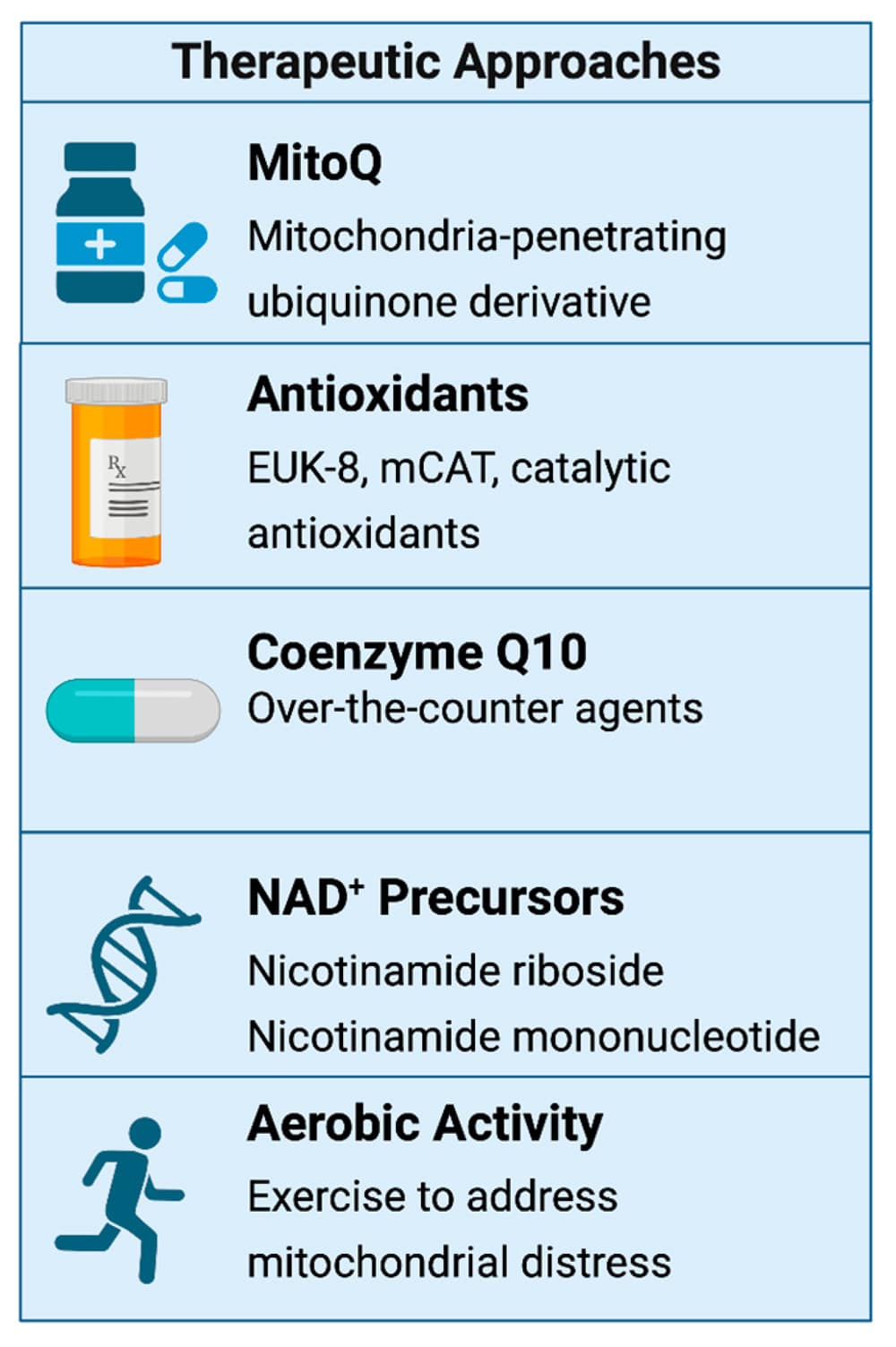
If these conditions stem from mitochondrial dysfunction, restoring mitochondrial health becomes the treatment target:
Pharmacological: Mitochondria-targeted antioxidants (MitoQ, EUK-8); NAD⁺ precursors like nicotinamide riboside; metformin for ROS suppression.
Nutritional: CoQ10, N-acetylcysteine, creatine, magnesium, riboflavin.
Non-pharmacological: Carefully calibrated exercise, timed to avoid symptom flares.
“Future studies should focus on validating non-invasive biomarkers and testing interventions that restore mitochondrial function,” notes Matthew Halma. “This approach has potential not only for long COVID but for other post-viral syndromes.”
From Dismissed to Defined
This review builds on IMA’s sustained work bringing scientific rigor to conditions mainstream medicine has ignored.
- June 2025: “Breaking the Silence” — first peer-reviewed study defining PACVS as a measurable condition
- November 2025: PACVS diagnostic criteria published in Frontiers in Medicine
- December 2025: Post-vaccine fatigue linked to mitochondrial dysfunction via MRS imaging
A year ago, PACVS had no definition. Now it has a biological basis, diagnostic biomarkers, and therapeutic targets. This review connects the dots, showing that Long COVID and PACVS share a mechanism—and potentially a treatment path.
The work continues.