
Why do long COVID and PACVS patients crash after simple activities? A new review by IMA researchers pinpoints three broken energy pathways and what to do about them.

For millions living with long COVID or PACVS, exhaustion is a constant biological reality. An estimated 10% of individuals infected with SARS-CoV-2 develop persistent long-term symptoms, while PACVS has been reported in 0.2–0.9% of vaccine administrations based on pharmacovigilance analyses. For both groups, the hallmark triad of fatigue, brain fog, and post-exertional malaise can make even routine physical activity impossible.
Standard tests often come back normal. But a new peer-reviewed review now explains what’s happening at the metabolic level, and maps a framework for recovery.
Published in Hormone and Metabolic Research (Thieme), the review by Carlos Gracidas, Rakeem Levy, Dr. Joseph Varon, and Matthew Halma identifies three interconnected ways that energy metabolism goes wrong in long COVID patients, and makes the case that the same framework applies to PACVS: fat oxidation, carbon dioxide balance, and lactate handling. Together, these disruptions help explain why something as simple as a short walk can leave patients completely wiped out.
📖 Read and Download the Full Paper
Lactate, Capnia, and Fat Oxidation as Therapeutic Axes for SARS-CoV-2 Spike Protein-Induced Sequelae Authors: Carlos Gracidas, Rakeem Levy, Joseph Varon and Matthew Halma
About the Study
This narrative review synthesizes evidence from muscle biopsy studies, cardiopulmonary exercise testing (CPET), and metabolomic analyses to build a comprehensive picture of what goes wrong in the energy metabolism of long COVID patients. Because both long COVID and PACVS share exposure to the SARS-CoV-2 spike protein as a primary biological driver, the authors argue that the same metabolic framework applies to both conditions.
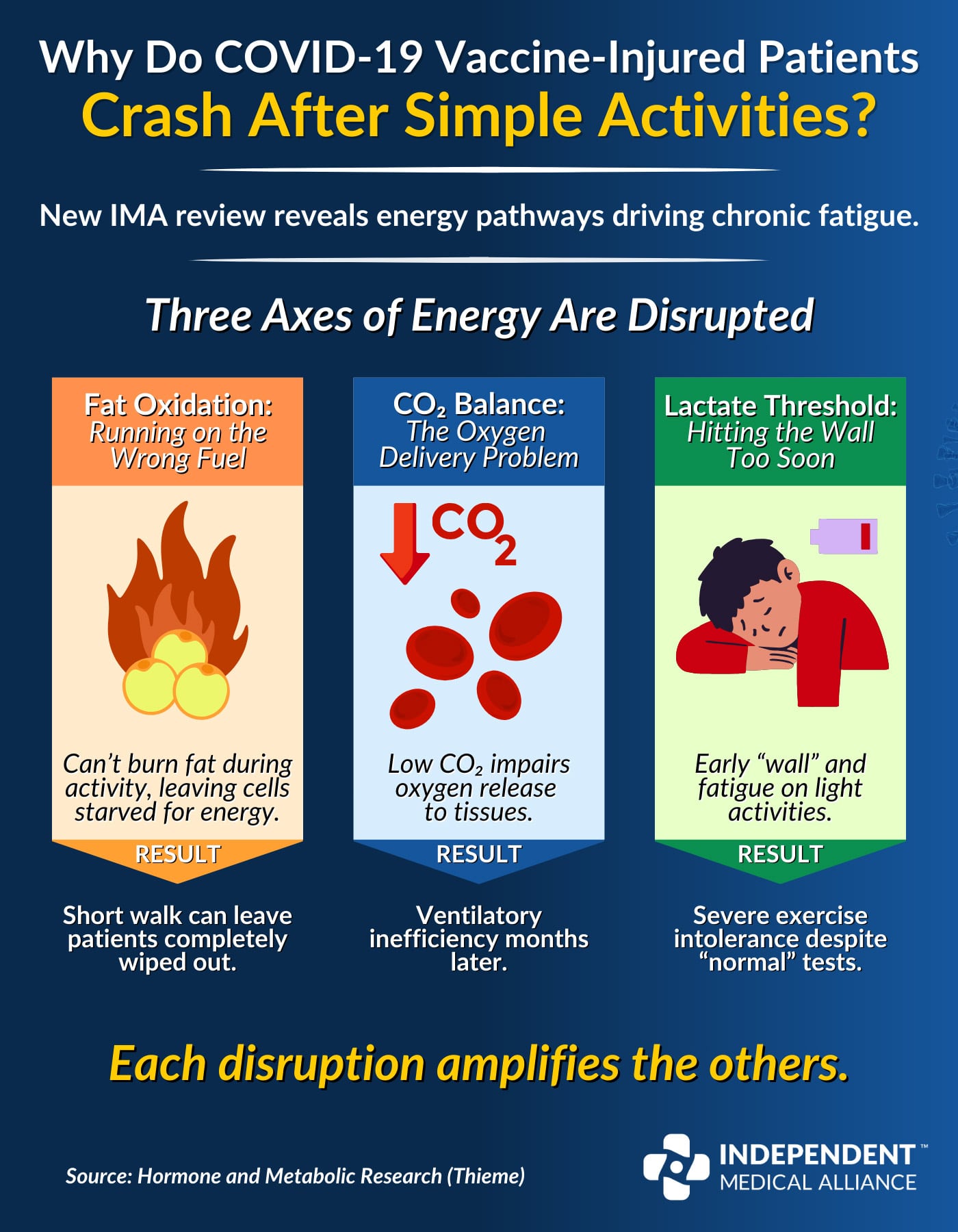
The core finding: there are three distinct ways that metabolism goes wrong in these patients, and they reinforce each other. When mitochondria are damaged by spike protein exposure, fat burning drops, lactate builds up too early, and CO₂ levels fall, creating a vicious cycle of chronic energy failure. The review frames these as three “therapeutic axes,” each offering measurable targets for intervention.
An important note: the metabolic data reviewed here comes primarily from studies of long COVID patients. The translation to the PACVS context is based on shared biological mechanisms (particularly spike protein-driven mitochondrial dysfunction) rather than direct PACVS-specific exercise testing data.
Three Pathways, One Condition
The review organizes the metabolic evidence around three axes, each disrupted in long COVID and PACVS and each offering a target for recovery.
🔋 Fat Oxidation: Running on the Wrong Fuel
During physical activity, the body normally shifts from burning fat to burning carbohydrates as intensity increases. In long COVID patients, this transition happens at much lower exertion levels. They are unable to use fat as fuel even under moderate effort, forcing their cells to rely on glucose, which produces less energy and more metabolic waste. The spike protein appears to drive this shift by disrupting mitochondrial function and diverting fatty acids toward storage rather than energy production.
Key data points:
- A carefully graded exercise-based rehabilitation program produced 30–45% increases in fat oxidation capacity in post-COVID patients, with improvements in aerobic performance (Garbsch et al., Clinical Nutrition, 2024). The graded approach is critical to avoid triggering post-exertional malaise.
- Endurance-trained individuals maintained higher fat oxidation rates, suggesting that preserved aerobic fitness is protective
- The pattern mirrors an inverse of what endurance athletes achieve through “fat adaptation”: long COVID patients are metabolically stuck in the opposite direction
🫁 Carbon Dioxide Balance: The Oxygen Delivery Problem
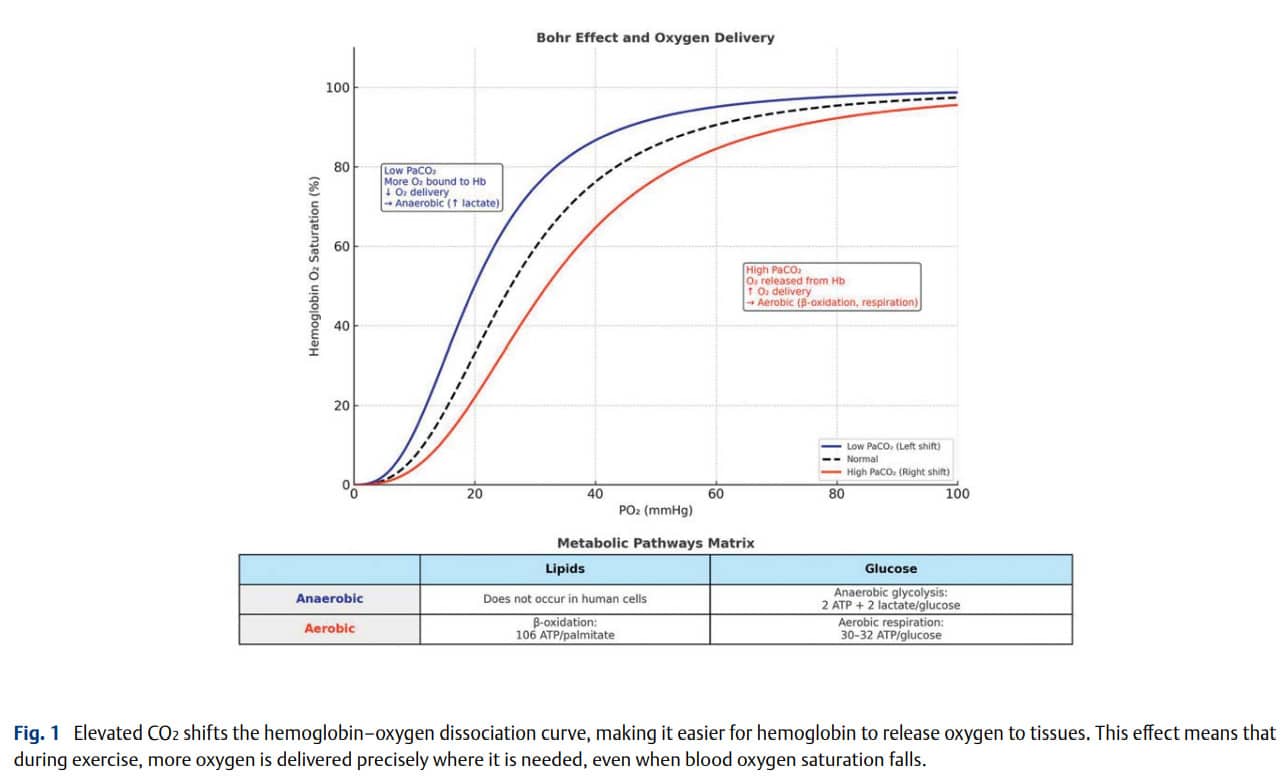
Long COVID patients show chronically low end-tidal CO₂ levels, even when breathing at a normal rate. This matters because low CO₂ shifts the oxygen-hemoglobin curve in the wrong direction: hemoglobin holds onto oxygen more tightly, delivering less to tissues that desperately need it.
Key data points:
- Some patients showed persistent ventilatory inefficiency 34 months after infection (Dorelli et al., BMC Pulmonary Medicine, 2024)
- The carotid chemoreflex appears sensitized in long COVID patients, driving excessive ventilatory drive and further CO₂ loss
- Combined with endothelial dysfunction, this creates a compounding oxygen delivery crisis
⚡ Lactate Threshold: Hitting the Wall Too Soon
In healthy individuals, lactate (a byproduct of anaerobic energy production) only builds up at higher exercise intensities. In long COVID patients, this threshold arrives far too early. Even low-level activities like walking can trigger the “burning” sensation and fatigue most people associate with intense exercise, despite normal heart and lung function on standard tests.
This premature shift to anaerobic metabolism is measurable through CPET and blood lactate monitoring, and it signals compromised mitochondrial function during the very activities patients need for recovery.
The vicious cycle: These three axes don’t operate in isolation. Poor fat oxidation forces more reliance on glucose, which produces more lactate. Low CO₂ means less oxygen reaching tissues, which pushes the body further into anaerobic metabolism. Each disruption amplifies the others.
Pathways to Recovery
The review maps specific interventions to each of the three therapeutic axes. While these approaches haven’t been tested specifically in PACVS patients, they have been shown to improve each individual parameter in other contexts. Several draw on established evidence from exercise science and nutritional medicine.
Fat oxidation strategies:
- Structured low-intensity endurance exercise (carefully titrated to avoid post-exertional malaise)
- CoQ10 supplementation: supports the electron transport chain; a randomized trial showed reduced fatigue and improved quality of life in ME/CFS patients
- Medium-chain triglycerides (MCTs): bypass the carnitine shuttle and are oxidized more quickly than long-chain fats
- Intermittent fasting: lowers insulin, promotes mitochondrial fat uptake
- Cordyceps militaris, green tea catechins, resveratrol, and baicalin
CO₂ and breathing strategies:
- Breathing techniques including Buteyko breathing, box breathing, and resonant breathing: in a 99-patient PASC cohort, resonant breathing was associated with significant improvements in wellbeing, focus, breathing capacity, stress control, and sleep quality
- Nattokinase: may support spike protein degradation and has anticoagulant properties
- Altitude training (real or simulated)
Lactate threshold strategies:
- Sodium bicarbonate supplementation: one study showed a 26% increase in lactate threshold
- Beetroot juice and dietary nitrate: trials showed a 7.2% improvement in lactate threshold with improved skeletal muscle oxygenation
- Branched-chain amino acids (BCAAs)
- Beta-alanine supplementation
- Structured aerobic training when tolerated, though the authors note this may not be advisable for all patients due to exercise intolerance
From Mechanism to Strategy
This review builds on a growing body of IMA-supported research into the metabolic foundations of long COVID and PACVS. Previous reviews identified mitochondrial dysfunction as a central driver of persistent symptoms. A companion review in Biomedicine & Pharmacotherapy mapped metabolic modulation strategies specific to PACVS. And foundational work on PACVS recognition, from Breaking the Silence to Restoring Trust in Vaccination, has helped define the condition itself.
This review takes the next step, mapping the specific metabolic pathways involved and outlining what can be done about them. Large-scale clinical trials are still needed, and many of the diagnostic tools involved aren’t yet available in routine clinical settings. But the direction is clear: energy metabolism is measurable, it’s treatable, and the research is moving fast.
Explore More
For more on IMA’s research into long COVID and PACVS, check out these resources:
- Hidden Culprit: New Review Reveals Mitochondrial Dysfunction Link in Long COVID and PACVS Patients
- New Review Links Post-Vaccine Fatigue to Mitochondrial Dysfunction
- Diagnosing PACVS: Peer-Reviewed Study Advances Recognition for COVID Vaccine-Injured
- New Research Defines Post-Vaccine Syndrome
Calling all researchers! We want to publish your work in the Journal of Independent Medicine. Learn more about our special editions and submit your work for review.