
Host: Dr. Joseph Varon | Guest: Dr. Ryan Cole
What can medicine learn when physicians from around the world compare notes? Dr. Joseph Varon, IMA President and Chief Medical Officer, takes us inside the 30th Asia Pacific Symposium on Critical Care and Emergency Medicine in Bali.
Joined by Dr. Ryan Cole, IMA Head of Medical and Scientific Affairs, Dr. Varon shares four conversations with international physicians and experts working across critical care, emergency medicine, toxinology, AI, and patient-centered care.
For 30 years, the Asia Pacific Symposium on Critical Care and Emergency Medicine has gathered physicians from around the world to challenge established thinking in acute care. Dr. Joseph Varon has chaired its scientific committee for 25 of them, and this year he brought the IMA along to Bali.
The premise of the trip was set by Dr. Varon himself: American medicine spent decades assuming it sat at the top of the field, and the pandemic tested that assumption. The honest response, he argues, is humility, and humility means listening to how doctors practice everywhere else.
Four conversations make the case. Dr. Varon sits down with an intensivist from Australia, a toxinologist from Indonesia, a hepatologist from Texas, and an emergency physician from Malaysia, then unpacks each interview with Dr. Ryan Cole. Each one lands a different lesson for American medicine.
Meet the Experts
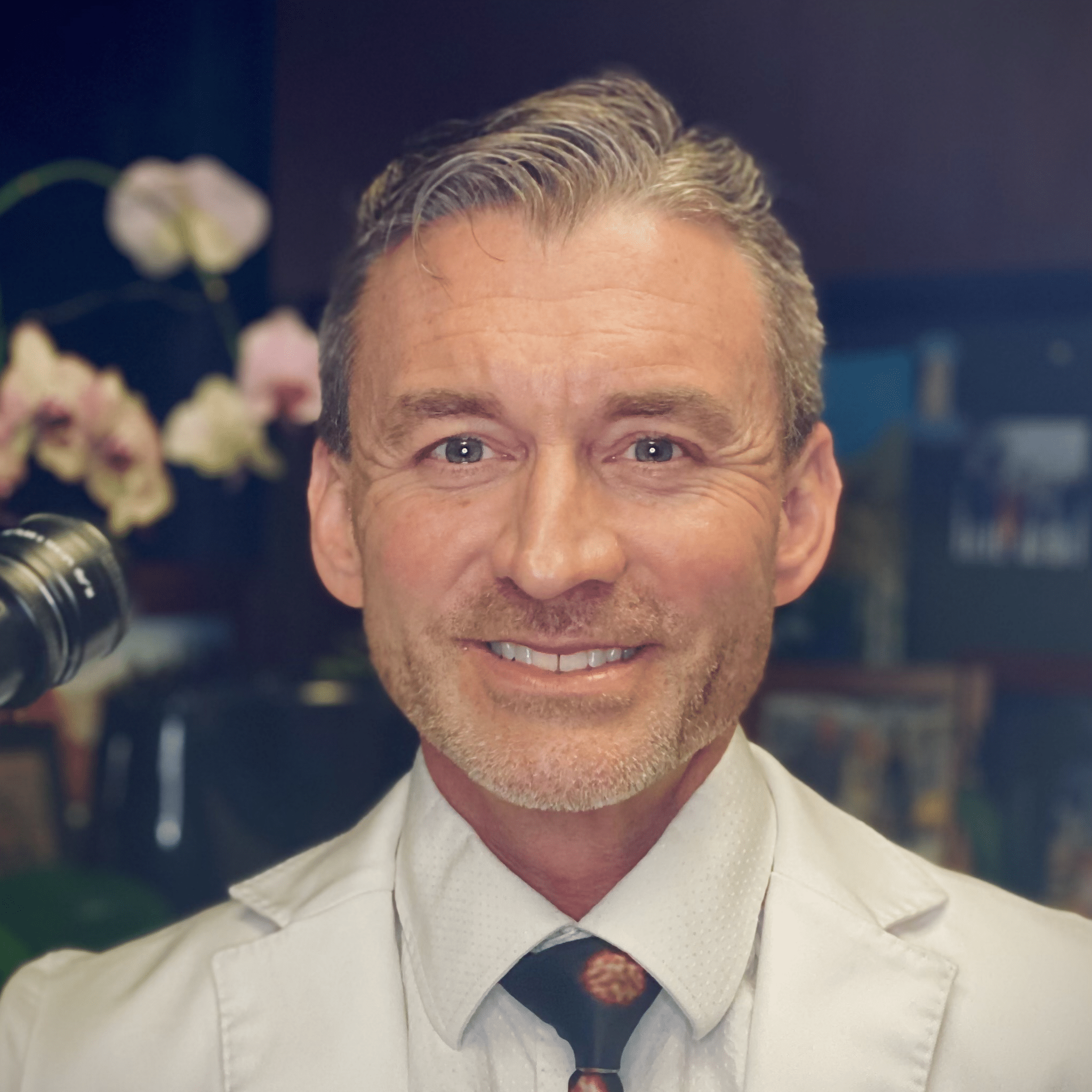
Dr. Ryan Cole
IMA Head of Medical & Scientific Affairs. Senior Fellow, Pathology. Dr. Cole attended the symposium as a presenting speaker and sat down with international clinicians throughout the week. He joins Dr. Varon to unpack the four interviews.

Dr. Joseph Varon
President and Chief Medical Officer, IMA. Professor of Medicine. Dr. Varon has chaired the scientific committee of the Asia Pacific Symposium for 25 years and conducted the four interviews featured in this episode.

1. Let Doctors Be Doctors: Australia’s Pandemic Red Tape
Dr. Anurag Saxena trained in India, completed his critical care fellowship in Australia, and now works as a staff specialist across the Hunter New England Network in New South Wales. He spent the pandemic split between quiet wards in lightly hit South Australia and hard-pressed rural hospitals in New South Wales and Victoria. To keep treating patients, he had to cross state lines, and the states had other ideas.
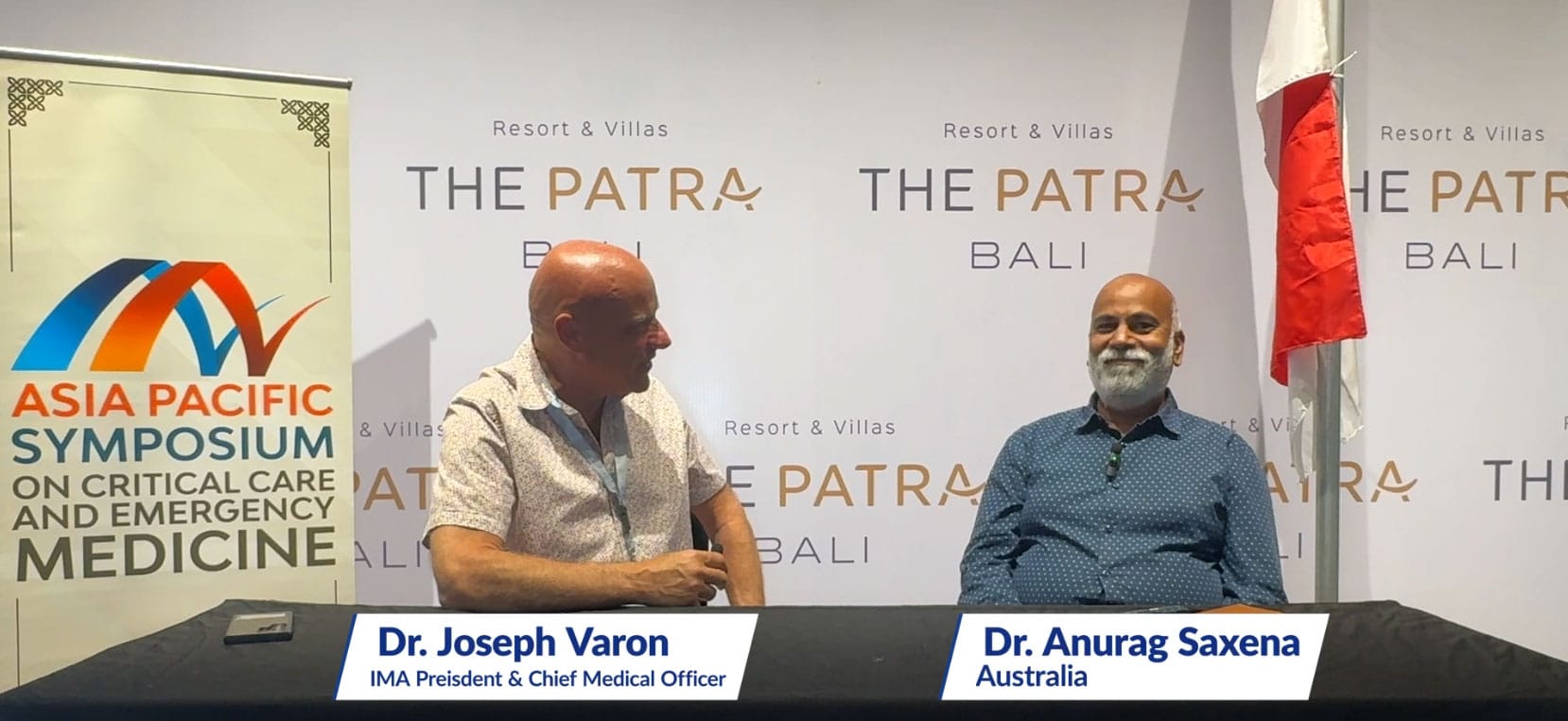
Dr. Joseph Varon interviews Dr. Anurag Saxena at the Asia Pacific Symposium in Bali.
A hospital certificate naming him an essential care worker meant nothing across a state line, even with critically ill patients waiting on the other side.
“I faced a lot of interesting red tape about travel restrictions. Despite being a doctor, despite being an intensivist, despite a hospital giving me a certificate as an essential care worker… the other state was not acknowledging that.” — Dr. Anurag Saxena
Asked what honest medicine means to him, Dr. Saxena split it in two: a clinical side driven by the best evidence available at the time, and a human side built on the doctor-patient relationship, on empathy and connection with families. Dr. Cole’s takeaway was blunt: let doctors be doctors and keep the politics out of it. He called Dr. Saxena one of us, a clinician who kept patient care first through every restriction placed in his way.
2. Antivenom by Drone: When the System Says No, Innovate Around It
Dr. Tri Maharani is the physician the World Health Organization calls about snakebites. An emergency specialist by training and a toxinologist by vocation, she leads the toxinology program at Indonesia’s Ministry of Health. The scale of her job: 135,000 snakebites a year, spread across 17,000 islands, in a country with no poison center.
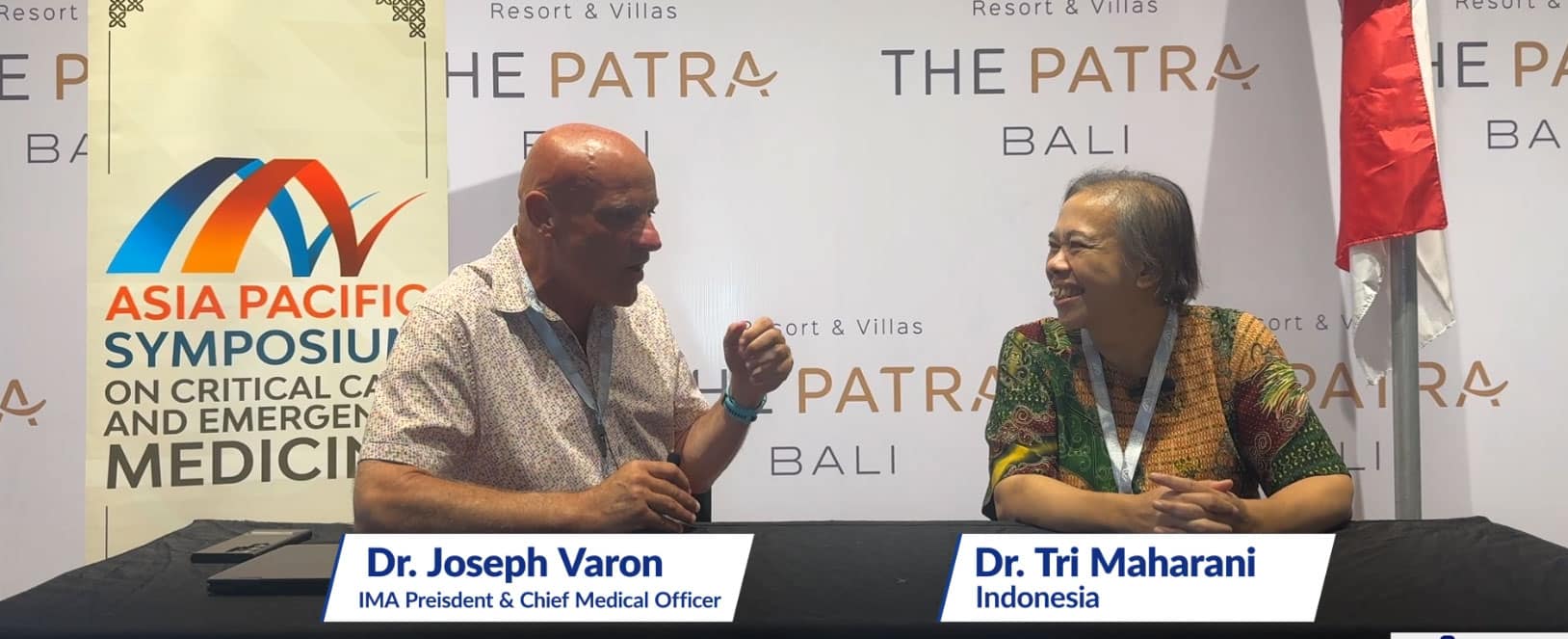
Dr. Joseph Varon interviews Dr. Tri Maharani at the Asia Pacific Symposium in Bali.
Her answer has been to build the missing infrastructure herself:
- A virtual poison center serving the entire country
- AI identification that names the snake from a phone camera and matches it to the right antivenom
- Drone delivery that carries antivenom to islands no conventional supply chain reaches
When the health director said no, Dr. Maharani took the idea to the military, which said yes. Before the drones, she paid for antivenoms out of her own pocket.
“I know one person is important. If I help one patient, it is the same as helping all patients in my country.” — Dr. Tri Maharani
For Dr. Varon, that is what thinking outside the box means: finding the parallel path when the system says no.
3. Medicine Without Philosophy Is a Body Without a Soul
Dr. Alan Glombicki has practiced hepatology and liver transplant medicine in Houston for four decades. He trained at MIT, where chemical engineering came with a required second major, and he chose philosophy. He brings both to his current focus: artificial intelligence in acute and critical care.
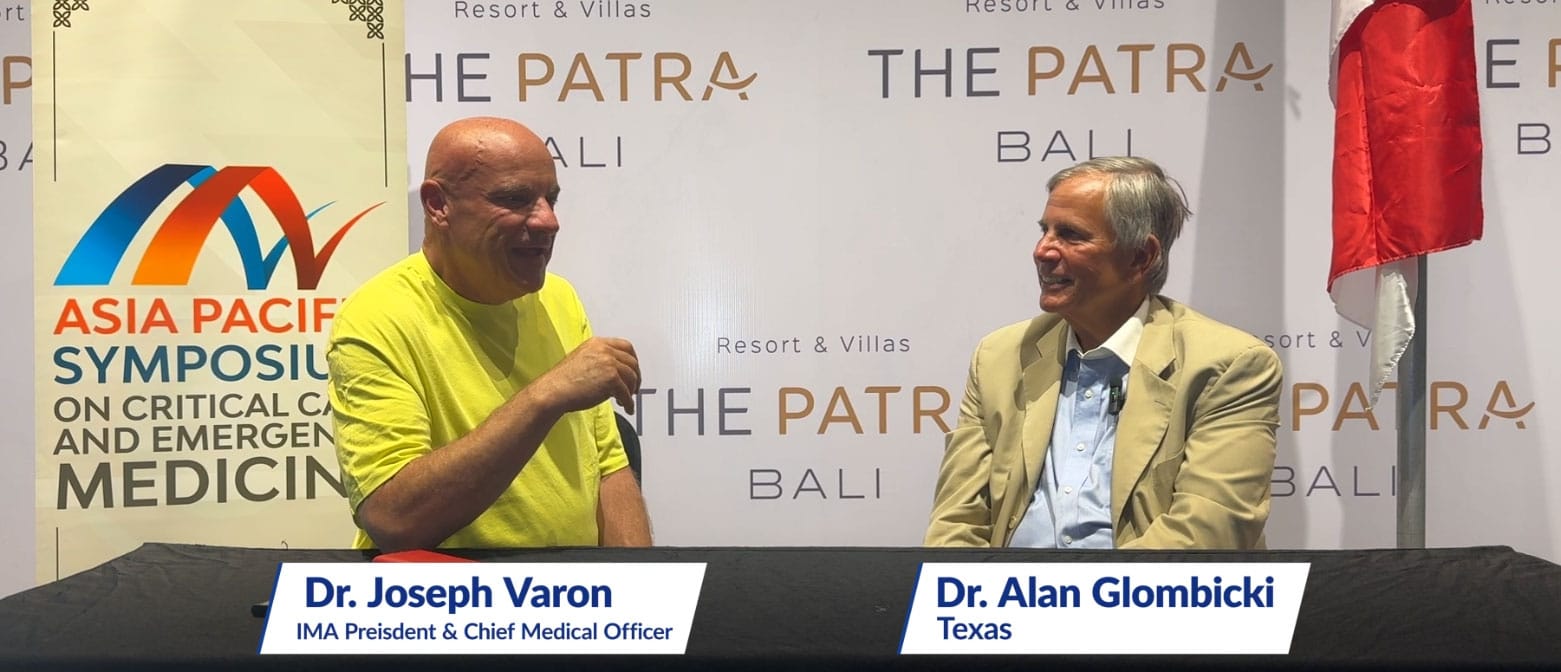
Dr. Joseph Varon interviews Dr. Alan Glombicki at the Asia Pacific Symposium in Bali.
His case for keeping philosophy in medicine starts with a patient: an accountant with recurrent liver cancer who needed to survive to the end of the year so his insurance would vest for his wife and two young children. Every utilitarian scoring system said the liver should go to someone else. The patient was asking a different question, and Dr. Glombicki listened. Transparency, he argues, means answering the question the patient is actually asking, then fighting the gatekeepers in whatever excruciating detail it takes to get the right care approved.
“Medicine without philosophy is like a body without a heart, without a mind, without a soul. It’s an incomplete package.” — Dr. Alan Glombicki
He worries about AI for the same reason. Einstein and Oppenheimer thought about ethics after the science, he noted, and both lived in regret. Medicine cannot afford the same sequence. For Dr. Cole, the right frame is a good junior resident: AI makes care quicker and better, and the doctor stays in charge. Dr. Glombicki’s parting charge went to young physicians: be brave, because the true honor of medicine is doing the hard and not the easy.
4. Science Without Sides: How Malaysia Kept Its Discourse
Dr. Alzamani Idrose runs the emergency department at Kuala Lumpur’s largest hospital, an institution more than 150 years old serving a nation of 35 million. He has worked as an expedition doctor on Everest, lectures on disaster preparedness and drone-assisted emergency response, and writes poetry to cope with the stress of the job. The symposium opened with one of his poems.
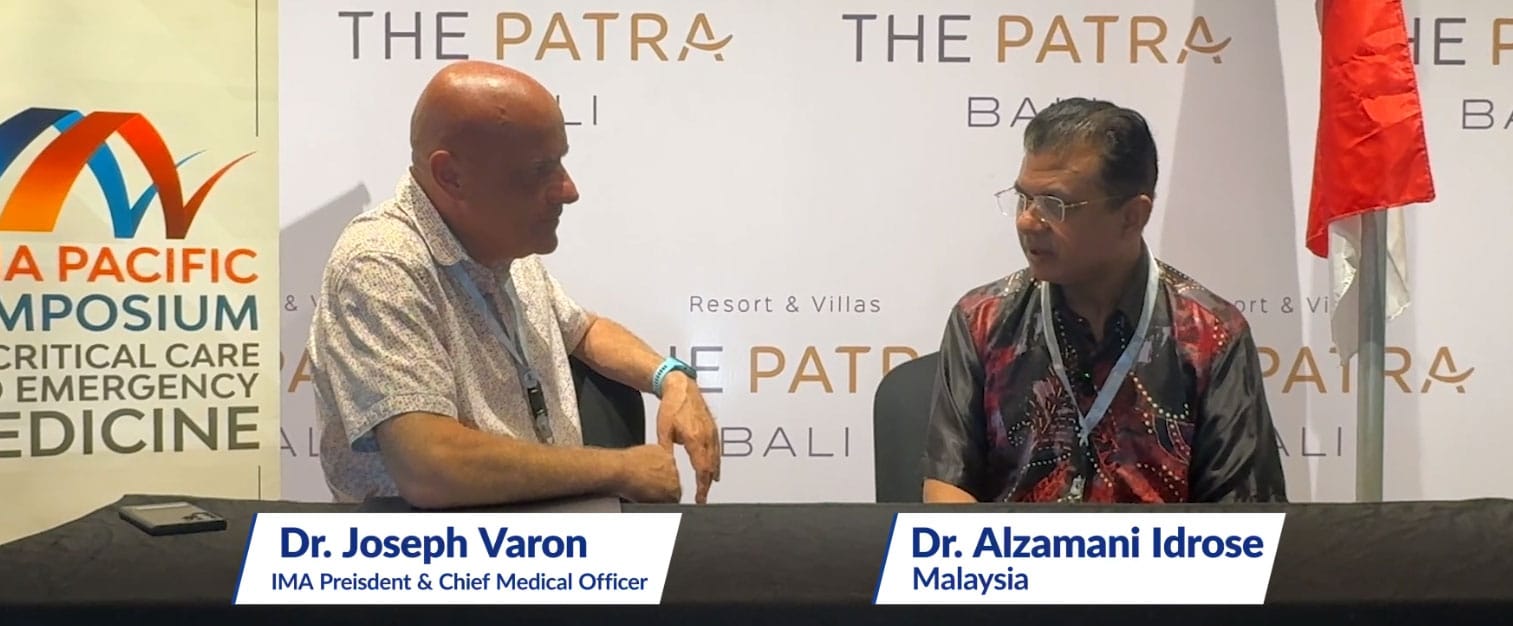
Dr. Joseph Varon interviews Dr. Alzamani Idrose at the Asia Pacific Symposium in Bali.
Dr. Varon put the American problem to him directly: since the pandemic, physicians in the United States pick a side on a therapy and stop talking to each other. Dr. Idrose described a different culture in Malaysia. Ideas there must be backed by evidence, positions get tested rather than defended, and opinion shifts when the results come in. In his telling, the question is rarely right versus wrong; it is which approach is better, evaluated as the evidence evolves, the way sepsis care has evolved over 30 years.
“The way we could show it to the people is that we repeat the same process, having the same results, and it still equates to science. That is just being honest.” — Dr. Alzamani Idrose
Dr. Cole pointed at what that culture buys: speed. Systems like Malaysia’s have to be nimble. An idea gets tested and passed down the chain while American medicine waits on IRBs and hospital systems.
Honest Medicine in Asia
Dr. Varon and Dr. Cole saw firsthand that Southeast Asia holds some of the sharpest medical minds on the planet. As the world moves toward unity, shouldn’t we collaborate across countries? Shouldn’t we share the best of our health systems and draw from the best of the world in turn? If this conference taught them anything, it’s that the pool of talent and ideas out there is far bigger than we ever hoped.