
Host: Dr. Ryan Cole | Guest: Dr. Kristina Carman
Does it matter when you take a supplement, what you take it with, or which form you use?
Dr. Ryan Cole is joined by Dr. Kristina Carman, IMA Senior Fellow in Nutritional and Holistic Health, for Part 2 of From A to Zinc. Together, they explore the details that can influence how the body absorbs and uses nutrients: dose, form, timing, medication depletion, and how to evaluate multi-ingredient products.
For the average health-conscious coffee drinker, adding a scoop of collagen to your brew seems like a simple way to pick up some added health benefits. But as you will learn in this webinar, there are details that don’t usually pop up in your average Instagram post. Collagen needs vitamin C to be processed in the body, and the vitamin C added to many collagen powders degrades above 70°C. This is just one of many ways we can miss the mark on the timing, dosing, and mixing of the nutritional supplements we take every day.
“A lot of people will just disregard the efficacy of a supplement. They’re like, ‘Oh, it doesn’t work. It didn’t work for me.’ And we have to really look at all of these components as to what’s actually going on in the body.” — Dr. Kristina Carman
It turns out it is not only what you take, but how you take it. Part 1 of From A to Zinc, recorded in June, covered what most people are missing: the common deficiencies, the gap between “normal” and optimal lab values, and the medications that quietly deplete nutrients. Part 2 asks whether what you are taking actually arrives. That depends on the dose, the form, the time of day, what it travels with, and what it competes against.
Dr. Carman’s slides follow a supplement from capsule to cell, and Dr. Ryan Cole adds the lab-testing lens throughout: what blood work shows, what it hides, and which habits to check before changing a dose. The slides are available to download below.
Meet the Experts

Dr. Kristina Carman
IMA Senior Fellow, Nutritional and Holistic Health. Dr. Carman is a naturopathic doctor, registered nutritional therapist, and functional medicine practitioner based in South Carolina. She is the author of the From A to Zinc guide and its six companion guides covering vitamins, minerals, amino acids, gut and metabolic health, and hormonal and longevity support.

Dr. Ryan Cole
IMA Head of Medical & Scientific Affairs; Senior Fellow, Pathology. A board-certified pathologist, Dr. Cole brings the laboratory perspective to the conversation: how mineral status is tested, which supplements interfere with lab assays, and why a “normal” result can still miss a deficiency.
1. Six Steps Between the Capsule and the Cell
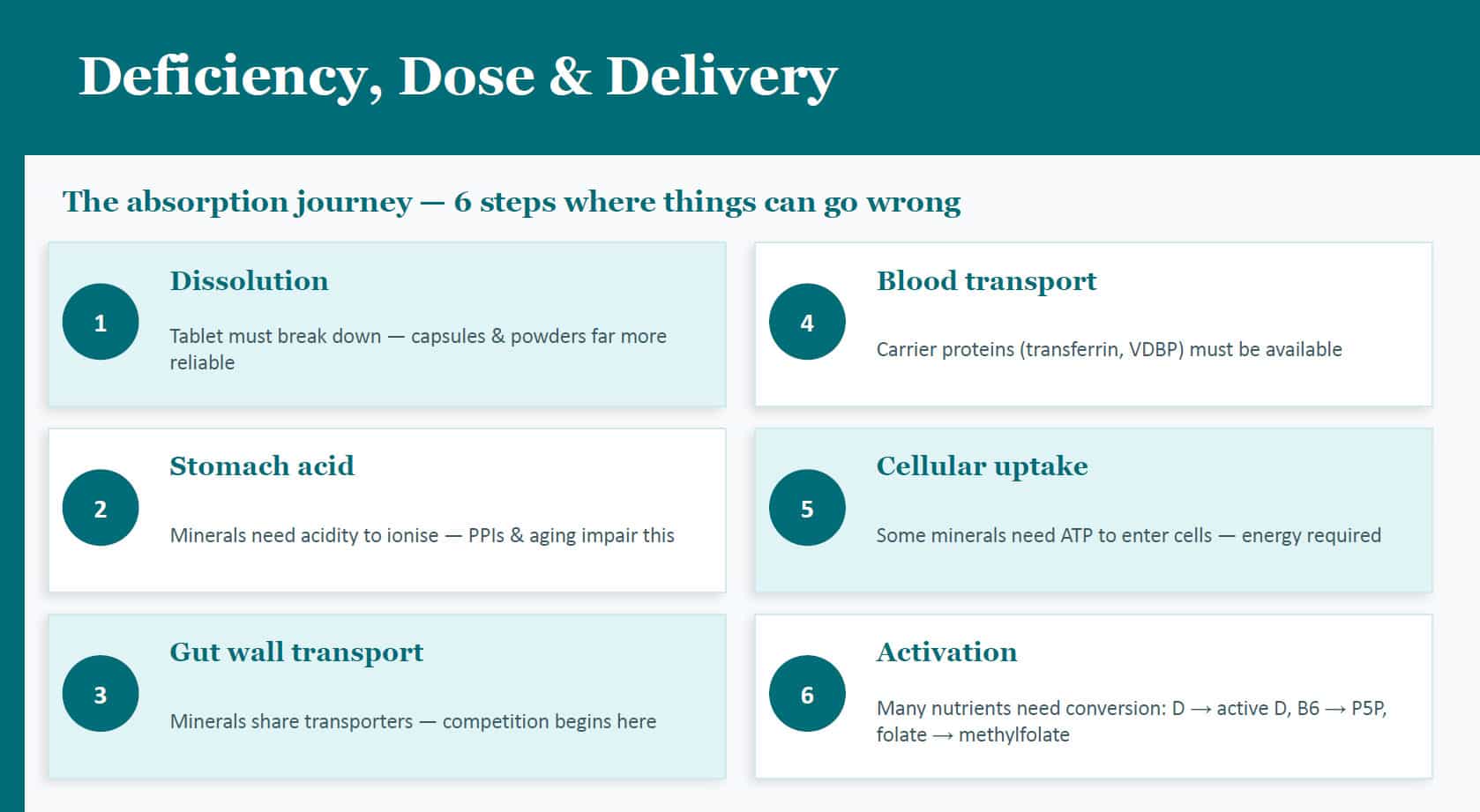
You swallow the capsule, and the job is done. That is how most of us picture it, and it is why so many people take magnesium for years and still test low. Dr. Carman described six steps between the capsule and the cell, and any one of them can fail.
- Dissolution: Compressed mineral tablets often pass through largely intact. Capsules and powders are more reliable.
- Stomach acid: Minerals need acid to ionize. PPIs, antacids, stress, poor sleep, and age all lower it.
- Gut wall transport: Minerals share transport proteins. Arriving together, all of them absorb less efficiently.
- Blood transport: Nutrients need carrier proteins to travel. If those are depleted, gut absorption becomes almost irrelevant.
- Cellular uptake: Magnesium and potassium need ATP, the cell’s energy currency, to get inside. Dr. Cole noted that chronic illness and mitochondrial dysfunction make this harder.
- Activation: Vitamin D needs two conversions, both magnesium-dependent. B6 must become its active form, P5P; folic acid must become methylfolate.
If you take a daily antacid, step two is already working against you. Dr. Carman called low stomach acid one of the most underappreciated causes of mineral deficiency in people who appear to be supplementing perfectly. Step three, the shared transport proteins, is the reason most of the timing rules and competing pairs later in this post exist.
“You can be taking mega doses of certain things, but if it doesn’t get to the cell and the machinery that needs it, then you’ve got to figure out some of the root causes before you can even see a benefit.” — Dr. Ryan Cole
When the gut is the weak link, the delivery route can work around it: liposomal vitamin C and glutathione, sublingual B12, transdermal magnesium (mixed evidence, Dr. Carman acknowledged), and IV options for compromised absorption. Whole food, in her view, still beats all of them.
2. Medication Depletions and the Levothyroxine Rule
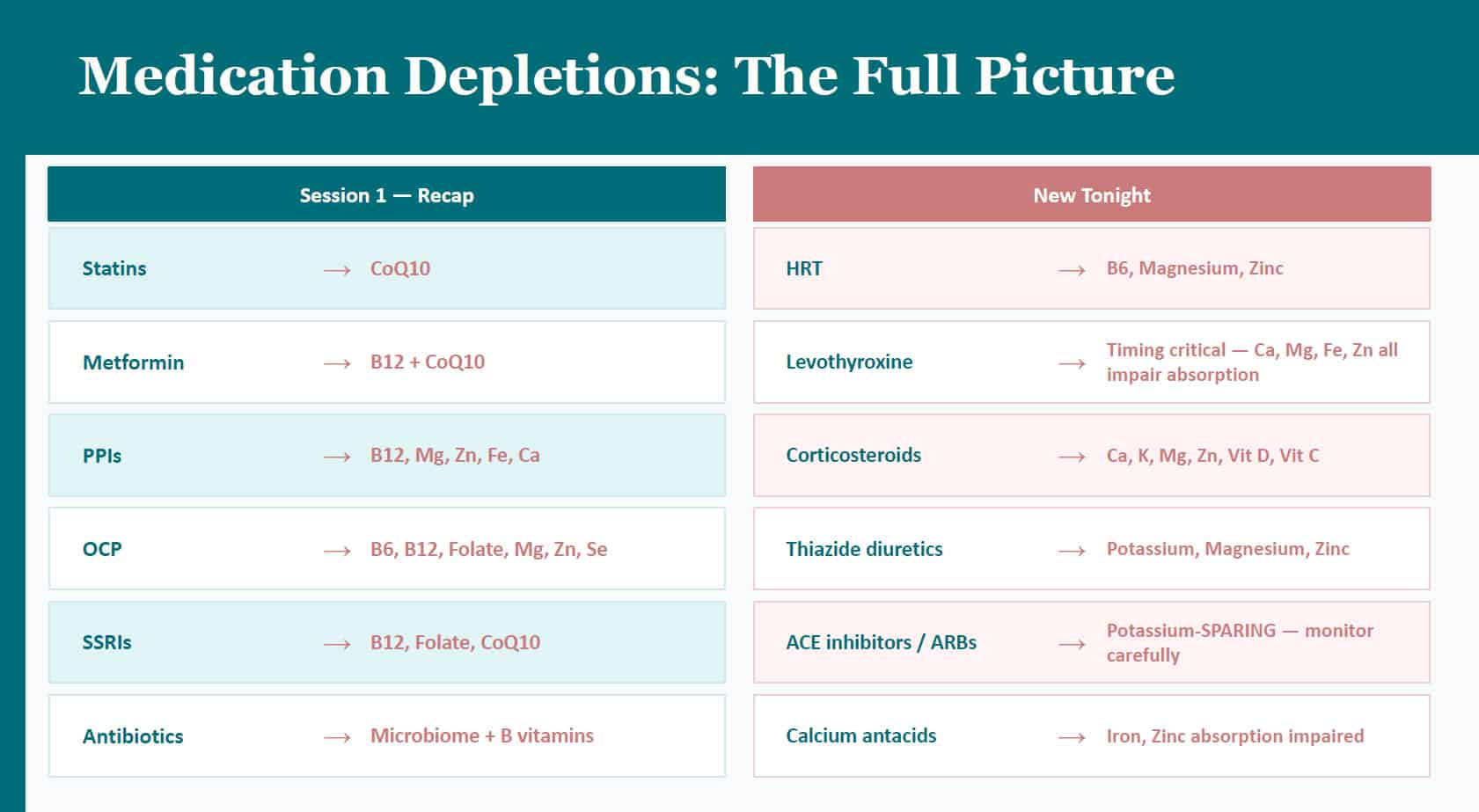
Your doctor prescribed it, you take it as directed, and nobody mentioned it might be quietly draining a nutrient you are also paying to replace. Part 1 covered the big six: statins, metformin, PPIs, the pill, SSRIs, and antibiotics. Part 2 completed the list.
- HRT: Depletes B6, magnesium, and zinc. Dr. Carman suggested that mood changes, poor sleep, and muscle cramps on hormone therapy may be nutrient depletion, not the hormone dose.
- Corticosteroids: Deplete calcium, potassium, magnesium, zinc, vitamin D, and vitamin C. Dr. Cole added that chronic inhaled steroids count too; a short burst-and-taper depletes only briefly.
- Thiazide diuretics: Deplete potassium, magnesium, and zinc. ACE inhibitors and ARBs spare potassium instead, so two people “on blood pressure medication” may need opposite interventions.
- Calcium antacids: Impair iron and zinc and suppress stomach acid exactly when minerals need it. Dr. Cole noted that low acid also cuts protein absorption, a possible culprit in unexplained muscle weakness.
Then there is the one medication millions of people take every single morning, often with breakfast. Levothyroxine is one of the most prescribed drugs in the world, and Dr. Carman said its interaction profile is one of the most consistently missed. Calcium (supplements or dairy), magnesium, zinc, iron, high-fiber foods, antacids, and coffee (even black, even one sip) all impair absorption. Her protocol: empty stomach, 30 to 60 minutes before food or coffee, same time every morning. The prescribing label adds a four-hour gap from calcium carbonate, iron, and antacids. Dr. Cole, 18 years on the drug, waits an hour or more before anything.
“Subtherapeutic thyroid levels in a well-dosed patient are very frequently a timing problem and not a dosing problem. I would highly recommend, before increasing someone’s levothyroxine dose, that you always ask them how they’re taking it.” — Dr. Kristina Carman
Dr. Cole added that milk in the morning latte blocks uptake alongside the coffee. Before chasing a stubborn TSH, check the habits.
3. The Timing Instructions Your Label Leaves Out
Look at the bottle in your cabinet. It says “take two daily.” It does not say when, with what, or apart from what, and that missing sentence may matter more than the dose.
“Timing is probably the most underappreciated aspect of supplementation, and almost nothing on a product label will tell you about it.” — Dr. Kristina Carman
Dr. Carman named three drivers:
- Competition for absorption: Minerals share transporters, so spacing them apart matters more than taking more.
- Food requirements: Fat-soluble vitamins need dietary fat; she cited roughly 50 percent less vitamin D absorbed on an empty stomach. Vitamin C has a plasma half-life of about 30 minutes, so she splits doses across the day.
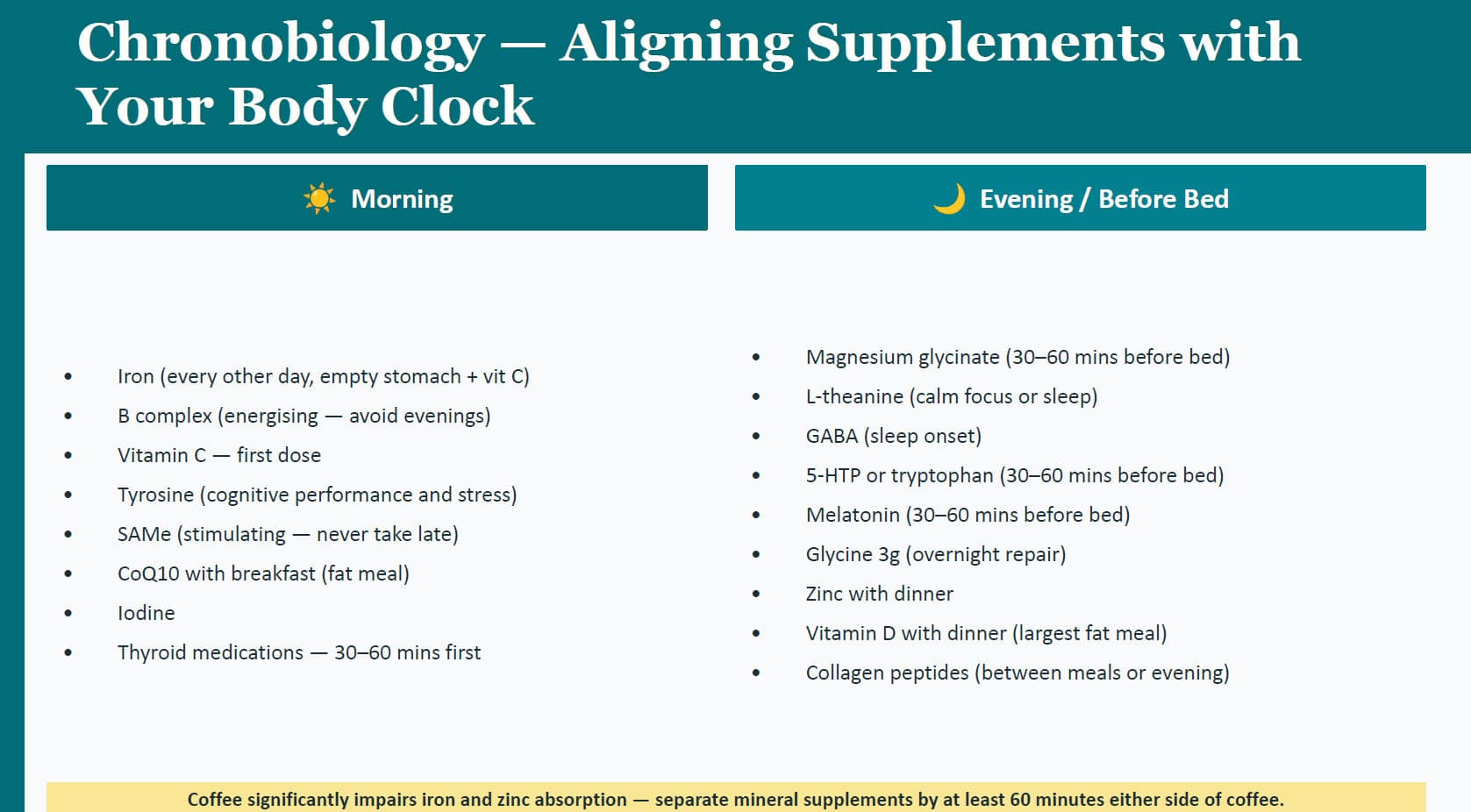
- Circadian biology: Stimulating nutrients at night can cost you sleep; calming ones in the morning are underused.
Iron is where this gets personal for a lot of people, especially women who have been taking it for months without their ferritin budging. After iron is absorbed, the liver releases hepcidin, a hormone that reduces further iron uptake for roughly 24 hours. Dr. Carman argues that much of a daily dose is lost to that window, and she prefers every other day, in the morning when hepcidin is lowest, with vitamin C, away from coffee, tea, and other minerals. Bisglycinate over ferrous sulfate, and a ferritin target of 50 to 100 ng/mL rather than “above 12.”
“If you’re ever told to take iron supplementation daily, I would push back on that one, simply from an absorption perspective.” — Dr. Kristina Carman
The morning-and-evening chart on the slide is a starting point, not a prescription, and your own response overrides it. Dr. Carman takes magnesium during the day because it keeps her awake; Dr. Cole takes vitamin D in the morning with a fatty meal and skips it in summer. She flagged that 5-HTP and GABA are contraindicated with SSRIs. His “vitamin L,” morning light, sets the clock for everything else.
4. Nutrients That Work Together and Nutrients That Compete
Some supplements are a team sport. Take one without its partner and you get a fraction of the effect. Others compete for the same transporters, and taking them together means each absorbs less. Dr. Carman walked through the pairs that come up most in her practice.
Pairs that need each other:
- D3 + K2 + magnesium: D3 absorbs calcium, K2 (as MK-7) directs it into bone, and magnesium activates both. None of the three is optional, per Dr. Carman, though Dr. Cole added they need not be taken at the same time.
- Zinc + quercetin: Quercetin carries zinc into the cell, where zinc inhibits viral replication. In Dr. Carman’s description, quercetin without zinc has nothing to carry, and zinc without quercetin struggles to get in.
- NAC + glycine: Both are limiting ingredients for making glutathione, and together far cheaper than glutathione itself.
- Selenium + iodine: Selenium-dependent enzymes convert T4 to active T3. Dr. Carman: never therapeutic iodine without selenium, and never without a practitioner.
- Magnesium + B6 (P5P): B6 drives magnesium into cells. Dr. Carman cautioned that high-dose, long-term P5P has been linked to peripheral neuropathy.
Pairs that undermine each other:
- Calcium and iron: Up to 60 percent less iron absorbed at therapeutic doses, a scenario Dr. Carman said she sees constantly in patients taking both.
- Zinc and copper: High-dose zinc blocks copper absorption. Dr. Carman sees the resulting deficiency show up as fatigue, anemia that ignores iron, premature graying, and neurological symptoms.
- High-dose isolates: Therapeutic B6 depletes B2 without a full B complex alongside. Vitamin E above 400 IU can impair vitamin K-dependent clotting. Calcium and magnesium compete at therapeutic doses.
“Copper is so important for proper iron absorption and ceruloplasmin. If you’re not getting adequate copper, you may become anemic.” — Dr. Ryan Cole

5. Why the Rules Change in a Blend
By now a sharp reader is asking the question Dr. Carman hears most often: if zinc and copper compete, why is there a zinc-and-copper supplement on the shelf?
Her answer is that dose determines clinical significance. A multivitamin with 100 mg of calcium and 8 mg of iron creates negligible competition. A 1,000 mg calcium supplement and a 65 mg therapeutic iron dose at the same breakfast is a different situation. Same molecules, different dose context. Ratio is the design principle: a zinc-copper product at 10:1 or 15:1 supports both pathways, and a bone formula pairing calcium citrate, magnesium glycinate, D3, and K2 is the same idea.
So the next time you are standing in the supplement aisle turning a bottle over, Dr. Carman suggested four questions:
- Are the forms bioavailable? She looks for glycinate, citrate, methylated B vitamins, P5P, methylfolate, and ubiquinol, and passes on oxide, carbonate, cyanocobalamin, folic acid, and dl-alpha tocopherol, especially for anyone with malabsorption or MTHFR variants.
- Are the doses meaningful? Token amounts on the label with no clinical effect are what she called “fairy dusting.”
- Are competing ratios appropriate? Zinc to copper at 10:1 to 15:1; calcium to magnesium at 2:1.
- Are antagonists below the threshold where competition matters? Therapeutic iron beside calcium carbonate in the same capsule fails this test.
“A multivitamin with magnesium oxide, cyanocobalamin, and folic acid is technically complete, but it will actually deliver very little genuine clinical value.” — Dr. Kristina Carman
Dr. Cole closed with a pathologist’s note: stop high-dose biotin three days before blood work, since it interferes with many lab assays, and know that high-dose vitamin C can skew glucometer readings.
Before You Buy Another Bottle
If this feels like a lot, good news: nobody needs everything on these slides, and both speakers said so. You do not need a pillbox the size of a tackle box. You need to know what competes, what pairs, and when to take it, and to revisit that as your goals change. Food first, morning light, movement, and sleep remain the foundation that makes any supplement work better. A Part 3 is already on the table, with adaptogens and iodine at the top of the list. Until then, the guide above and its companions cover what one hour could only introduce.
“You don’t have to take all these things, but if you’re deficient and you figure out what is missing, so many of these things can make a big difference in your energy and your health and wellness.” — Dr. Ryan Cole
Figuring out what is missing is exactly what IMA’s Tools & Guides library exists for. It holds dozens of free, downloadable resources on nutrition, hormones, gut health, and integrative care, most of them written by Dr. Carman, and every one of them built to be brought to your next appointment.
Related Reading
- Guide: From A to Zinc: The IMA Nutrient Guide
- Hub: IMA Tools & Guides
- Webinar: From A to Zinc: What Your Body Is Really Missing
- Guide: Vitamins 101
- Guide: Minerals 101
- Guide: Amino Acids 101
- Guide: Hormonal & Longevity Support