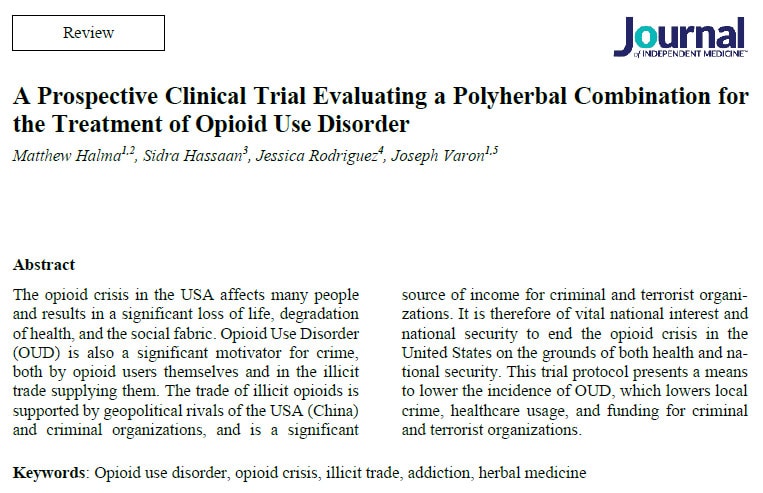
A new study published in the Journal of Independent Medicine proposes testing a combination of herbal therapies (saffron, berberine, Nigella sativa, and Corydalis) as adjunctive treatment for opioid use disorder.
Though opioid overdose deaths have declined from their 2023 peak, the crisis remains massive. More than 54,000 Americans died from opioid-related overdoses in 2024, and despite evidence-based treatments like methadone and buprenorphine, relapse rates remain stubbornly high: between 60% and 90% in the first year of withdrawal.
Now, IMA researchers are proposing a new approach: a prospective clinical trial testing whether herbal medicine can help fill the gaps that conventional treatments leave behind.
📖 Read and Download the Full Paper
A Prospective Clinical Trial Evaluating a Polyherbal Combination for the Treatment of Opioid Use Disorder (JIM Vol. 2, No. 1, 2026) Authors: Matthew Halma, Sidra Hassaan, Jessica Rodriguez, Joseph Varon
👉 Visit the Journal of Independent Medicine to create a free account and download the full article.
Building on Previous Research
This study isn’t emerging from nowhere. It builds directly on research IMA published last year demonstrating that herbal therapeutics offer credible, science-backed alternatives for chronic pain and opioid dependence.
In October 2025, IMA researchers published two peer-reviewed studies (covered in detail here) showing that botanicals like saffron, berberine, and black seed can meaningfully reduce pain and ease withdrawal symptoms. That foundational work established the scientific rationale. This new proposal is the next logical step: putting those findings to the test in a controlled clinical trial.
“We’re hoping that this paper will be able to implement a real clinical trial on real bases across the United States,” Dr. Varon explains.
About the Proposed Trial
The proposed study is a 12-week, prospective, case-controlled trial comparing a polyherbal combination against placebo in patients with diagnosed opioid use disorder. The trial will be conducted at Dr. Varon’s primary care practice in Houston, Texas, with 50 participants (25 per group).
The herbal intervention combines four botanicals:
| Herb | Dosage | Key Properties |
|---|---|---|
| Saffron | 100mg twice daily | Reduces opioid craving and withdrawal scores |
| Berberine | 100mg twice daily | Inhibits morphine-induced sensitization; modulates dopamine, serotonin, norepinephrine |
| Nigella sativa (black seed) | 100mg twice daily | Alleviates withdrawal tendency; anti-inflammatory, anxiolytic effects |
| Corydalis extract | 100mg twice daily | Analgesic properties; inhibits dopamine D2 receptor |
Each of these compounds was selected based on evidence showing they can regulate neurotransmitter systems, particularly the dopaminergic, serotonergic, and GABAergic pathways that play central roles in opioid dependence and withdrawal.
Primary outcomes:
- Clinical Opiate Withdrawal Scale (COWS) scores
- Relapse frequency
Secondary outcomes:
- Mental well-being (PHQ-9 for depression, GAD-7 for anxiety)
- Sleep quality (Pittsburgh Sleep Quality Index)
- Safety and tolerability
- Treatment retention and adherence
Why Herbal Medicine?
The paper provides an extensive review of the neurobiological mechanisms underlying opioid addiction: how chronic opioid exposure changes reward processing circuits, how withdrawal symptoms drive continued use through negative reinforcement, and how epigenetic modifications can produce long-lasting vulnerability to relapse.
Conventional treatments address some of these mechanisms but not all. Many patients face additional barriers including stigma, limited access to treatment programs, side effects, and psychosocial stressors that contribute to treatment discontinuation.
The authors argue that herbal adjuncts may help bridge these gaps:
- Saffron components like crocin have demonstrated effects on reducing opioid craving and withdrawal scores in patients on methadone maintenance therapy.
- Berberine can inhibit morphine-induced sensitization and has potential to induce extinction of drug-related behavior.
- Nigella sativa supplementation has been linked with alleviation of withdrawal symptoms and improved psychological health.
- Corydalis alkaloids are modulatory neurotransmitters of analgesia and dopamine, directly relevant to the neurobiology of OUD.
Importantly, the authors emphasize these agents aren’t intended to replace standard medications for opioid use disorder (MOUD). Rather, they’re positioned as adjuncts that could improve treatment adherence, comfort during withdrawal, and long-term recovery outcomes.
Safety Considerations
The study includes detailed exclusion criteria to ensure participant safety. Given that some of the botanicals can affect liver function, coagulation, blood pressure, and drug metabolism, the following populations are excluded:
- Pregnant or breastfeeding women
- People with bipolar disorder
- Those with bleeding disorders or on anticoagulants
- People with liver disease or impaired liver function
- Those taking immunosuppressants, diuretics, or serotonergic medications
- People taking medications metabolized by cytochrome P450 enzymes
- Anyone scheduled for surgery within two weeks
The study includes comprehensive adverse event monitoring, regular liver function testing, and structured tolerability assessments throughout the 12-week intervention period.
The Case for National Security
The paper makes an unusual but compelling case: the opioid crisis isn’t just a public health emergency. It’s a national security concern.
The trade in illicit opioids supports criminal organizations and, according to the authors, geopolitical rivals. The economic burden of the opioid epidemic exceeds $1 trillion annually when accounting for healthcare costs, lost productivity, criminal justice expenses, and mortality.
Effective treatments that reduce demand for illicit opioids don’t just save individual lives. They weaken the funding streams that sustain organized crime and undermine national interests.
What Comes Next?
This is a detailed blueprint for research that the authors hope will be implemented across the United States. The goal is to generate the rigorous clinical evidence needed to either validate or refute the potential of herbal adjuncts in OUD treatment.
If the intervention proves effective, the implications could extend far beyond a single study. Herbal treatments are typically more affordable and accessible than pharmaceutical alternatives, potentially making them scalable solutions for a crisis that continues to devastate communities nationwide.
Explore More
This article is featured in Volume 2, Issue 1 of the Journal of Independent Medicine. Stay tuned for more highlights from this issue.
Related Reading:
- 📖 Innovative Approaches to Pain & Opioid Use Disorder – The foundational research this trial builds upon
More from the Journal:
These resources are free to download—but not free to create. Our medical journal, and every system of technology and review that powers it, requires significant time and resources to build and maintain. Please support our mission to continue sharing evidence-backed medical research with the world by donating today.