
Repurposed drugs and nutraceuticals can be part of an individualized cancer-care plan. Explore Dr. Paul Marik’s updated guide for practical frameworks, dosing, and diagnosis-specific guidance.
“You have cancer.”
Nobody is ever truly ready to hear those words. In the days that follow, many patients are quickly swept into a program of chemotherapy, radiation, and surgery. It is an incredibly scary track to be on, and far too often, it feels like you are on it alone.
But there is something important every cancer patient should know: you are not limited to just one set of tools. Integrative and adjunctive-care clinicians can help patients consider conventional treatment alongside other approaches, with the goal of tailoring a plan to the person and the disease in front of them.
That is why Dr. Paul Marik created this updated cancer-care guide: Approach to the Use of Repurposed Drugs and Nutraceuticals in Patients With Cancer. It is a practical resource for patients and clinicians who want a clearer starting point for those conversations.
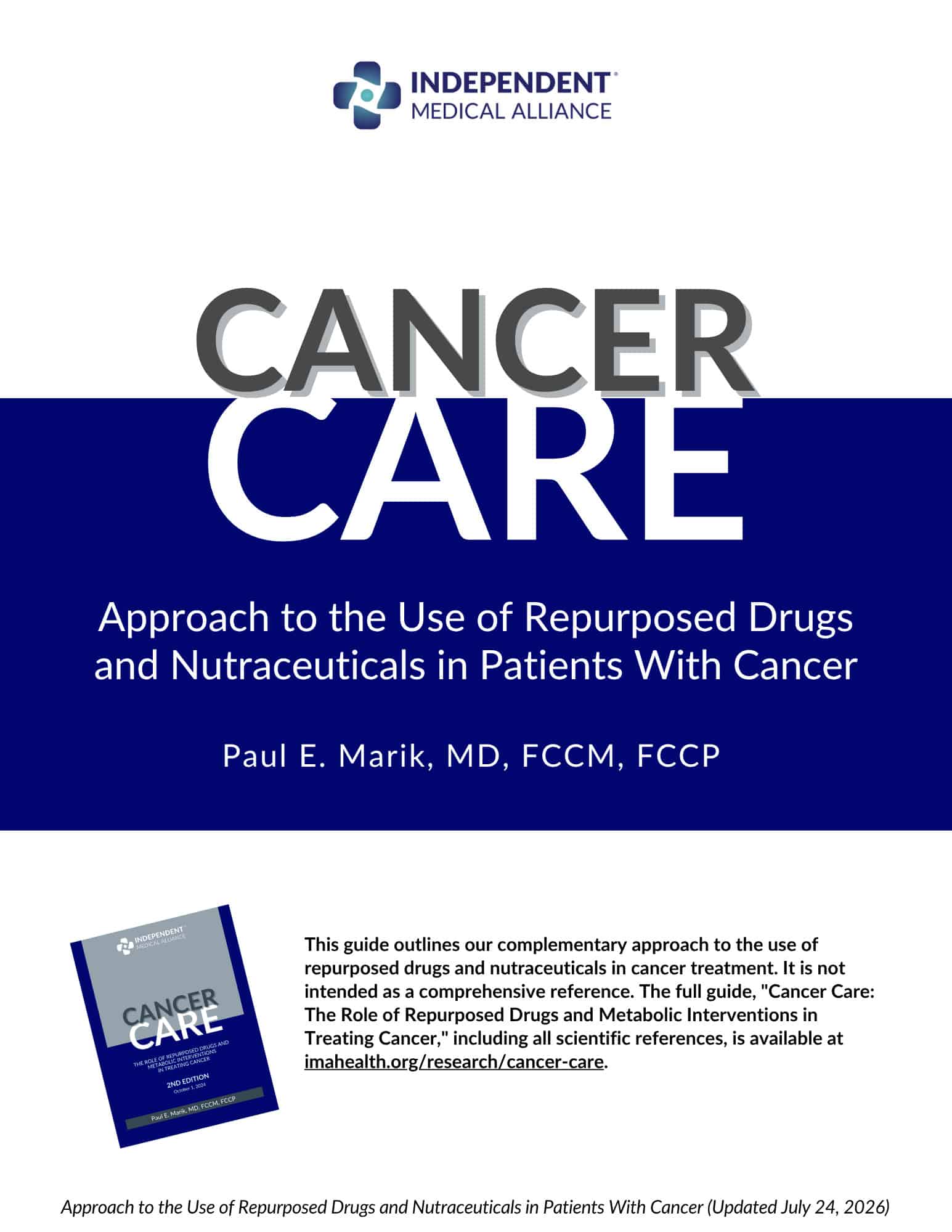
📘 This Guide Is Part of a Series
Dr. Marik’s cancer companion guides build on each other. For the best understanding, we recommend reading them in this order:
- The Approach to Repurposed Drugs for Cancer (you are here): Which drugs, which doses, and why.
- Cancer Resistance: When and how to cycle drugs to prevent treatment failure.
- The Metabolic Trap: Why targeting five metabolic axes at once can be decisive.
✨ What’s New in the July 2026 Update
The familiar Limited and Aggressive frameworks remain. The July 2026 edition builds substantially on them with tiered, diagnosis-specific guidance and more context for the situations that can change a treatment conversation.
- Updated dosing tables: The practical Limited and Aggressive tables below now match the July guide exactly, including the addition of luteolin and genistein and removal of methylene blue.
- Tiered cancer-specific priorities: The guide now ranks agents by cancer type, rather than presenting one flat list for every diagnosis.
- More clinical context: New pages address molecular subtypes, metastatic disease, immunotherapy, and hematologic cancers, along with expanded coverage of bladder, kidney, and skin cancers.
The downloadable PDF remains the clinical source of truth. It should be used with a qualified integrative clinician, not as a self-treatment protocol.
Post Contents
💡 Why We Made This Guide
Cancer Care, Dr. Paul Marik’s monograph, pulls together an extraordinary amount of research, including dosage guidance for dozens of repurposed compounds. But cancer care changes quickly. There was a need for something more agile, something that could be updated as new information came to light.
That is what this guide is: a streamlined companion to Cancer Care. It is designed for patients and doctors who are working together to shape a care plan. You can find the broader ecosystem at the Cancer Care page and the IMA Cancer Resource Hub.
As Dr. Marik explains:
“We provide the clinician but also the patient with an overall guide to how to manage these patients.”
📖 What’s Inside the Guide
- Two practical tracks for care: Limited and Aggressive therapy frameworks, with core agents and dosing ranges that can be individualized over time.
- Ranking tables: AI-generated tables that organize repurposed agents by anticancer activity, cancer stem cell pathways, and safety profile.
- Tiered cancer-specific guidance: Rankings for solid tumors, hematologic cancers, and selected disease contexts such as metastatic disease and immunotherapy.
- Molecular and clinical context: Targeted sections for relevant tumor subtypes, including KRAS-mutant, EGFR-mutant, HER2-positive, and treatment-resistant disease settings.
- Safety considerations: Practical cautions on curcumin, green tea extract, metformin with berberine, doxycycline, and zinc in prostate cancer.
🎯 Limited vs. Aggressive Approach
Cancer care must be individualized. The guide presents two broad therapeutic strategies, with a spectrum of options in between:
- Limited Therapy: Starts with fewer core agents at lower doses and escalates gradually when appropriate. The guide identifies this as a useful starting point for early-stage or less aggressive cancers, or for people already receiving multiple conventional therapies.
- Aggressive Therapy: Uses higher doses and a wider combination of agents, then scales back or escalates based on tolerance and response. The guide identifies this approach for metastatic disease, highly aggressive tumors, or patients receiving metronomic chemotherapy.
The goal in both is to target multiple cancer stem cell pathways while matching intensity to the clinical picture. The following tables are drawn directly from the July 24, 2026 PDF.
Important: The guide states that treatment should be supervised by a qualified integrative clinician and that self-treatment is strongly discouraged.
Limited Therapy Approach
| Intervention | Notes / Dosage |
|---|---|
| Diet | Low-carbohydrate, low-glycemic diet; intermittent fasting or OMAD (one meal a day); add matcha tea, brewed green tea, and 4 cups of coffee daily |
| Ivermectin | 0.2–0.4 mg/kg/day (commonly 0.3 mg/kg/day) |
| Vitamin D3 and K2 | Vitamin D3 10,000 IU daily and vitamin K2 100 mcg, with monitoring of 25-OH vitamin D3 and parathyroid hormone (PTH) levels |
| Curcumin | 1,000–2,000 mg per day (500–1,000 mg twice daily); use a highly bioavailable preparation, such as phytosome curcumin, nano-curcumin, or CurcuWIN |
| Melatonin | 20 mg at night, titrated upward from 5 mg |
| Propranolol | 10–40 mg twice daily as tolerated |
| Green tea extract (EGCG) | Less than 800 mg per day, divided into two doses |
| Berberine | 500 mg twice daily; hold during multi-day fast |
| Resveratrol | 500 mg twice daily; use a preparation with high bioavailability |
Aggressive Therapy Approach
| Intervention | Notes / Dosage |
|---|---|
| Diet | Low-glycemic ketogenic diet; OMAD; periodic 48- and 72-hour fasts |
| Ivermectin | 0.4–0.8 mg/kg/day (commonly 0.6 mg/kg/day), with titration up to 1 mg/kg/day if response is poor and the drug is well tolerated; take with food; reduce dose if headaches, dizziness, or other neurological symptoms occur |
| Mebendazole | 200 mg daily (100 mg twice daily) |
| Curcumin | 1,000–2,000 mg per day (500–1,000 mg twice daily); use a highly bioavailable preparation, such as phytosome curcumin, nano-curcumin, or CurcuWIN |
| Vitamin D3 + K2 | Vitamin D3 10,000 IU daily and vitamin K2 100 mcg, with monitoring of 25-OH vitamin D3, calcium, and PTH levels; titrate to achieve a low-normal PTH level (Coimbra Protocol) |
| Green tea extract (EGCG) | Twice daily, less than 800 mg per day |
| Berberine | 500 mg twice daily (monitor glucose if taking metformin) |
| Resveratrol | 500 mg twice daily (high bioavailability) |
| Sulforaphane | Free stabilized sulforaphane from broccoli seed extract (dosage varies) |
| Metformin | 500–1,000 mg twice daily; hold during multi-day fast |
| Propranolol | 10–40 mg twice daily as tolerated |
| Melatonin | 20 mg at night, titrated upward from 5 mg |
| Doxycycline | 100 mg twice daily for 12 weeks or 100 mg daily during alternate months (indefinitely) |
| Modified citrus pectin (PectaSol) | 14.4 g daily; six capsules three times a day |
| Aged garlic extract | 1,000 mg daily |
| Omega-3 fatty acids | 2–4 g daily |
| Statins | Atorvastatin 40–80 mg daily or simvastatin 40 mg daily; avoid long-term use or precipitous LDL reduction, which may increase dementia risk |
| Quercetin | 500–1,000 mg twice daily (stagger the dose with ivermectin) |
| Alpha lipoic acid | 300–600 mg daily |
| Luteolin | 100–200 mg daily |
| Genistein | 50–100 mg per day |
| Dandelion extract | 250–1,000 mg twice daily |
| Artesunate | 200 mg daily |
| Low-dose naltrexone | 2–4.5 mg daily |
| Apigenin (epigenin) | Plant-derived flavonoid, 50–400 mg per day |
| Pomegranate extract | 250 mg daily |
| Monk fruit sweetener | As needed |
- Consider high-dose IV vitamin C: 75–100 g, two to three times weekly, together with standard chemotherapy in patients with cancers that express low catalase activity (melanoma, breast, pancreatic, esophageal, and lung cancer); screen for G6PD deficiency and kidney insufficiency.
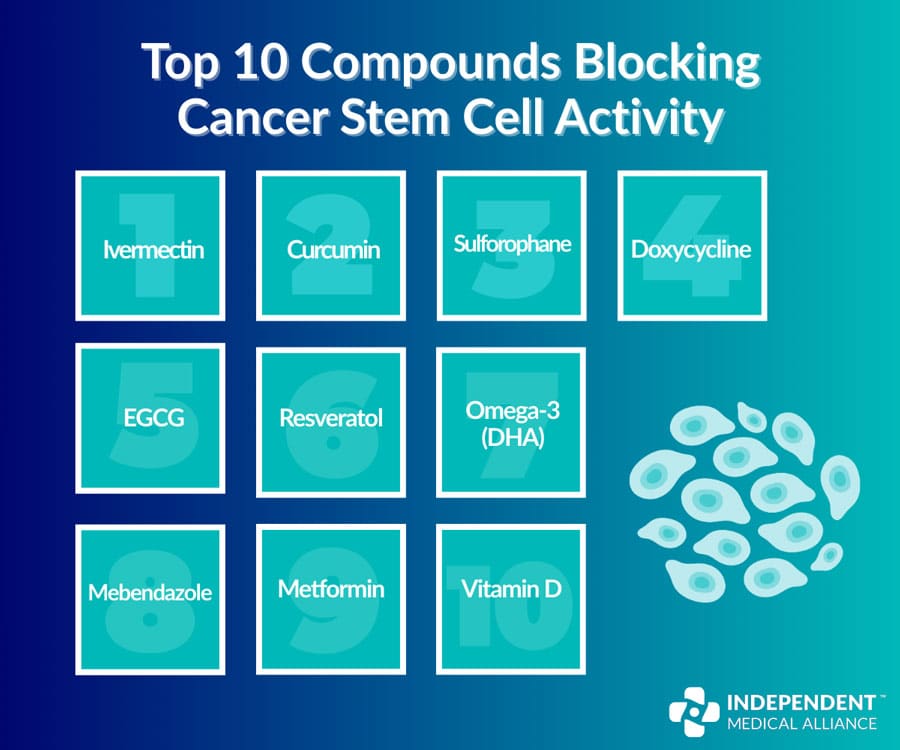
Top 10 Compounds for Cancer Stem Cell (CSC) Blocking Activity
The guide’s ranking tables use AI engines to organize repurposed agents by anticancer activity, cancer stem cell pathways affected, and safety profile. They are useful for seeing how the guide weighs different agents, but they are not head-to-head clinical comparisons. The guide frames them as support for a patient-specific plan developed with a clinician.
🛠️ Tailoring Repurposed Therapy to Cancer Type
Every patient responds differently, and cancers themselves can behave in distinct ways. The July guide moves beyond a one-size-fits-all list with Tier 1, Tier 2, and Tier 3 priorities for specific diagnoses and clinical settings.
The tiering is based on mechanistic rationale, preclinical evidence, safety, and limited clinical data. It is intended to help guide clinician-led, patient-specific conversations, not to replace established care.
Cancers and Contexts Covered in This Guide
- Prostate
- Breast, including triple-negative, hormone receptor-positive, and HER2-positive disease
- Colorectal, including KRAS-mutant and metastatic disease
- Lung, including KRAS-mutant and EGFR-mutant NSCLC and SCLC
- Melanoma, including BRAF-mutant and immunotherapy-treated disease
- Ovarian, including BRCA-mutated and platinum-resistant disease
- Endometrial (uterine)
- Liver (hepatocellular carcinoma)
- Bladder
- Head and neck squamous cell cancer
- Esophageal squamous cell carcinoma
- Pancreatic, including KRAS-mutant and metastatic or chemotherapy-resistant disease
- Gastric, including HER2-positive and diffuse-type disease
- Glioblastoma
- Kidney cancer / renal cell carcinoma
- Basal cell carcinoma and cutaneous squamous cell carcinoma
- Stage 0 carcinoma in situ and stage 4 metastatic disease
- Patients receiving immunotherapy and OXPHOS-dependent metastatic disease
- Non-Hodgkin lymphoma and Hodgkin lymphoma
- Multiple myeloma
- Pediatric and adult acute myeloid leukemia
- Chronic lymphocytic leukemia
- Polycythemia vera
- Sarcomas and mesothelioma
🧭 Special Considerations
The largest change in the July guide is not simply a longer disease list. It is a shift toward subtype- and setting-specific guidance. A few examples show what that means in practice:
Molecular Subtypes and Treatment Context
For breast, colorectal, lung, melanoma, ovarian, pancreatic, and gastric cancer, the guide now separates clinically relevant subtypes or disease contexts such as KRAS mutation status, HER2-positive disease, immunotherapy, platinum resistance, and metastatic disease.
Stage and Disease Setting
The guide adds dedicated sections for stage 0 carcinoma in situ, stage 4 metastatic disease, patients receiving immunotherapy, and OXPHOS-dependent metastatic disease. Those pages are meant to reflect how cancer biology and treatment priorities can change as disease advances or a patient’s treatment setting changes.
Newly Added Diagnoses
Bladder cancer, kidney cancer, basal cell carcinoma, and cutaneous squamous cell carcinoma now have their own tiered pages. The guide repeatedly distinguishes between investigational adjunctive strategies and established treatment, particularly where surgery or systemic therapy remains standard care.
Hematologic Cancers
The July edition separates non-Hodgkin lymphoma from Hodgkin lymphoma and adds expanded coverage of multiple myeloma, pediatric and adult acute myeloid leukemia, chronic lymphocytic leukemia, and polycythemia vera.
⚠️ Cautions & Contraindications
Repurposed drugs and natural compounds can require careful monitoring. Always discuss them with a qualified clinician before starting or adjusting therapy.
- Curcumin: The guide notes potential blood-thinning effects, especially with anticoagulants, antiplatelet drugs, NSAIDs, or other supplements that affect clotting. It advises discontinuing curcumin at least two weeks before scheduled surgery.
- Doxycycline: The guide reports minimal impact on overall gut-microbiome composition and diversity, while emphasizing that treatment decisions should still be individualized.
- Green Tea Extract (EGCG): Keep the daily dose below 800 mg, increase gradually, and take with food and/or vitamin C. The guide advises avoiding it in patients with liver disease or those receiving chronic lymphocytic leukemia-directed therapy, and monitoring liver function tests.
- Metformin + Berberine: Both can lower blood glucose. The guide recommends monitoring blood glucose when they are used together or reducing one of the doses.
- Zinc in Prostate Cancer: The guide identifies cautious low-dose use in early-stage nonmetastatic disease as distinct from high-dose or long-term supplementation, which it associates with increased risk and aggressiveness.
🌅 The Future of Cancer Treatment
Repurposed drugs and metabolic strategies can provide meaningful adjuncts to conventional cancer therapy, particularly by targeting cancer stem cells and treatment resistance. The July guide makes the same central point throughout: the approach should be individualized, closely monitored, and integrated with standard care.
That is why this companion post remains an overview. The full PDF carries the detailed rankings, caveats, and disease-specific context needed for a productive patient-clinician conversation.
📚 More Cancer Care Resources
IMA is dedicated to creating and curating cancer resources for patients, caregivers, and clinicians.
- Guide: Cancer Nutrition Guide: Support Healing with Food
- Webinar: Journal of Independent Medicine No. 3: Turbo Cancer Research & More
- Webinar: Cancer Care: Research and Insights from the Frontline
- Post: $14 Billion Later, Cancer Is Worse Than Ever. Where Did the Money Go?
- Post: The 10 Deadliest Cancers—and How to Stop Them