
✍️ By Lynne Kristensen, IMA Senior Director of Communications & International Fellowship Program
In the first article in this series, we looked at the earliest roots of American medicine. Care began in the home. It was shaped by midwives, household remedies, local physicians, family responsibility, faith, and community trust.
But American medicine did not remain at the bedside forever.
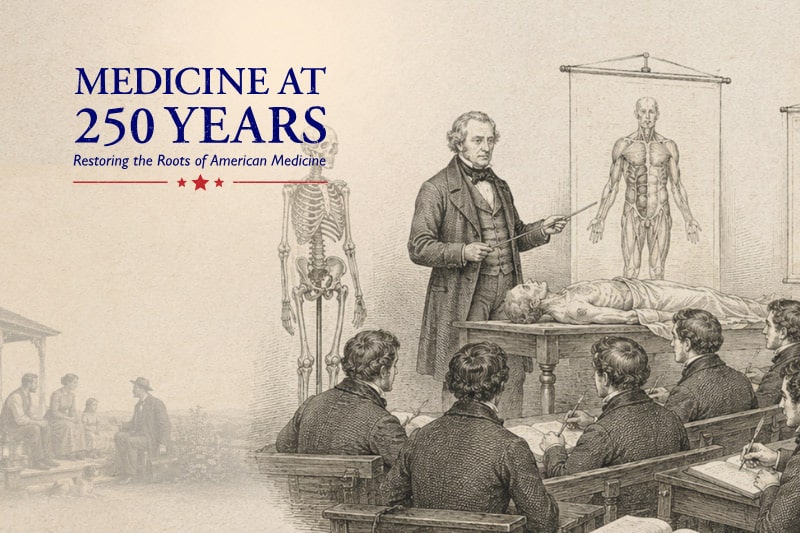
Over time, care moved into lecture halls, laboratories, hospitals, and professional institutions. Physicians were no longer trained only by apprenticeship. Medical schools began to define the path. Licensing, clinical standards, and institutional authority gradually reshaped what it meant to practice medicine.
Much of this transformation was necessary. Some of it was lifesaving.
Medicine needed rigor. It needed anatomy, chemistry, pathology, public health, hospital experience, and scientific accountability. The loosely organized world of early American healing held real wisdom, but it also left patients vulnerable to poor training, dangerous remedies, inconsistent care, and even outright fraud.
Still, every transformation comes with a cost.
As medicine became more professional, it became more centralized. As it became more scientific, it sometimes became less personal. As it gained authority, it began to define more narrowly who could heal, what counted as legitimate knowledge, and which voices were allowed to be trusted.
The question for America at 250 Years is not whether medicine should be scientific. It must be. The question is whether medicine can preserve scientific rigor without losing the independent physician, the informed patient, and the human relationship at the center of care.
The First American Medical Schools
Formal medical education in America began before the nation itself. In 1765, the College of Philadelphia, now the University of Pennsylvania, became the first medical school in the American colonies. Students enrolled for anatomical lectures and instruction in the theory and practice of medicine. The school’s founder, John Morgan, had studied in Europe and returned with a vision for formal medical training modeled in part on Edinburgh and London.[1]
This was a turning point. Medicine was beginning to move beyond apprenticeship alone. Students would study anatomy, theory, practice, and eventually clinical care. Pennsylvania Hospital, founded in 1751, also became an important site of clinical instruction for early medical students.[2]
The emergence of medical schools reflected an important truth. Good intentions were not enough. A physician needed disciplined training. Anatomy mattered. Observation mattered. Clinical experience mattered. Standards mattered.
This was the good side of professionalization. It helped move medicine away from guesswork and toward organized knowledge for the growing population in the New World.
But from the beginning, access to this emerging profession was limited. Formal medicine was largely controlled by men, often those with social standing, money, and educational access. Women were mostly excluded. So were many Black Americans, Indigenous healers, midwives, enslaved people with practical healing knowledge, and non-mainstream practitioners.
As medical institutions gained power, they also began deciding who belonged inside the profession and who would be left outside it.
Medicine and the American Republic
The professionalization of medicine unfolded alongside the formation of the United States itself. That timing matters.
The founding generation understood health as more than a private concern. It was part of civic life. A healthy people were better able to work, raise families, serve communities, think independently, and participate in the life of the republic.
Benjamin Franklin was not a physician, but he embodied part of this founding-era health ethic. He promoted moderation, practical wisdom, civic responsibility, and empirical curiosity. His well-known maxim from Poor Richard’s Almanack, “Early to bed and early to rise, makes a man healthy, wealthy, and wise,” captured a broader belief that personal habits and public flourishing were connected.
That founding-era instinct is worth recovering.
Prevention was not a fringe idea. Personal responsibility was not separate from health. Practical evidence mattered. Health was not merely the absence of disease. It was connected to self-governance, resilience, and the ability to live freely.
Medicine at its best supports that kind of freedom. It helps people live with agency, dignity, responsibility, and strength.
The Rise of Professional Standards
By the 19th century, the need for reform was clear.
American medical training was uneven. Some schools were serious. Others were proprietary institutions with limited requirements. Many doctors learned through apprenticeships of varying quality. Medical sects competed for patients. Patent medicines and cure-alls flooded the marketplace.
The public had reason to be skeptical.
In 1847, the American Medical Association was founded after Nathan Smith Davis called for a national medical convention. According to the AMA’s own history, its early goals included scientific advancement, standards for medical education, medical ethics, and improved public health.[3]
These were legitimate goals. A nation could not build trustworthy medicine on chaotic training and unregulated claims. Patients deserved physicians who were well educated, clinically competent, and ethically accountable.
The problem was not the desire for standards.
The problem was what can happen when standards become gatekeeping. Professional authority can become institutional power. Centralized organizations can begin to confuse their own approval with the full measure of truth.
Medicine needed reform. But reform also began to consolidate power.
Scientific Breakthroughs Changed Everything
The 19th century brought breakthroughs that changed the direction of medicine.
Anesthesia transformed surgery. In 1846, the public demonstration of ether anesthesia at Massachusetts General Hospital became one of the defining moments in modern surgical history. Surgery had once been limited by agony and speed. With anesthesia, it could become more deliberate, complex, and humane.[4]
Germ theory and antiseptic surgery would later transform the understanding of infection. Hospitals, once feared by many as places of death, increasingly became centers of training, innovation, surgery, and specialized care.
These advances deserve to be celebrated. They were not mere institutional victories. They relieved suffering. They saved lives. They made once-impossible procedures possible.
But they also changed the center of gravity.
Medicine moved further from the home and more deeply into hospitals, laboratories, universities, and professional societies. The physician became more formally trained and more scientifically grounded. He also became more shaped by institutions.
That shift brought progress. It also changed the relationship between doctor and patient.
Women in Medicine: Excluded, Then Essential
The story of professionalization must include the women who were kept outside formal medicine and the women who forced the door open.
For generations, women carried much of the practical burden of care in homes and communities. They attended births. They nursed the sick. They prepared remedies. They preserved household medical knowledge.
Yet when medicine became formalized, women were often excluded from the professional path.
Elizabeth Blackwell changed history in 1849 when she graduated from Geneva Medical College and became the first woman in America to earn an M.D. degree. She later supported medical education for women and helped establish the New York Infirmary in 1857, creating opportunities for women physicians who were often denied internships and training elsewhere.[5]
Her story reveals a paradox. Women had always been central to healing, but they had to fight to be recognized as physicians.
As medicine became more professional, it gained scientific legitimacy. At the same time, it risked losing contact with caregiving traditions that women had long sustained.
Any serious effort to restore the roots of American medicine must honor both. It must honor the scientific physician. It must also honor the caregiving inheritance of women, families, nurses, midwives, and community healers.
The Hospital and the Loss of the Whole Picture
Hospitals and medical schools gave physicians tools they could not have acquired in isolation or rural communities. Doctors could observe disease more closely. They could study anatomy, learn pathology, perform surgery, and compare cases. Over time, these institutions helped create a shared body of medical knowledge.
But institutional medicine also changed how patients were seen.
In the home, the patient was inseparable from context. In the hospital, the patient increasingly became a case. In the classroom, the disease could become the object of study. In the laboratory, the body could be analyzed in parts.
These developments were scientifically useful. They also encouraged fragmentation.
The whole person could be divided into organ systems, specialties, diagnoses, and later, billing codes. The more powerful medicine became, the easier it became to mistake the part for the whole.
That tension remains with us today.
Specialization has saved lives. It has also left many patients feeling that no one is looking at the full picture. One doctor sees the heart. Another sees the hormones. Another sees the gut. Another sees the immune system. Another sees the mental health symptoms. Another sees the medication list.
The patient is left trying to assemble the story alone.
The roots of American medicine remind us that the whole person must never disappear behind the disease.
The Cost of Centralized Authority
Professionalization created accountability. It also created hierarchy.
Licensing boards, medical societies, hospitals, universities, and later accrediting bodies increasingly determined who could practice, what could be taught, and what counted as acceptable medicine.
While the intention to protect patients from incompetence and fraud is important to note, overseeing entities were able to put some protections in place. Such that fraud should be exposed and dangerous claims should be challenged. Poor training should not be tolerated.
But the same machinery can also suppress legitimate disagreement. It can discourage innovation outside dominant institutions. It can marginalize independent physicians. It can dismiss approaches that deserve careful study rather than reflexive rejection.
This is where IMA’s mission becomes especially important.
The answer to medical fraud is not blind trust in centralized authority. The answer is transparency, evidence, open debate, ethical standards, informed consent, and protection of the doctor-patient relationship.
Remember the Roots, Preserve the Rigor
American medicine became a profession because it had to.
Patients needed better-trained physicians. Surgery needed anesthesia and technique. Infection needed scientific understanding. Public health needed organization for a new and rapidly expanding country. Medical education needed standards.
We should be grateful for those advances.
But medicine now faces a different kind of crisis. Many patients do not feel known. Many physicians do not feel free. Many families do not feel fully informed.
Doctors are often pressured to follow protocols that may not reflect the complexity of the individual patient. Patients sense when medicine has become too close to corporate incentives, government directives, and institutional control.
The next 250 years should not abandon professional medicine. They should redeem it.
That means preserving what professionalization gave us. Science. Training. Ethics. Accountability. Innovation. Standards that protect patients from harm.
But it also means restoring what professionalization too often crowded out. The independent physician. The informed patient. The family. The community. Clinical judgment. Humility. Prevention. Whole-person care.
Medicine became a profession.
Now it must remember that it is still a calling.
Source Notes
- University of Pennsylvania Archives & Records Center, “Brief History: School of Medicine”. Used for the founding of the first medical school in the 13 American colonies, including the 1765 enrollment of students for anatomical lectures and instruction in “the theory and practice of physik,” as well as the role of John Morgan and European medical education influences.
- Perelman School of Medicine at the University of Pennsylvania, “Perelman School of Medicine History Timeline”. Used for background on Pennsylvania Hospital, founded in 1751, and its role as an early site of clinical instruction for medical students, as well as early medical education and 18th-century practices such as bloodletting.
- American Medical Association, “AMA History”. Used for the founding of the American Medical Association in 1847 and its early goals related to scientific advancement, standards for medical education, medical ethics and improved public health.
- National Institutes of Health / PubMed Central, “The Ether Dome and the First Public Demonstration of Surgical Anesthesia”. Used for background on the 1846 public demonstration of ether anesthesia at Massachusetts General Hospital and its significance in the history of surgery.
- National Institutes of Health / National Library of Medicine, “Biography: Dr. Elizabeth Blackwell”. Used for Elizabeth Blackwell becoming the first woman in America to receive an M.D. degree from an American medical school in 1849 and founding the New York Infirmary for Women and Children in 1857.