
✍️ By Lynne Kristensen, IMA Senior Director of Communications & International Fellowship Program
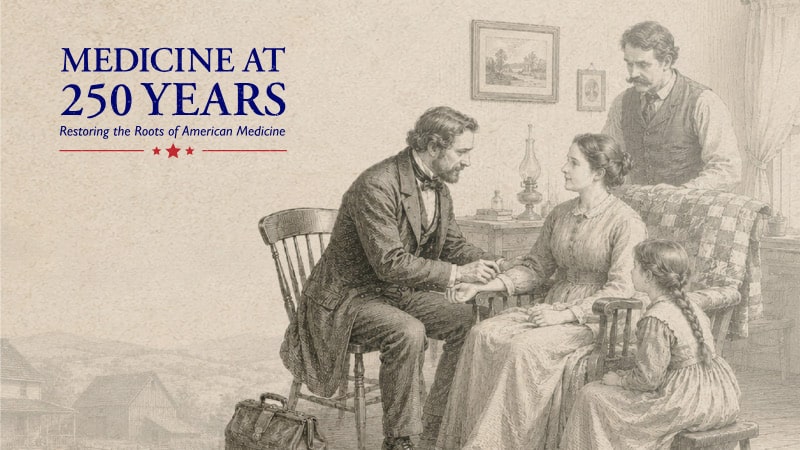
As America approaches its 250th anniversary, it is worth remembering that American medicine did not begin as a system. It began in homes, churches, kitchens, sickrooms, childbirthing rooms, farms, and small communities where illness was not first met by institutions, but by family, faith, observation, practical remedies, and, when available, a local healer or physician.
This is not a call to romanticize the past. Medicine in 1776 was often limited, inconsistent, and sometimes dangerous. Physicians had few reliable tools. Many treatments were based on theories that would later be rejected. Patients were bled, purged, blistered, dosed with mercury, given opium preparations, or treated with remedies that were more forceful than effective.[1]
And yet, there is something about early American medicine that deserves to be remembered. Before medicine became centralized, corporatized, and protocol-driven, care was deeply human. It was relational. It was local. It was personal. The sick person was not a chart or a claim. They were a neighbor, a mother, a father, a child, a parishioner, a farmer, a friend.
The first clinic was the home.
Care Began at the Bedside
For the average American in the late 18th century, illness usually began and was first addressed within the household. Families relied on inherited knowledge, home remedies, herbal preparations, rest, food, prayer, and the experience of women who often served as the first guardians of health. Midwives, grandmothers, and local healers held practical knowledge about childbirth, fevers, wounds, digestive complaints, pain, and seasonal illness.[2]
In many communities, especially rural ones, trained physicians were not immediately available. Distance, cost, weather, transportation, and social class all shaped access to care. When a doctor was available, he often came to the patient. The sickroom was not yet a clinical space. It was the patient’s own world: the home, the family, the environment, along with the habits and the social reality in which illness unfolded.
That setting mattered. The physician saw more than symptoms. He saw the patient’s circumstances. He saw the family. He saw whether food was available, whether the home was cold, whether the patient was isolated, whether work demands were severe, whether childbirth had left a mother depleted, whether grief, exhaustion, or poverty had weakened the body’s ability to recover.
Modern medicine has gained extraordinary capabilities, but it has often lost this proximity. Today, patients are usually asked to enter the system on the system’s terms. They sit in waiting rooms, answer standardized questions, move through electronic portals, and receive care shaped by insurance rules, institutional policies, and limited appointment times.
The old model was imperfect, but it understood one essential truth: care begins by knowing the person.
The Role of Midwives, Women Healers, and Household Knowledge
Any honest history of American medicine must acknowledge the central role of women. Long before women were formally accepted into the medical profession, they were practicing care in homes and communities. Midwives were essential figures in colonial and early American life, and in many places they were among the most trusted and accessible health practitioners. OHSU’s history of midwifery notes that women-centered childbirth care was central in colonial America and that midwives came from many backgrounds, including enslaved Black women who served as midwives in the antebellum South.[3]
Midwives did more than attend births. In many communities, they advised families, helped manage women’s health, provided practical remedies, and served as a bridge between household care and more formal medical intervention. A historical source from North Carolina notes that in the 18th century, people often consulted a midwife rather than a physician for illness or ailments, and in more remote areas, a midwife could be the only medical expert available.
This matters for IMA’s Medicine at 250 Years project because the roots of American medicine were never purely institutional. They were familial, female, community-based, and practical. They were built around trust.
When modern medicine became more professionalized, much of that knowledge was dismissed as informal or unscientific. Some of it undoubtedly needed scrutiny. But the wholesale dismissal of household wisdom, women’s healing roles, traditional remedies, and patient experience also narrowed the meaning of medicine.
The future should not require medicine to choose between science and wisdom. It should require the humility to study both.
IMA President Dr. Joseph Varon reflects on the roots of American medicine and makes a call to restore trust, honesty, informed consent, and the doctor-patient relationship.
Healing Was Local, Natural, and Spiritual
Early American care also included herbal and botanical remedies. Colonial-era medicine made use of plants, roots, barks, tinctures, teas, and purgatives. Some botanical remedies were based on European traditions; others drew from Indigenous knowledge, African healing traditions, and local adaptation to the American environment.[4]
This does not mean every natural remedy was safe or effective. The word “natural” has never automatically meant harmless. Some herbal preparations were powerful, toxic, contaminated, or misused. But the instinct behind much of household medicine was important: support the body, observe patterns, use what is available, and treat the person in context.
Faith also played an important role. For many Americans, illness was not understood only as a mechanical malfunction. It was a moment of vulnerability, fear, family, and prayer. Churches, clergy, neighbors, and communities often helped carry the sick through illness and death.
Modern medicine does not need to become religious medicine. But it should remember that patients are not merely biological systems. They are human beings with values, beliefs, and sources of strength. For many patients, faith and community remain part of healing, resilience, and decision-making today. A medical system that ignores those realities risks misunderstanding the whole person it is trying to treat.
The Limits and Harms of Early Medicine
The roots of American medicine were human, but they were not always healing. Early physicians often worked within humoral theory, which understood disease as imbalance or impurity within the body. Treatments were designed to remove or rebalance what was thought to be harmful through bleeding, purging, sweating, vomiting, blistering, and other forceful interventions.[5]
Mercury was commonly used. So were purgatives and emetics. Opium preparations were used for pain, sleep, cough, diarrhea and distress. Bloodletting remained common for many conditions and was not broadly discredited until the late 19th century.[6]
These practices are a warning. Medical consensus can be wrong. A treatment can be widely accepted, taught, defended, and used by respected physicians—and yet still later be recognized as harmful.
That lesson should not make us anti-medicine. It should make us humble.
The honest physician knows that every era is tempted to confuse confidence with truth. Every medical generation looks back at the previous one and sees error. The question is whether we are willing to look at our own era with the same clarity.
The Doctor as Steward
For all its limitations, early American medicine preserved a role we desperately need to recover: the physician as steward.
A steward is not merely a technician. A steward is entrusted with something sacred. In medicine, that sacred trust is the vulnerable patient, the family, the truth, and the physician’s duty to act according to conscience and clinical judgment.
The community doctor did not have all the answers. Oftentimes, he had too few. But he was expected to show up. He was expected to know the family. He was expected to bear witness. He was expected to serve.
Today, physicians have far more knowledge and far better tools. But many are trapped in systems that make it harder to practice as stewards. They are asked to document more, see more patients in less time, follow more protocols, satisfy more administrative demands, and subordinate clinical judgment to institutional policy, payer requirements, or algorithmic pathways.
Patients feel this loss. They know when they are being processed instead of heard. They know when the doctor is rushed. They know when the computer has become the third person in the room.
The first article in this series begins here because this is the foundation: before medicine was a system, it was a relationship.
Remember the Roots, Shape the Future
Returning to the roots of American medicine does not mean returning to bloodletting, mercury, or medical guesswork. It does not mean rejecting antibiotics, surgery, diagnostics, emergency medicine, anesthesia, or the extraordinary advances that have saved millions of lives.
It means remembering that science without relationship is incomplete, and never truly “settled.” Technology without trust is insufficient. Protocols without judgment are dangerous. Systems without humanity are not healing systems at all.
The home was the first clinic. The family was the first care team. The community was the first health network. The physician, when called, entered the patient’s life as a guest, witness, and steward.
As America looks toward its next 250 years, medicine should not simply ask what more it can do. It should ask what it must restore.
The answer begins with the patient, the physician, the family, and the trust between them.
Source Notes
- The Encyclopedia of Greater Philadelphia, “Medicine (Colonial Era)”. Background on colonial-era medicine, including humoral theory, bleeding, purging, vomiting, mercury, botanical remedies, and the role of Philadelphia in early American medical development.
- Oregon Health & Science University Center for Women’s Health, “A Brief History of Midwifery in America”. Background on midwifery in colonial America, women-centered childbirth care, midwives traveling to homes, and the role of midwives as community care providers.
- Oregon Health & Science University Historical Collections and Archives, “There’s a Cure for That: Historic Medicines and Cure-alls in America”. Historical context on patent medicines, bloodletting, purges, laxatives, mercury, opium, alcohol-containing remedies, and the accessibility of patent medicines compared with physician care.
- U.S. National Library of Medicine / PubMed, “Medicine in the American Revolution”. Historical context on colonial and Revolutionary-era medical care, including depletion practices such as bleeding, purging, sweating, blistering, and vomiting, as well as common drugs such as opium and cinchona bark.
- National Institutes of Health / National Library of Medicine, “Plants and Medicine: The National Library of Medicine’s Herbal Pharmacopeia”. Background on the long history of botanical and herbal remedies in medicine.