
A Lancet-published study claims COVID vaccines halved all-cause mortality in elderly Australians. New research shows the math does not add up.
For years, IMA has documented serious safety concerns tied to COVID-19 vaccines, from cardiac inflammation and DNA contamination to elevated mortality risk in young men. IMA researchers and fellows have called for these products to be withdrawn, and the evidence supporting that position continues to grow.
Against that evidence, defenders of mass vaccination have leaned on one core claim: even if the vaccines carried risks, they prevented death.
A major government-funded study from Australia made that claim in unusually strong terms. Published in The Lancet in 2023, the study examined more than 3.8 million adults aged 65 and older and concluded that COVID vaccination was “highly effective” against COVID death. A fourth dose, the authors reported, showed vaccine effectiveness above 84%. The Australian government still cites the study to support annual booster recommendations for people over 65.
A new analysis published in the Journal of Independent Medicine puts those claims to a basic plausibility test.
The authors, Clare Pain, a medical journalist and former statistician, Dr. Mark Jones, Associate Professor of Biostatistics at Bond University, and Dr. Christopher Neil, a cardiologist and independent researcher, compared the Lancet study’s findings against Australia’s own official death statistics. Their conclusion is simple: the numbers require believing something that is not mathematically plausible.
“On one side of the coin, you’ve got a study saying that the vaccine was given to almost everyone and reduced all-cause mortality by 50%. But then the official data said that in that population, the all-cause mortality was higher than expected by 13%.” — Mark Jones
📖 Read and Download the Full Paper
The Claim That COVID-19 Vaccination Protected Australians from All-Cause Mortality Is Not Plausible (JIM Vol. 2, No. 3, 2026) — Author: Clare M. Pain, Christopher Neil and Mark Jones
👉 Visit the Journal of Independent Medicine to create a free account and download the full article.
The Study Behind Australia’s Booster Policy
The study in question, by Liu et al. (2023), compared outcomes for 3.7 million vaccinated Australians aged 65 and older with roughly 165,000 who were unvaccinated. More than 95% of the elderly population had received at least one dose.
This was an observational study, not a randomized controlled trial. The vaccinated and unvaccinated groups were not randomly assigned. In a country where nearly everyone in this age group complied with vaccination recommendations, the small group that remained unvaccinated was likely different in important ways, including health status, behavior, access to care, and baseline risk of death.
Yet Liu et al. concluded that a recent fourth dose provided vaccine effectiveness above 84% against COVID death. The study also reported that vaccination reduced all-cause mortality by 57.5% within three months of a fourth dose.
The authors reported large reductions in death from cancer (66.6%), dementia (41.2%), heart disease (43.4%), cerebrovascular disease (42.5%), and respiratory disease (57.3%).
A COVID vaccine was not designed to prevent death from cancer, dementia, or heart disease. Some of these conditions develop over years. Some take years to become fatal. Yet the study’s reported protective effect appeared across nearly every major category of death.
When a COVID vaccine appears to protect against COVID, cancer, dementia, and heart disease at similar rates, the most likely explanation is not that the vaccine prevents nearly every major cause of death.
The more likely explanation is that something went wrong in the analysis.
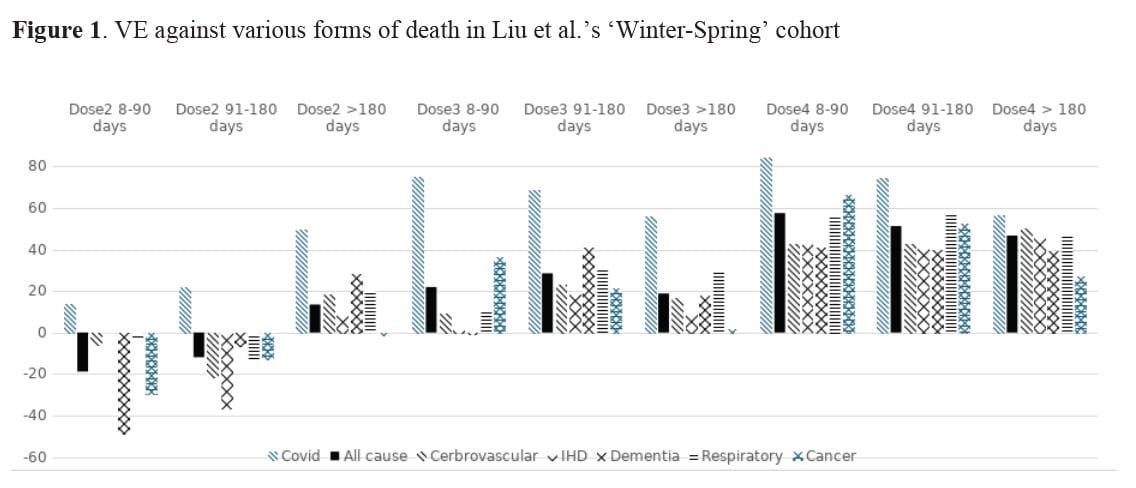
Vaccine effectiveness reported by Liu et al. against COVID death, all-cause mortality, and five non-COVID causes of death. The nearly identical pattern across all categories suggests methodological bias, not genuine protection.
One number makes the problem impossible to ignore: the Australian Bureau of Statistics reported 13% excess mortality among people 65 and older in 2022.
If vaccination cut all-cause mortality roughly in half in a population where more than 95% were vaccinated, excess mortality should have moved sharply downward.
Instead, it rose to the highest level in nearly a century.

The 121% Problem
Pain, Neil, and Jones put a number on that contradiction.
Using Liu et al.’s own claims, they calculated a weighted average vaccine effectiveness of 51.2% against all-cause mortality. Then they asked the obvious question:
If that level of protection was real, what would excess mortality have been in Australia without vaccination?
The answer: 121%. More than double the expected number of deaths.
Two independent lines of evidence show why the figure is not plausible.
First, the global comparison. In 2020, COVID swept through unvaccinated populations around the world. Across 28 OECD countries, the median excess mortality among people 65 and older was 11.9%. Mexico was the highest at 52.7%, a clear outlier. The next highest was Poland at 25%.
No country came close to 121%.
And those countries were hit before vaccination, during the earlier and more severe phases of the pandemic, not during the Omicron period Australia faced in 2022.
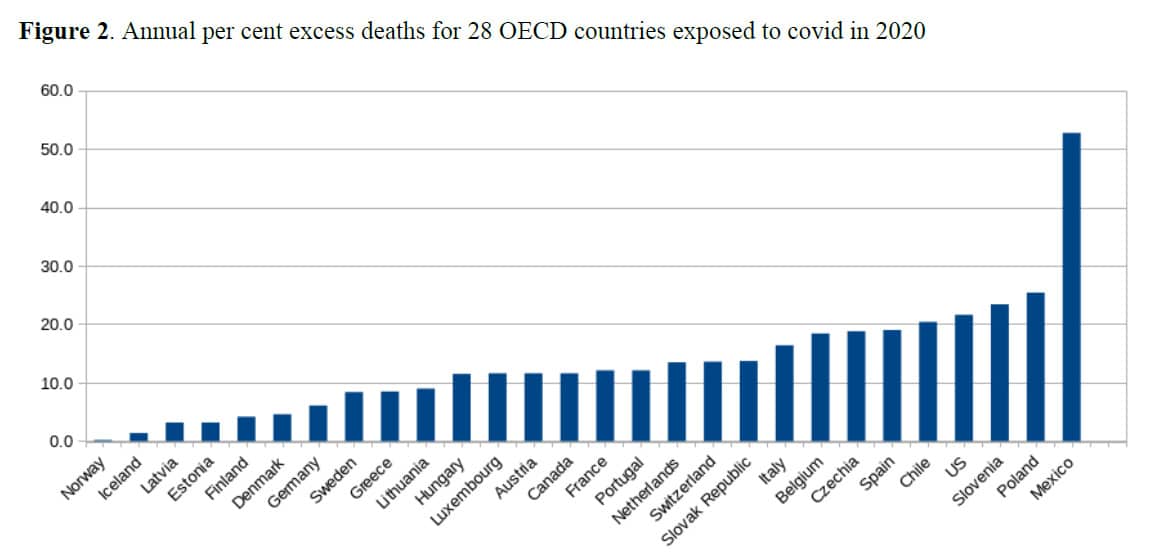
Excess mortality among people 65 and older in 28 OECD countries during 2020, when COVID hit unvaccinated populations. The highest was Mexico at 52.7%. Liu et al.’s findings would require Australia to have reached 121%.
Second, Australia’s own mortality history. Death rate data going back to 1935 shows that the highest annual excess death rate before COVID was 7.5%, recorded in 1942 during World War II. In 2022, Australia reached 12.8%, the highest level in 87 years.
Liu et al.’s results require accepting that without vaccination, the 2022 spike would have been nearly 10 times higher.
“Liu et al. are asking us to accept that if their claims about the effects on all-cause mortality are true, then that spike in 2022 would have been nearly 10 times higher. Well, we think this is just not plausible.” — Clare Pain
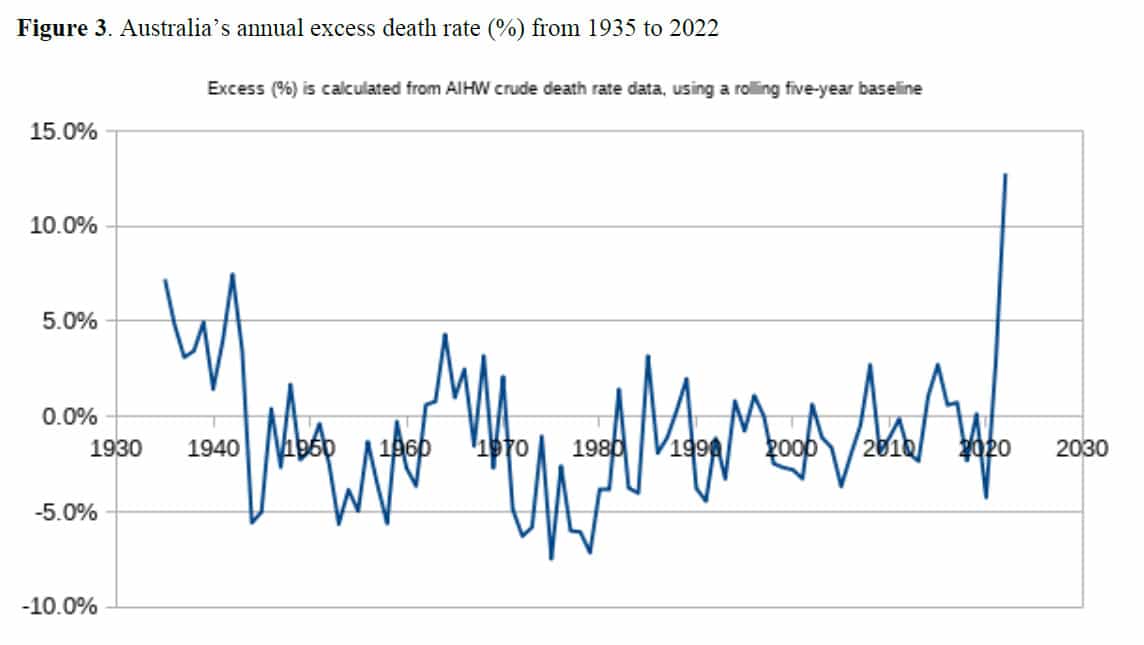
Australia’s annual excess death rate from 1935 to 2022. The 2022 spike of 12.8% was already the highest in 87 years. Liu et al.’s claims require accepting it would have been nearly 10 times higher without vaccination.
Even when the authors ran sensitivity analyses accounting for healthy and unhealthy vaccinee effects, the implied excess mortality remained extreme: 112% and 126%.
And Then There’s Cancer and Dementia
The all-cause mortality claim was already difficult to accept. Liu et al. went further.
The study reported that a fourth COVID booster reduced cancer deaths by 66.6% and dementia deaths by 41.2% within three months.
The authors suggested that COVID infection can worsen cardiovascular and respiratory conditions, meaning vaccination might indirectly reduce deaths in those categories. But that explanation does not resolve the problem.
The vaccine provided only limited protection from infection. Seroprevalence data showed prior COVID infection among Australians aged 70 and older rose from 6.4% in February 2022 to 51.4% by November 2022, regardless of vaccination status.
Severe disease was also uncommon. Only 1.9% of infections led to hospitalization.
That is not enough to explain large reductions in deaths from cardiovascular and respiratory conditions. It does even less to explain sharp reductions in deaths from cancer or dementia.
Liu et al. acknowledged that “uncontrolled confounding by behavioural aspects associated with vaccine uptake” could explain their findings.
They reached the vaccine-effectiveness conclusion anyway.
From Flawed Data to Flawed Policy
The all-cause mortality results are almost certainly an artifact of methodology, not evidence that COVID vaccination prevents death from all causes.
The same methodology was used to estimate COVID-specific mortality. If the all-cause mortality findings are distorted, then the study’s central conclusion, that the vaccines were “highly effective” against COVID death, becomes harder to trust.
Despite this, the study continues to support Australian government recommendations that people 65 and older receive annual COVID boosters.
Pain, Neil, and Jones first submitted their critique to The Lancet, where the original Liu et al. study appeared. It was rejected. They pressed further. The editor asked for more information. They provided it.
The response: their data was “too preliminary” to publish.
“We’re very grateful that this study and our letter in March have been published by JIM because without that, our concerns about this claim of the effect on all-cause mortality just wouldn’t have seen the light of day.” — Clare Pain
The full study is available open-access at journalofindependentmedicine.org.
Related Reading
- Post: Tainted Vials: New Study Reveals Massive DNA Contamination in COVID Shots
- Post: New Study: mRNA Vaccines Trigger 620% Heart Risk Surge in Young Men
- Post: DARE-SAFE: A New Standard for Comparing Vaccine and Drug Safety
- Guide: COVID Vaccine Harm: What the Data Shows
- Journal: Journal of Independent Medicine