Host: Dr. Ryan Cole | Guest: Dr. David Wiseman, PhD
What happens when the system designed to detect vaccine safety signals may be missing them? Dr. Ryan Cole is joined by Dr. David Wiseman, PhD, for an update following Sen. Ron Johnson’s recent hearing on COVID-19 vaccine safety signal detection.
VAERS, the Vaccine Adverse Event Reporting System, is the nation’s early warning system for vaccine safety. Dr. Wiseman explains how VAERS data is analyzed, how safety signals may be missed or obscured, and why transparent pharmacovigilance matters for patients, physicians, and public trust.
The CDC calls VAERS “the nation’s early warning system for vaccine safety.” The system works by collecting reports of health problems that happen after vaccination, then watching for patterns. When a particular problem shows up more often after a particular shot than you’d expect by chance, that pattern is called a safety signal. A signal isn’t proof the vaccine caused the problem. It’s a flag that says: this deserves a closer look.
For more than 18 months during the COVID vaccine rollout, that system was missing hundreds of these signals. Not because the reports weren’t there, but because of how the FDA analyzed them. When a public records request finally forced the agency’s weekly signal reports into the open in January 2025, the data showed something strange: one vaccine was generating almost all the signals, while two others generated almost none.
Sen. Ron Johnson’s Permanent Subcommittee on Investigations went looking for why. Its April 29, 2026 hearing drew on 11 million pages of FDA and CDC records obtained by subpoena. The internal emails told a clear story. FDA staff were warned as early as December 2020 that their analysis method was hiding signals for certain vaccines. The scientists who built that method had already created a fix for the problem. The fix was never used, and the FDA analyst who kept sounding the alarm was told to stop.
Dr. David Wiseman, a research bioscientist who testified at the hearing, joins Dr. Cole to walk through what the data shows. His published analysis puts the number of lost signals at 763 at minimum. The emails explain how they went missing, and what the agency knew while it happened.
Meet the Experts

David Wiseman, PhD, MRPharmS
Research bioscientist. Dr. Wiseman’s career spans pharmacy, pharmacology, immunology, and experimental pathology, with decades of experience in pharmacovigilance and regulatory science. He has made more than 36 governmental submissions on vaccine issues and has testified before the Texas Senate and the U.S. Senate. His analysis of VAERS signal loss was published on ResearchGate in September 2025.

Ryan Cole, MD
IMA Head of Medical & Scientific Affairs; Senior Fellow, Pathology; Founder, Cole Diagnostics. Dr. Cole is a board-certified anatomic and clinical pathologist with extensive experience in diagnostics and laboratory medicine. His clinical and research work has focused on COVID-19 vaccine safety, tissue pathology, and immune system function.
1. The Numbers That Don’t Add Up
The records covered the FDA’s weekly signal reports from January 2021 through July 2022. To find signals, the FDA relies on a statistical method called Empirical Bayesian Data Mining. It scans every report and flags any vaccine-and-reaction pairing that shows up far more often than chance would predict.
One week’s report makes the pattern obvious. On April 29, 2022, the FDA logged 124 signals, split like this:
- Janssen: 110 signals
- Moderna: 6 signals
- Pfizer: 8 signals
That lopsided result, roughly nine to twenty-two times more Janssen signals than the other two vaccines, held steady week after week for the entire period.
The details made it stranger. Most of the few Pfizer and Moderna signals weren’t even medical problems. They were paperwork issues: a product prepared incorrectly, a dose given to someone the wrong age. The serious clinical signals, the ones involving real injuries, landed almost entirely on Janssen. A system working properly does not produce a result that lopsided.
So Dr. Wiseman checked the FDA’s numbers against other databases and the published research, and found the signals that should have been there. At least 763 of them, he calculated, had dropped out of the FDA’s analysis, and larger datasets push the count into the thousands. Every one was a potential risk the FDA was legally required to investigate. Under the rules for emergency-authorized products, the agency didn’t even have to prove the vaccine caused the harm to be obligated to look.
“These signals that were lost represent still mostly uninvestigated potential risk. FDA was legally required to consider without needing to determine causality.” — David Wiseman
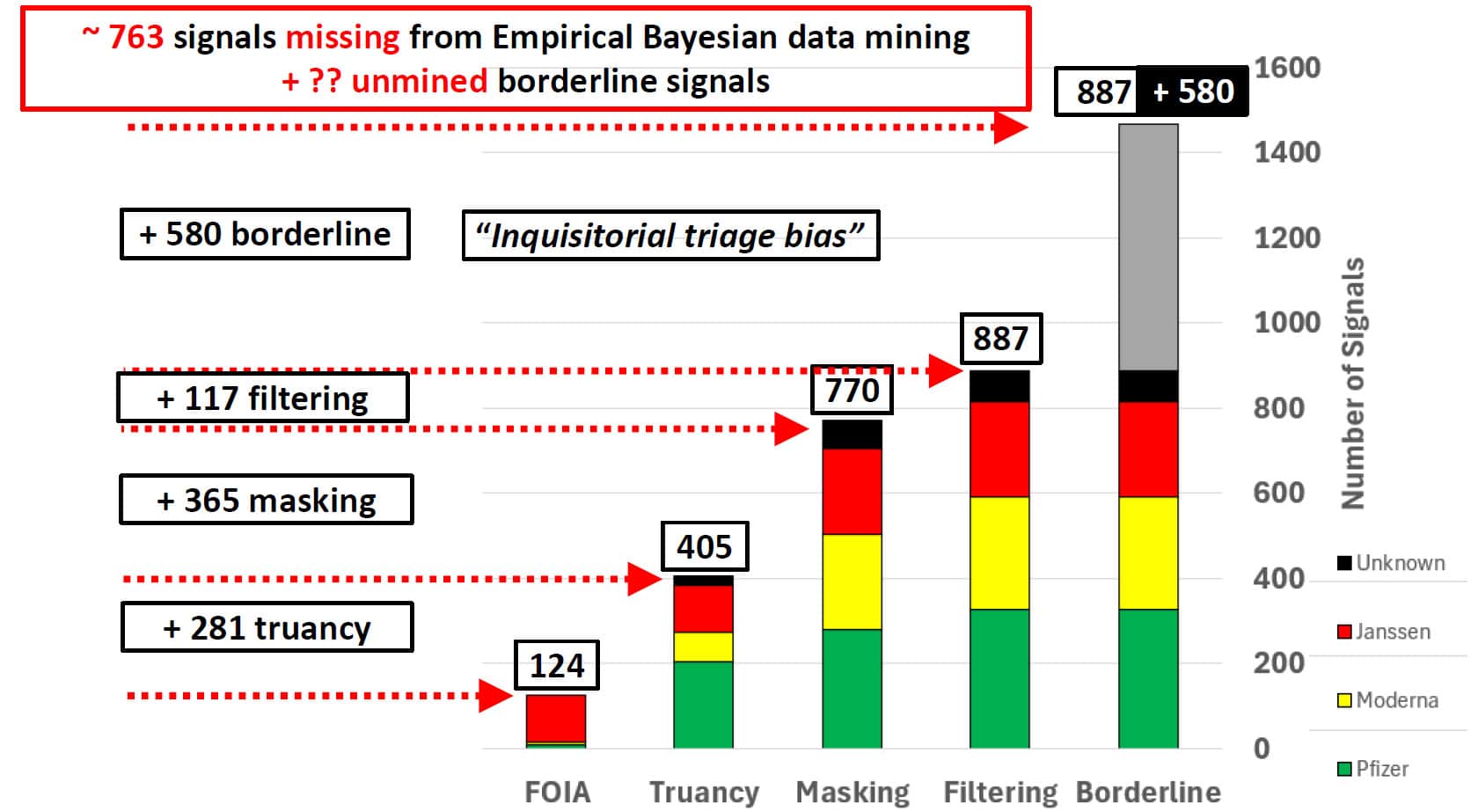
The FDA’s own released data showed just 124 signals (far left). Adding back the signals lost to three separate flaws, explained in the next section, rebuilds the true count step by step to 887, with hundreds more borderline cases the FDA never examined at all. (Source: Wiseman, 2025)
2. How Signals Disappear
The biggest reason signals went missing has a name: masking. When two vaccines cause the same reaction at similar rates, the FDA’s method can let them hide each other, so a real problem looks normal.
Dr. Wiseman used an analogy from the hearing. Line up hemlock and arsenic next to a cup of tea, and both poisons obviously look dangerous. But secretly stir the arsenic into the tea first, then compare the hemlock against that spiked tea, and the hemlock suddenly looks harmless. You’re measuring one poison against a baseline that’s already poisoned.
Dr. Cole put it more simply: one zebra among a hundred kangaroos stands out. Add a second zebra to the group, then compare the first zebra against the whole herd, and it no longer looks out of place.
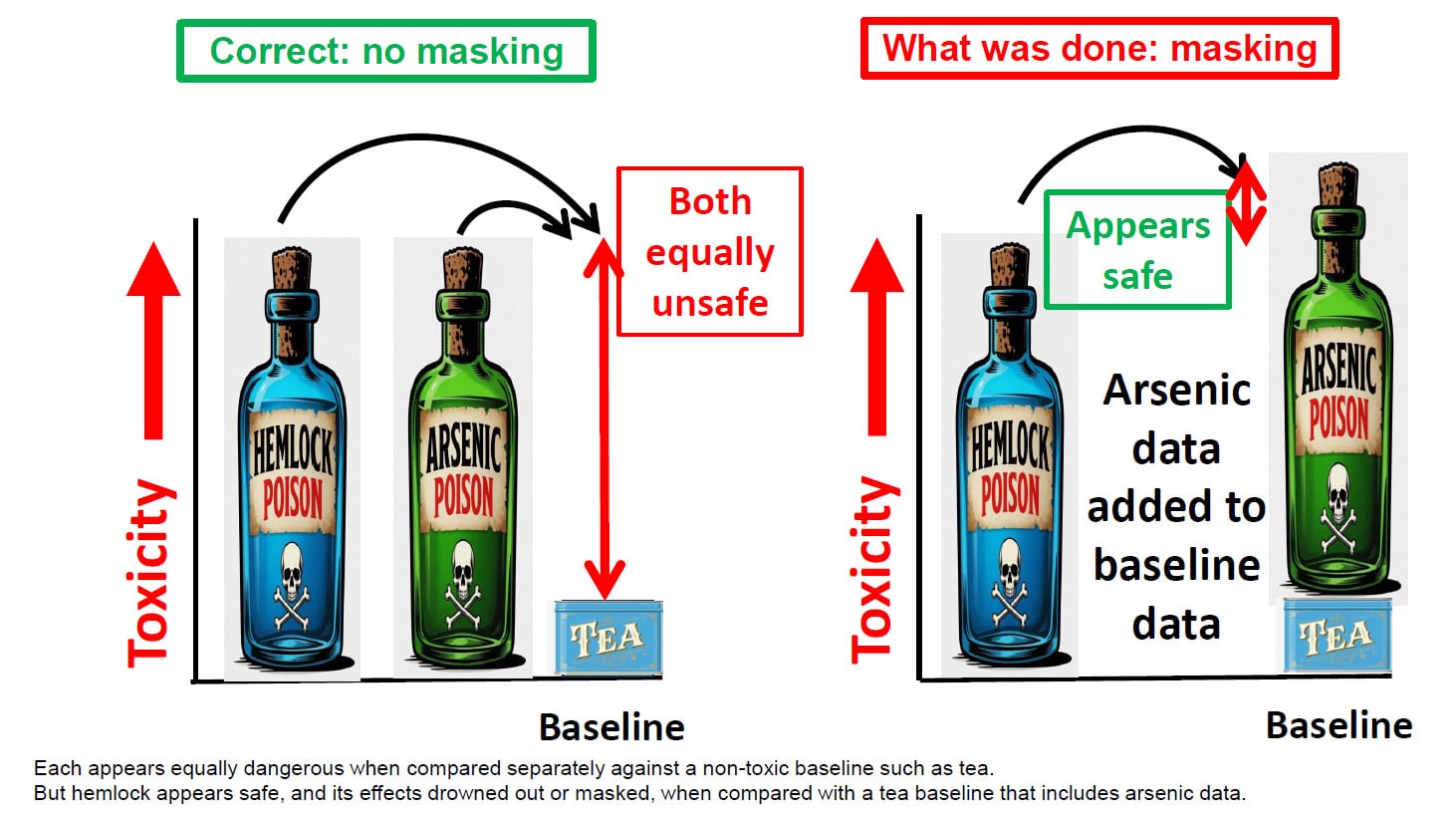
On the left, hemlock and arsenic each look dangerous when measured against a clean baseline (tea). On the right, arsenic has been mixed into the baseline itself, so hemlock now looks safe by comparison. This is masking: hiding one hazard by folding a similar one into the measuring stick. (Source: Wiseman, 2025)
Masking wasn’t the only problem. Dr. Wiseman found two more:
- Truancy: Hundreds of signals that appeared in other databases and in the published research were simply missing from the FDA’s records, with no explanation for where they went.
- Filtering: The FDA set the bar for what counts as a signal higher than the method’s own inventor recommended. A higher bar means fewer signals clear it, so real warnings got filtered out before anyone reviewed them.
3. What FDA Knew and Chose Not to Fix
Here is what turns a statistical problem into a scandal: the people who built the FDA’s detection system were the ones who spotted the flaw. In a 2022 paper, three researchers laid out the masking problem plainly, and two of them were insiders. William DuMouchel invented the exact math method the FDA uses. Dr. Ana Szarfman brought that method into the agency and made it the standard for catching drug and vaccine problems. Their conclusion was damning: the method was hiding real signals, and the software already had a built-in setting that would fix it. When the inventors of a system tell you it’s broken, that carries weight.
And they weren’t the only warning. The internal record shows a steady drumbeat:
- December 2020: Dr. Szarfman flags the masking risk to FDA colleagues, before the vaccines are even widely rolled out.
- March 2021: She shares an analysis finding 49 examples of “extreme masking,” including hidden signals for sudden cardiac death and stroke.
- Same period: Another FDA official, Dr. David Menschik, runs his own check and confirms the problem independently.
- September 2021: Instead of fixing it, senior official Peter Marks reports that Dr. Szarfman “has been asked to cease and desist,” meaning she was ordered to stop.
Dr. Szarfman was blunt about what the broken method meant.
“I am not astonished that [FDA’s data mining system] was unable to detect these signals.” — Dr. Ana Szarfman, per internal communications shared by David Wiseman
The reason for shutting her down wasn’t scientific. It was about optics, as one internal email spelled out.
“Results from adjusting parameters that raise or lower sensitivity of the alerts as the vaccination campaign is underway could lead to confusion and have unintended consequences, e.g. regarding vaccine confidence.” — Dr. Zinderman, FDA, per internal communications shared by David Wiseman
The people paying the price were sitting across the table from Dr. Marks. Through 2021 and into 2022, vaccine-injured patients from the group React19 met with him and his staff, asking only to be believed. Marks told them, more than once, that VAERS showed no safety signals, even while the FDA’s own analysts were documenting that the system was hiding them. These were people who lined up for their shots, did what they were asked, and were told the system saw nothing wrong.

4. A Broken Early Warning System
The problem doesn’t stop with COVID. The same researchers warned that the flood of COVID vaccine reports now sitting in VAERS has damaged the database’s ability to catch problems with any future vaccine, like a smoke detector so clogged it may not go off for the next fire. At least three European studies of their own vaccine databases reached the same conclusion.
Put the pieces together and the system is weak at every stage:
- The math method hides signals for vaccines that cause similar reactions.
- Only an estimated 1% of real adverse events ever get reported in the first place.
- When a fix was available, the FDA chose not to use it.
Dr. Marks himself understood what was at stake. In a line Dr. Wiseman read back to the Senate, Marks had written that failing to catch and communicate a serious vaccine problem “could impact confidence, not only in COVID vaccines, but in all vaccines.”
Sen. Johnson’s investigation is still open, and it’s not yet clear whether anyone will be held accountable. But the fix is not a mystery. It comes down to three things:
- Use the correct analysis settings the FDA already had access to.
- Protect the staff who report problems instead of silencing them.
- Release the safety data in full.
“What’s the point of even having a system if you’re not going to act on it… and now to know that your system’s broken, and you haven’t replaced your system.” — Ryan Cole
Looking Forward
The data, the emails, and the sworn testimony are public now. What Dr. Wiseman’s work makes clear is that this isn’t just history. The missing signals still haven’t been investigated, and the detection system still runs the same way it did. Getting the records released took years of effort. Whether it leads to a system that actually works is the next question, and the one worth watching.