
A new systematic review of 20 studies documents COVID-19 vaccine mRNA, spike protein, and lipid nanoparticles persisting in blood and tissues for months to years. The authors call for urgent investigation.

When mRNA COVID-19 vaccines were first rolled out, a key selling point was their transience. The modified RNA would be translated into spike protein, trigger an immune response, and then be rapidly degraded. Simple, clean, and temporary.
Individual studies have been challenging that assumption for years: spike protein in blood months after vaccination, mRNA in lymph nodes weeks later, and vaccine components in brain and heart tissue. But until now, no one had pulled all that evidence together in one place.
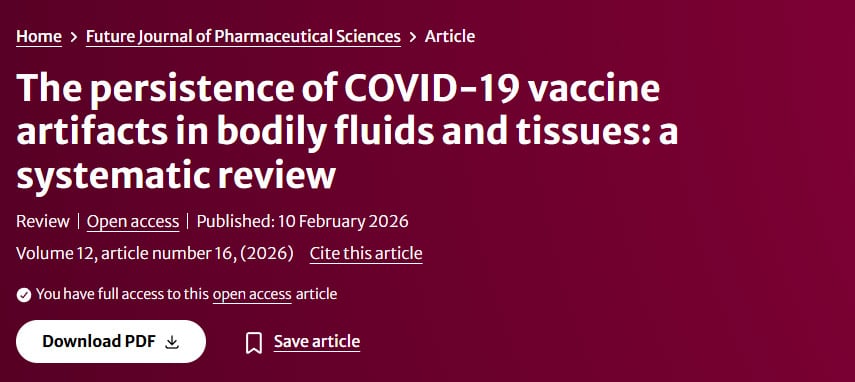
A new systematic review published in the Future Journal of Pharmaceutical Sciences does exactly that. Researchers Edgar Selem, Mikolaj Raszek, PhD, IMA President Dr. Joseph Varon, and IMA Director of Research Matthew Halma screened 2,470 records and assembled findings from 20 studies covering blood, plasma, breast milk, lymph nodes, brain, heart, liver, and other tissues. The result is the first comprehensive map of where COVID-19 vaccine materials have been found in the human body and how long they persist.
Taken together, the pattern is clear: these materials lasted far longer and traveled far further than anyone was told to expect.
📖 Read and Download the Full Paper
The persistence of COVID-19 vaccine artifacts in bodily fluids and tissues: a systematic review Authors: Edgar Selem, Mikolaj Raszek, Joseph Varon and Matthew Halma
What the Evidence Reveals
This study is a review of several papers centered around the same question: do COVID vaccine materials linger in the body longer than expected?
Across the 20 studies analyzed, vaccine-derived spike protein, mRNA, and lipid nanoparticle components were detected far longer than initially expected, and in locations well beyond the injection site.
Key findings:
- Spike protein detected in blood plasma up to 709 days after vaccination (Bhattacharjee et al./Yale LISTEN cohort)
- S1 subunit found in immune cells (CD16+ monocytes) up to 245 days (Patterson et al.)
- Spike protein identified in cerebral arteries up to 17 months post-vaccination (Ota et al.)
- Spike protein found in brain, heart, and vasculature three weeks after a third dose, with no nucleocapsid protein present, ruling out infection (Mörz)
- Vaccine mRNA detected in lymph node germinal centers up to 60 days (Röltgen et al.)
- mRNA found in breast milk up to 45 hours post-vaccination (Hanna et al.)
The review also highlights a striking finding. People experiencing post-vaccination syndrome had dramatically higher levels of spike protein in their blood compared to healthy individuals. In the Yale LISTEN study, the difference wasn’t subtle; it was orders of magnitude higher.
This raises an important possibility: spike protein levels could serve as a straightforward way to identify who’s been affected.
Why Nobody Checked Sooner
The original COVID-19 vaccine trials never tested for long-term persistence of vaccine components or their distribution beyond the injection site. Only about five years of data existed on the behavior of modified (n1-methyl-pseudouridinylated) mRNA before it was deployed globally in 2020.
Standard RNA degrades with a half-life of roughly 16 hours. The modified version used in mRNA vaccines extends that to 5–6 days, but even under those calculations, the material should theoretically reach undetectable levels within about 272 days for Pfizer and 263 for Moderna. Several of the studies in this review found persistence well beyond those timelines.
As the authors put it:
“The foundational assumptions of rapid decay and localized distribution have not consistently held.”
The promise that these vaccine materials would break down quickly and disappear hasn’t held up. This study pulls together what we actually know, flags what we don’t, and makes a clear case for why it’s time to find out.
What’s more, these findings don’t just apply to COVID-19 vaccines. The same core mRNA technology is being developed for cancer treatments, rare diseases, and influenza. If the assumptions are wrong here, they need to be re-examined everywhere.
From Research to Real-World Care
This review is part of a growing body of IMA-led research filling gaps the system hasn’t addressed. Dr. Varon and Halma, both co-authors on this study, have also published work defining post-vaccination syndrome as a clinical condition and exploring mitochondrial dysfunction as a driver of post-vaccine fatigue. IMA-affiliated researchers have separately documented DNA contamination in mRNA vaccine vials and explored how regulatory testing methods may have missed it.
For more on IMA’s work in this area, have a look below: