
PACVS (Post-Acute COVID Vaccine Syndrome) is real, and the science is finally opening up. Months ago, IMA researchers broke ground. Now, another team is validating what patients have known all along.

Those suffering from Post-Acute COVID-19 Vaccination Syndrome (PACVS) face not only debilitating symptoms but also institutional resistance to recognition, diagnosis, and care. Despite these barriers, researchers are beginning to shed light on this underrecognized condition. Those who follow IMA know we’ve been working in this space for years—seeing our peers in the research community finally open up is more than encouraging.
A recent publication by Yong et al. in Reviews in Medical Virology offers one of the most comprehensive summaries to date on PACVS (which they refer to as Post-COVID-19 Vaccination Syndrome, or PCVS). Their team, spanning 25 institutions, reviewed existing scientific literature and highlighted several important areas of progress:
*See references in https://onlinelibrary.wiley.com/doi/epdf/10.1002/rmv.70070
Key Takeaways from the Review:
Terminology
The review outlines the evolving language around this condition — from “Long Vax” to “post-vac syndrome.” At the Independent Medical Alliance, we’ve adopted Post-Acute COVID-19 Vaccination Syndrome (PACVS) as our standard terminology to reflect both the temporal and mechanistic distinctions from Long COVID.
Symptom Clusters
The article identifies hallmark symptoms that will be familiar to both clinicians and patients: fatigue, cognitive dysfunction (brain fog), and paresthesia.
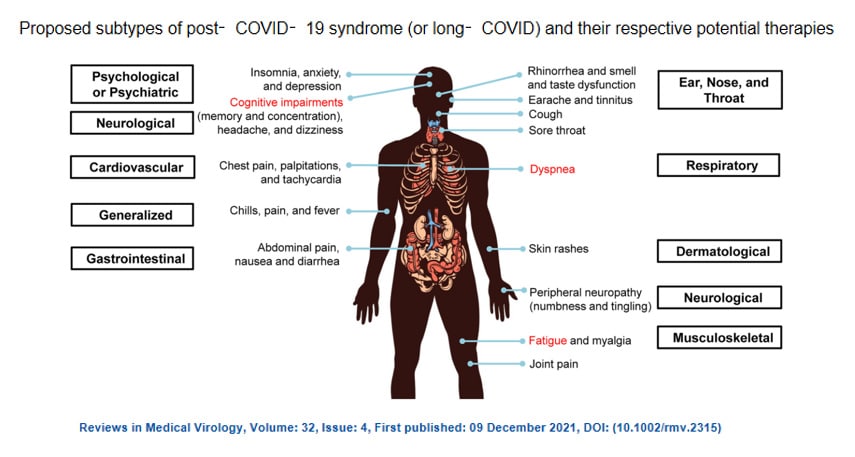
*This figure for post-COVID-19 syndrome is reproduced under an Attribution-NonCommercial 4.0 International license
The image above is adapted from an earlier study on “post-COVID-19 syndrome” (long COVID). The more recent article expands on this by introducing additional system categories: autonomic, visual, auditory, gustatory**, and multi-system syndromes that highlight a broader range of physiological effects.
It introduces new symptoms, including:
- paresthesia
- neuropathy
- tremors
- orthostatic hypotension
- fluctuating blood pressure or heart rate
- heat or cold intolerance
- vision problems
- tinnitus
- taste dysfunction
- urticaria
- exercise intolerance.
It also adds a new section on multi-system and immune-mediated conditions such as POTS, SFN, ME/CFS, myocarditis, VITT, and ITP, framing the syndrome as a more complex, vaccine-specific condition with autonomic and immune involvement beyond the generalized symptoms in the second image.
Proposed Mechanisms
The authors explore two leading hypotheses for PACVS: one centering on spike protein–induced tissue damage and another on dysregulated immune responses. While not mutually exclusive, both warrant deeper investigation.
Treatment Landscape
Though research is still early, the paper compiles a useful snapshot of current treatment strategies—ranging from manual therapies (e.g., compression garments, vestibular rehab) to pharmaceuticals (SNRIs, modafinil) and nutraceuticals (melatonin, NADH, acetyl-l-carnitine).
📣 Call for Papers: PACVS Special Edition
Our team at the Independent Medical Alliance has made PACVS research a central focus. Now, we’re inviting submissions for a special edition of the Journal of Independent Medicine dedicated to this emerging condition. If you’re studying spike injury, vaccine-related syndromes, or chronic post-injection effects, we encourage you to submit your work or learn more here before the submission deadline of December 31, 2025.
The Yong et al. review is a welcome contribution to the growing PACVS landscape, but much more research is urgently needed. Our team recently published a complementary case series on PACVS mechanisms and treatment hypotheses, available here:
👉 Read the study in Heliyon
👉 Read the summary at IMAHealth.org
Together, let’s build the evidence base for the patients still waiting to be heard.