
Host: Dr. Ryan Cole | Guest: Dr. Vibeke Manniche
Some people were seriously injured by their COVID-19 shot. Others got the same shot and walked away with a sore arm. But what if it wasn’t the same shot?
In this episode, host Dr. Ryan Cole welcomes Dr. Vibeke Manniche, IMA Senior Fellow in Public Health & Epidemiology, to explore research that found substantial differences in suspected adverse-event reporting rates across Pfizer’s COVID-19 vaccine batches.
Dr. Vibeke Manniche sums up her first batch study in two words: Russian roulette. Five out of six players walk away unharmed, and the sixth is not so lucky. When colleagues tell Dr. Ryan Cole they got their shots and they’re fine, he hears the five lucky ones talking.
IMA’s readers don’t need convincing that people were harmed by the shots. But Dr. Manniche’s research adds another layer, one many have likely heard whispers about: the risk may have depended on which batch a person got. In Denmark, Sweden, and Germany, reports of suspected side effects piled up in the early batches of the rollout, and she says Pfizer has never responded to her findings.
Dr. Cole hosts Dr. Manniche, a Danish physician and IMA Senior Fellow who has tested the batch question in three countries. Her team includes a University of Copenhagen cardiology professor, an independent data scientist, and researchers in Sweden and the Czech Republic. Together, they cover what the data shows, why batches might differ, why nothing happened, and what would settle it.

Meet the Experts

Dr. Vibeke Manniche
IMA Senior Fellow, Public Health & Epidemiology. Dr. Manniche is a Danish physician with a PhD in public health who leads a research team studying differences in reported side effects across COVID-19 vaccine batches. She has also written 35 books, mostly on children’s and women’s health.
What Denmark’s Batch Data Showed
A bottle of Tylenol should hold the same pills whichever shelf it came from. When early U.S. data hinted that COVID-19 vaccine batches weren’t that consistent, Dr. Manniche was alarmed:
“I was actually, as a doctor, shocked… you won’t know if you take this jab or if you take that vial from that batch, what would your risk be?” — Dr. Vibeke Manniche
Denmark’s national registers record which batch each resident received and when. From late December 2020 to mid-January 2022, about 4 million adults received nearly 10.8 million doses from 52 Pfizer batches, and 43,496 suspected adverse events were reported.
The chance of having a side effect reported depended heavily on the batch, and the batches fell into three clusters:
- Blue batches: the start of the rollout through about March 2021, with far more reports. One small blue batch drew a reported side effect from 1 in every 20 people who received it, and reports are “the tip of the iceberg,” she says.
- Green batches: used later, with far fewer reports per batch.
- Yellow batches: the end of the rollout, with almost none.
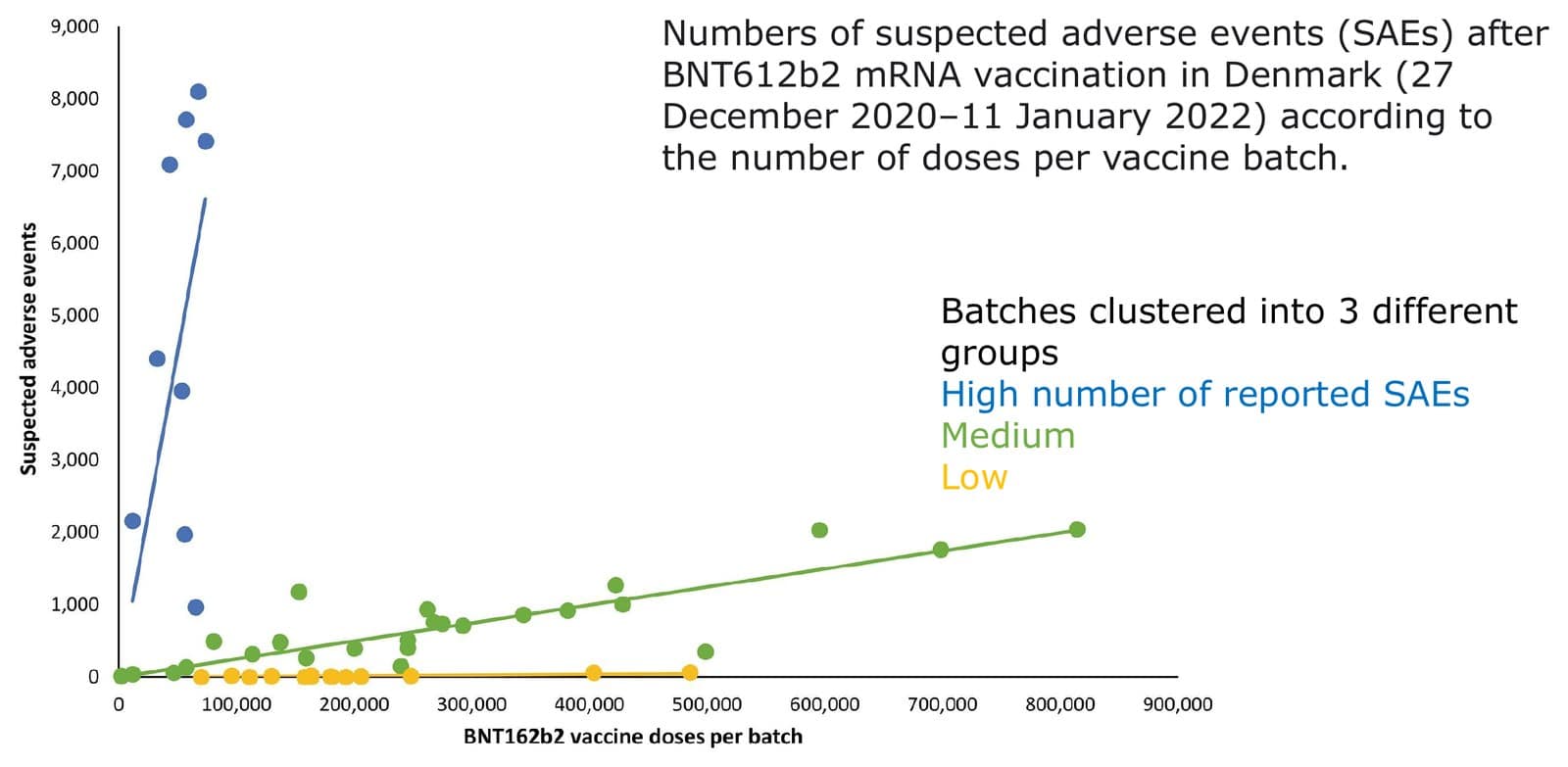
Danish batch clusters, from Dr. Manniche’s presentation.
The usual explanation is that the early batches went to the elderly. Dr. Manniche says most went to frontline workers such as doctors, nurses, and police officers.
Replicated in Sweden and Germany
One country’s data could hide a local quirk, so the team repeated the analysis in Sweden and Germany.
The team’s 2024 study of Sweden, which also relied mainly on Pfizer, found the same clusters across 112 batches.
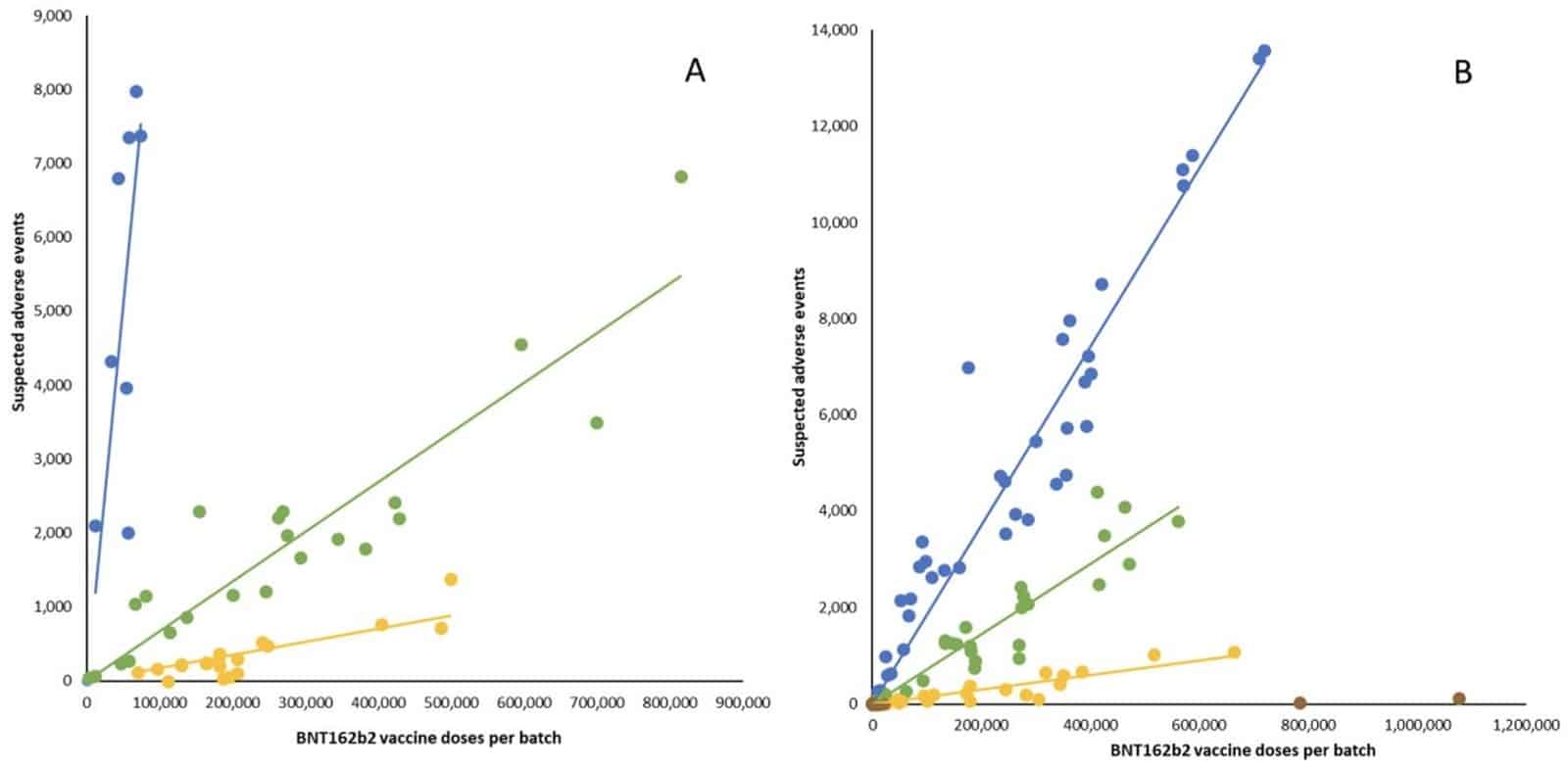
Suspected adverse events per Pfizer batch in Denmark (A, December 2020 to January 2022) and Sweden (B, December 2020 to January 2024). Each dot is one batch.
In the batches both countries used, reports of every severity, including deaths, peaked early in the rollout. Sweden also showed something new: three of every four reports came from women, more than reports of bleeding disturbances can explain, Dr. Manniche says.
Germany’s public data doesn’t break out batches, so the team’s 2026 study tracked weekly report rates for Pfizer, Moderna, and AstraZeneca. For all three, rates peaked at the start of the rollout and fell steeply within months, and women again filed most of the reports, 72% of them.
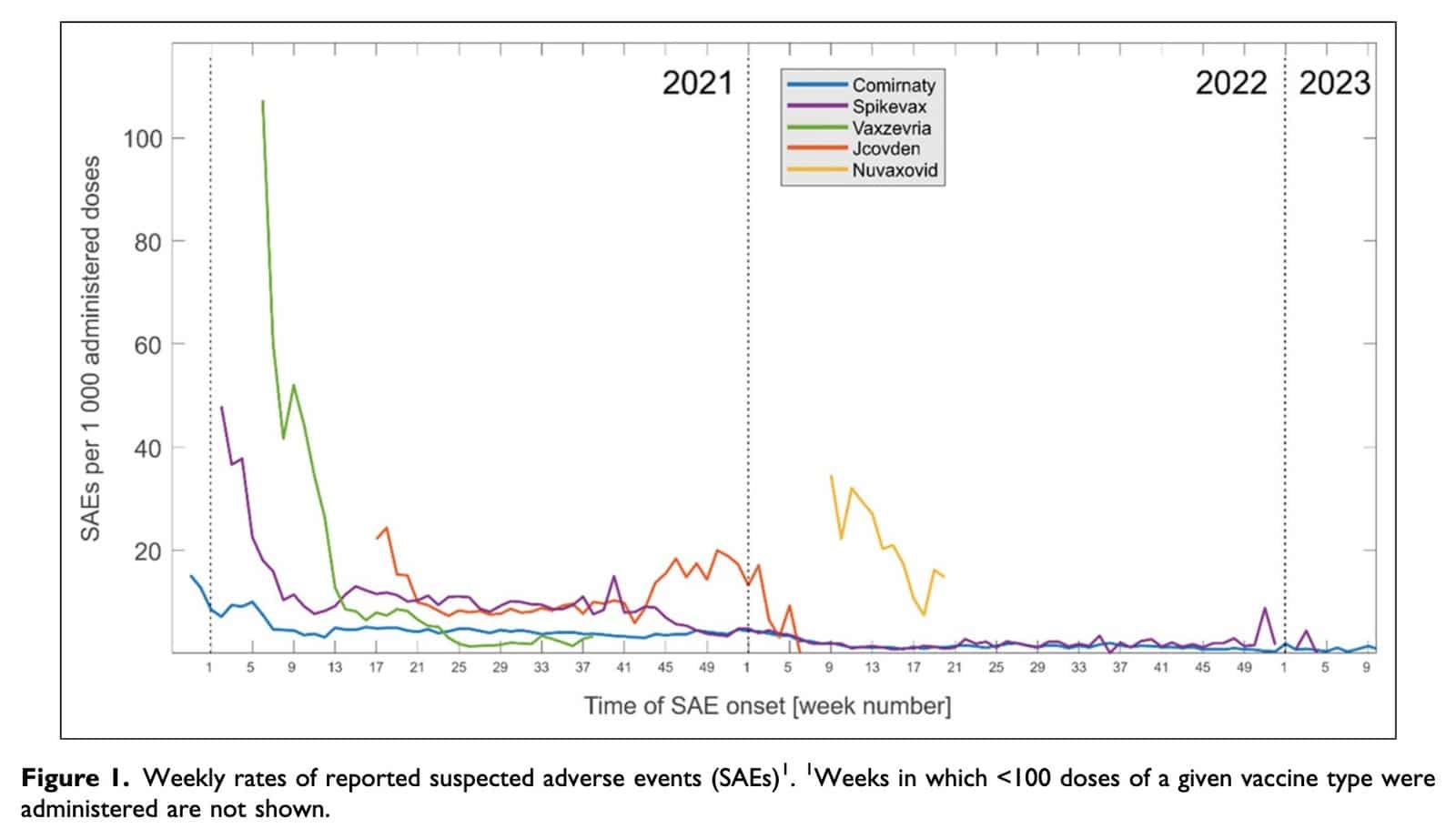
Comirnaty is Pfizer’s vaccine, Spikevax is Moderna’s, and Vaxzevria is AstraZeneca’s.
A Czech study (Fürst, 2024) and a U.S. study (Jablonski and Hooker, 2024) found the same trend.
Dr. Cole raised the standard objection: a report filed after a shot doesn’t prove the shot caused the problem. Dr. Manniche agrees her studies can’t prove causation on their own. After this many replications, though, she points to the vials and how they were handled:
“So something odd was with these vials or these batches, or the way of transportation.” — Dr. Vibeke Manniche
Why Batches Might Differ
What could make batches of the same vaccine so different? Dr. Manniche points to a line from Kathrin Jansen, a former Pfizer senior vice president over vaccine research and development, in a 2022 interview with Nature Reviews Drug Discovery:
“We flew the aeroplane while we were still building it.” — Kathrin Jansen
To Dr. Manniche, the batch data shows the product changing along the way. Her slides list the suspects:
- Rapid upscaling: quality problems as manufacturing ramped up
- The contents: too much mRNA, or contamination with DNA
- Storage and transport: vials had to be kept at −70°C at launch, a rule she recalls being relaxed within weeks
- Administration: how the shot went into the arm
Dr. Cole points to a patent held by Moderna CEO Stéphane Bancel that says the product must be clean of residual DNA, which can disturb the innate immune system and can be carcinogenic. Independent labs have since confirmed DNA contamination, he says, in early batches and in the bivalent boosters.
If the risk fell as the product changed, her slides ask, what happened to efficacy? “Did it end up just being saline?” Her verdict on the rollout:
“And I would say they were building the airplane while flying, and it crashed.” — Dr. Vibeke Manniche
Why Nothing Happened
Once the Swedish data showed women hit hardest, Dr. Manniche expected authorities to pause the rollout. “But nothing happened.” Pfizer, she says, never responded to any of the studies; in her view, the company already knew from its own August 2021 safety report to the European Medicines Agency:
“So we have a report from Pfizer where they themselves report to EMA… that some batches give many more side effects than others. And that’s exactly what we have shown.” — Dr. Vibeke Manniche
The silence went well beyond Pfizer:
- The data: Danish authorities “harassed” her team as it sought the data, and the team has been denied access to data from Statens Serum Institut (SSI).
- The press: no outlet covered the Danish study, yet Altmetric ranks it #375 of the more than 34.5 million research outputs it has tracked.
- The recalls: findings like these “would normally have led to safety reviews and product recalls,” as her slides put it. Here, the rule has been “don’t even mention the jab.”
Fear plays a part too. Nine in 10 Danish adults had at least one shot, and many, including doctors who gave it to their own children, are afraid to look.
“You can read it in their eyes. They are really frightened. Oh my God, did I take one of those nasty jabs?” — Dr. Vibeke Manniche

What Would Settle It
For Dr. Manniche, settling the question starts with independent scientists who can test stored vials from earlier batches, from the U.S. to Europe and Australia.
“And I think that the public deserves to have an answer.” — Dr. Vibeke Manniche
Beyond the vials, she wants:
- Open data: U.S. data is big enough to catch rarer signals such as myocarditis and ALS, and her team shares its own de-identified data with anyone who asks.
- Studies by disease: starting with myocarditis, “the lowest hanging fruit,” then breast cancer and arrhythmia, using registers like Denmark’s.
- Cancer checks: in countries with registers, “a brave, courageous oncologist” could look up which batches young colon cancer patients received.
- Accountability: those in charge should answer for the harm, as the tobacco industry eventually had to.
Where can people who got the shots learn about their batch? “We’re not here to judge them,” Dr. Cole said, “but we are here to help.” Dr. Manniche mentions How Bad Is My Batch, one of several lookup sites working the same theme her studies build on, and her team’s studies list the batches too. She wants the checking done publicly, so doctors can prevent and treat the harm.
An Obligation to Continue
Dr. Manniche’s team has more coming. A study it has submitted for peer review shows, she says, a batch pattern in deaths from all causes within three months of a shot. Next come batch studies of myocarditis, colon cancer, and turbo cancers. Having the data and the knowledge, she says, creates an obligation to continue. Dr. Cole agreed that independent research is essential to clearer answers “for all of us and for the patients.”
Related Reading
- Peer-Reviewed Study: Batch-dependent safety of the BNT162b2 mRNA COVID-19 vaccine
- Peer-Reviewed Study: Reports of Batch-Dependent Suspected Adverse Events of the BNT162b2 mRNA COVID-19 Vaccine: Comparison of Results from Denmark and Sweden
- Peer-Reviewed Study: Batch-dependent safety signal: Nationwide analysis of suspected adverse events following COVID-19 vaccination in Germany
- Webinar: Turbo Cancers: Clinical Observations, Emerging Research, and Patient Care
- Webinar: DNA Inside COVID Shots: Independent Science Confirms What Regulators Ignored
- Treatment Guide: I-RECOVER: Post-Vaccine Treatment

More on: COVID-19 Vaccine | Dr. Ryan Cole | Dr. Vibeke Manniche | mRNA | Vaccine Batch Consistencies