✍️ By Lynne Kristensen, IMA Senior Director of Communications & International Fellowship Program, and Dr. Joseph Varon, IMA President and Chief Medical Officer
Introduction: What We Built and What We Lost Along the Way
The story of American medicine is not just the story of physicians, hospitals, discoveries, and institutions. It is also the story of the American patient: the mother caring for a feverish child at home, the family waiting for a doctor to arrive at their bedside, the patient consenting to a treatment they barely understood, and the individual trying to determine whom to trust when illness, fear, and uncertainty enter their life. Over the course of 250 years, medicine has repeatedly asked individuals to place their bodies, their families, and their futures in the hands of those who claimed to know what was best. Sometimes that trust was rewarded. Sometimes it broke.
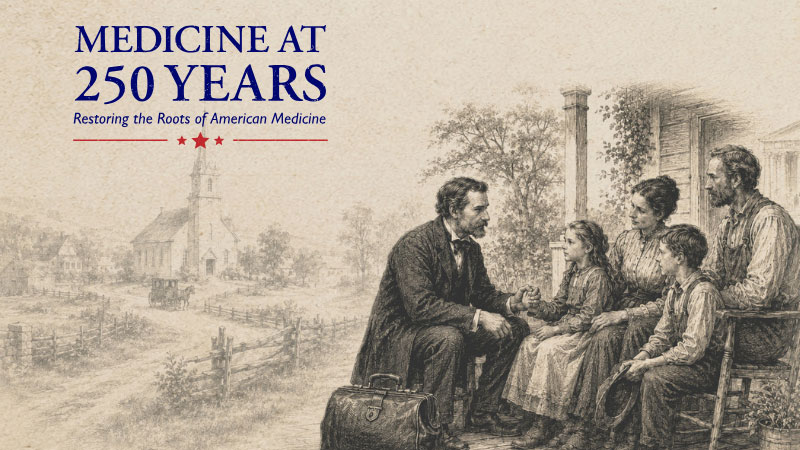
In 1776, medicine in America did not constitute a system. It was not even a profession in the contemporary sense. Rather, it was a calling: messy, imperfect, frequently ineffective, yet profoundly human. Physicians had limited means to offer. They performed bloodletting and purging, often relying on conjecture rather than knowledge. Nevertheless, they remained present and bore witness to suffering in its most unmediated form. That mattered.
For the average American, care often began not in a hospital, but in the home. Families relied on practical knowledge, local healers, midwives, home remedies, faith, observation, and, when available, the town physician. This is not to romanticize the past.
Much of early medicine was ineffective or harmful. Yet there was something embedded in that earlier model that modern medicine should not dismiss too easily: care was personal, familiar, and rooted in the lived reality of the patient. The physician entered the patient’s world, not the other way around.
Over time, that simplicity was replaced by increasing sophistication. The field developed machines capable of supporting respiration, pharmaceuticals that rapidly cure infections, and systems that monitor nearly every biological signal in real time. However, if we are candid, we must confront a difficult question: Did we gain everything, or did we sacrifice something essential in the process?
From the patient’s perspective, the gains have been extraordinary. Americans today have access to interventions that previous generations could not have imagined. But progress also brought distance. The bedside became the exam room, then the hospital system, then the insurance network, then the electronic portal. Patients gained access to extraordinary technology, but many lost time, continuity, and the sense that their physician truly knew them. Too often, the individual became a diagnosis, the diagnosis became a code, and the code became a pathway.
This essay does not advocate for nostalgia or regression. My career in intensive care units has involved utilizing every tool modern medicine provides. I have witnessed outcomes that would have been inconceivable a century ago. Yet, I have also observed another dimension. I have witnessed the consequences when medicine loses sight of its foundational purpose.
That foundational purpose is not merely to treat disease. It is to serve the person who carries it. At its best, medicine honors both science and conscience, both evidence and judgment, both innovation and humility. It protects informed consent, preserves the doctor-patient relationship, and recognizes that no protocol can fully replace the moral responsibility of a physician sitting across from a patient and asking, “What is best for this person, in this moment?”
The Good: When Medicine Changed the Fate of Humanity
There is no denying what American medicine has accomplished. The Flexner Report in 1910 forced a long-overdue reckoning. (1) It shut down inadequate training programs and imposed scientific rigor on a field that desperately needed it. Medicine stopped being an apprenticeship of tradition and became a discipline grounded in evidence.
Then came antibiotics. When penicillin entered clinical use, it did not just treat infection, it redefined expectations. (2) Diseases that had killed without mercy suddenly became manageable. Entire hospital wards emptied.
The polio vaccine did something even more powerful: it restored hope. (3) Parents who had lived in fear of paralysis watched their children grow up without it. That is not just science. That is liberation.
Cardiac surgery. Organ transplantation. Mechanical ventilation. These were not incremental advances. These were leaps, moments when medicine crossed lines that once seemed permanent. (4–6)
Life expectancy rose. Survival improved. Entire categories of disease lost their dominance. (7) And in the ICU, my world, we learned how to hold life at the edge and, sometimes, pull it back. That is the good. And it is real.
The Bad: When Progress Came Without Guardrails
However, progress that advances too rapidly or without humility can result in significant harm. Tuskegee was not a mistake. It was a decision. (8) For forty years, men were observed instead of treated. Not because we did not know what to do, but because someone decided not to do it. That distinction matters.
Thalidomide taught us another lesson: that safety is never guaranteed, and that oversight is not optional. (9)
Then came opioids. An initial effort to treat pain more aggressively evolved into a broader crisis. The boundaries between marketing and medicine became indistinct, prescribing patterns changed, and widespread dependency developed before the full implications were understood. (10,11) We still have not recovered from that.
And then came COVID-19. I will address this point directly. We were not just dealing with a virus. We were dealing with a system under stress, and that system did not always respond in a way that reflected the best traditions of medicine. Early uncertainty was expected. That is the nature of a novel disease. What was harder to accept was what followed.
Guidelines changed, sometimes appropriately, sometimes without clear explanation. Treatments were embraced, then dismissed. Questions were raised—and too often shut down instead of explored.
Science, at its core, depends on disagreement. It depends on tension. It depends on people saying, “I am not convinced, show me more.” At times during the COVID-19 pandemic, that process appeared constrained. There was a growing sense, among many clinicians, that decisions were not always being driven solely by evolving evidence, but by forces adjacent to it. And when that perception takes hold, trust begins to erode. We implemented policies with enormous consequences, lockdowns, isolation, delayed care, without fully understanding the downstream effects. (12,13) We have personally observed these effects. Patients who came in too late. Diseases that progressed due to deferred care. Families who never had the chance to say goodbye. Those are not statistics. Those are people. And we need to be honest about that.
The Ugly: What We Have Seen with Our Own Eyes
This is the part that is hardest to write, and the hardest to read. Because it is not about history. It is about now. Medicine today is extraordinarily capable. But it is also, in many places, profoundly impersonal. Physicians are exhausted. Not just tired, drained. (14) Patients feel it. They sit in rooms where the computer gets more attention than they do.
In the intensive care unit, where circumstances become acute rapidly, we have witnessed moments that remain indelible. We remember one patient during COVID. He was not particularly old. He was not ready to die. He was alone. No family. No familiar voices. Just alarms, tubing, and a team covered head to toe in protective equipment. We remained at the bedside longer than was strictly necessary. Not because another intervention was available, but because departing felt ethically inappropriate. At one point, we found ourselves reflecting: This is not how this process is intended to unfold. Medicine is not supposed to look like this. And yet, for a period, it did. This is what I refer to as the ‘ugly’ aspect. It is not the absence of knowledge, but rather the absence of humanity.
Where We Stand: A System That Can Do Almost Anything
We are now in an era where medicine can do things that border on science fiction. Artificial intelligence can assist in diagnosis. Genomics can guide therapy at the molecular level. Wearables can monitor physiology continuously. (15) Nevertheless, there remains a sense that something is amiss. Trust is uneven. (16) Costs are rising beyond reason. (17) Physicians feel less autonomous than ever. We have built an incredibly powerful system. However, power that lacks clarity poses significant risks. So, we have to ask again: What is the purpose of medicine? Not in theory. In practice.
From the patient’s lens, this question is not abstract. It is felt in the waiting room, in the exam room, at the pharmacy counter, and at the hospital bedside. Patients today have access to more information than any generation before them, yet many feel less certain about whom to trust. They are told to follow the pathway, accept the protocol, comply with the recommendation, and move through a system that often leaves little room for their questions, values, histories, or instincts. Families are not rejecting medicine when they ask for clarity, transparency, or alternatives. They are asking medicine to remember that informed consent is not a formality, trust is not automatic, and the person seeking care is not merely the recipient of a decision made by bureaucrats.
How We Get Better: Not Forward, But Back to Center
The solution is not to abandon progress. It is to rebalance it. We suggest:
- Put the Patient Back at the Center. Not the system. Not the metric. Although this appears straightforward, it is not, as the prevailing forces in modern healthcare often act in opposition to one another.
- Protect Clinical Judgment. Protocols matter. Evidence matters. But so does experience. So does context. A physician’s role cannot be reduced to a checklist.
- Fix the Incentives. You get what you reward. Right now, we reward volume, documentation, and compliance. We should be rewarding outcomes, clarity, and trust.
- Use Technology. Do Not Worship It. AI will help us. Genomics will help us. However, neither can substitute for the insight gained when a physician engages directly with a patient and perceives unspoken concerns.
- Tell the Truth (even when it is inconvenient). Medicine must be honest again. About uncertainty. About mistakes. About limits. Trust does not come from being right all the time. It is derived from authenticity.
Conclusion: Returning to the Roots of American Medicine: The Next 250 Years Must Restore Trust, Truth, and Put the Patient Back at the Center
The next chapter of American medicine must be measured not only by what we invent, but by what we restore. We must reestablish the patient as an active participant, not a passive recipient. We must restore the physician as a healer and advocate, not merely a functionary of systems, algorithms, institutions, or incentives. We must restore informed consent as a living principle, not a signature on a form. And we must restore the trust that is created when truth is spoken plainly, uncertainty is acknowledged honestly, and care is guided by the individual person in front of us.
If the past 250 years have taught us anything, it is that medicine is at its best when knowledge is joined with humility, skill is joined with conscience, and progress is combined with humanity. The future will require innovation, but it will also require courage: the courage to question, to listen, to individualize, to admit when we have been wrong, and to protect the sacred relationship between physician and patient from every force that seeks to reduce it.
The next 250 years of medicine in America will not be saved by technology alone; they will be saved by physicians willing to tell the truth, patients powered to ask questions, and a profession courageous enough to place the human being back at the center of care.
References
- Flexner A. Medical Education in the United States and Canada. New York: Carnegie Foundation; 1910.
- Fleming A, Chain E, Florey HW, et al. Penicillin as a chemotherapeutic agent. Lancet. 1940;2:226–228.
- Salk JE, Francis T Jr, Francis J, et al. Evaluation of poliomyelitis vaccine. JAMA. 1955;158(14):1239–1254.
- Gibbon JH, Spencer FC, Bahnson HT, et al. Application of mechanical heart and lung apparatus. Ann Surg. 1954;140(3):343–351.
- Starzl TE, Marchioro TL, Vonkaulla KN, et al. Homotransplantation of the liver. Surg Gynecol Obstet. 1963;117:659–676.
- Safar P, Dekornfeld TJ, Pearson JW, et al. Artificial ventilation and ICU origins. Anesthesiology. 1961;22:459–474.
- Arias E, Xu J, Tejada-Vera B, et al. United States life tables. Natl Vital Stat Rep. 2022;71(1):1–63.
- Jones JH, Smith J, Brown P, et al. The Tuskegee syphilis study revisited. N Engl J Med. 1993;329:681–686.
- Vargesson N, Mahadevan R, Smith K, et al. Thalidomide embryopathy mechanisms. Birth Defects Res. 2015;105(2):140–156.
- Kolodny A, Courtwright DT, Hwang CS, et al. The opioid epidemic. Annu Rev Public Health. 2015;36:559–574.
- Relman AS, Angell M, Kassirer JP, et al. The health care system crisis. N Engl J Med. 2002;346:1715–1717.
- Funk C, Kennedy B, Tyson A, et al. Trust in medical scientists has grown in U.S., but mainly among Democrats. Pew Research Center. 2020.
- Martin AB, Hartman M, Washington B, et al. National health care spending in 2021. Health Aff (Millwood). 2023;42(1):1–10.
- Shanafelt TD, West CP, Sinsky C, et al. Physician burnout trends. Mayo Clin Proc. 2022;97(3):491–506.
- Topol EJ, Steinhubl SR, Torkamani A, et al. Digital medicine transformation. Lancet. 2015;386:1775–1787.
- Haug N, Geyrhofer L, Londei A, et al. Ranking the effectiveness of worldwide COVID-19 interventions. Nat Hum Behav. 2020;4:1303–1312.
- Czeisler MÉ, Lane RI, Petrosky E, et al. Mental health during COVID-19 pandemic. MMWR Morb Mortal Wkly Rep. 2020;69:1049–1057.