
Host: Dr. JP Saleeby | Guest: Josh Dech
What if Crohn’s disease and ulcerative colitis are caused by more than genetics alone?
Dr. Yusuf “JP” Saleeby, IMA Senior Fellow in Functional and Integrative Medicine, and gut health specialist Josh Dech take a closer look at what may contribute to inflammatory bowel disease, also known as IBD. The two recently co-authored a new paper published in the Journal of Independent Medicine. Their conversation traces how genetics, diet, gut health, and the environment may work together to shape both diseases.
Inflammatory bowel disease affects more than 7 million people worldwide and ranks among the fastest-growing chronic diseases globally. Nearly everyone diagnosed with Crohn’s disease or ulcerative colitis hears some version of the same three things: the disease is genetic, the immune system is attacking its own tissue, and the underlying cause is unknown. Those three explanations leave two treatments on the table, drugs and surgery, and they leave a patient nothing to investigate.
A new paper in the Journal of Independent Medicine argues that all three explanations fail against current evidence. Josh Dech and Dr. JP Saleeby, its co-authors, point out that each has been contested separately in the literature for two decades without anyone testing them as a set. Taken together, they conclude, the conventional model does not hold.
What replaces it is a disease that is partially heritable, environmentally activated, and immune-mediated, and the distinction is not academic for anyone living with one. If exposures determine whether susceptibility becomes disease, exposures can be found and changed.
Meet the Experts

Josh Dech
Gut health specialist, The Gut Health Solution, Calgary. Lead author of the paper. He works with Crohn’s and ulcerative colitis cases and hosts the podcast Reversing Crohn’s and Colitis Naturally. More of his work is at The Gut Health Solution, on YouTube, and on Facebook.

Yusuf “JP” Saleeby, MD
IMA Senior Fellow, Functional and Integrative Medicine. Co-author of the paper. He is medical director of Carolina Holistic Medicine in South Carolina, and his clinical work centers on mold and mycotoxin illness, tick-borne infections, and chronic inflammatory conditions.
📖 Read and Download the Full Paper
Inflammatory Bowel Disease Is Not Genetically Determined, Not Classically Autoimmune, and Not Idiopathic: A Critical Reframing of Pathogenesis
Journal of Independent Medicine, Vol. 2, No. 4, 2026. Authors: Josh Dech and Yusuf JP Saleeby.
👉 Visit the Journal of Independent Medicine to create a free account and download the full article.
1. What the Strongest Crohn’s Risk Gene Actually Predicts
Pooled heritability for IBD comes to roughly 0.25, which the authors read as genetics explaining about a quarter of disease risk across a population rather than settling the matter in any one person. The more than 240 risk loci turned up by genome-wide association studies explain only about 13% of Crohn’s heritability and 8% of ulcerative colitis heritability. Three quarters of the picture sits somewhere else.
NOD2 is where that gets concrete. Compound heterozygous and homozygous carriers hold the highest Crohn’s risk profile known to science, and between 60% and 80% of them never develop the disease. The conditions medicine genuinely calls genetically determined behave nothing like this. Huntington’s disease and cystic fibrosis run at or near full penetrance: carry the genotype, develop the disease. Crohn’s has been explained to patients in the same language as those diseases for years while behaving like something else.
Three further lines of evidence say the same thing from different angles:
- Twin cohorts in Sweden and Germany found monozygotic concordance of 20% to 50% for Crohn’s and 10% to 19% for ulcerative colitis. Identical DNA, divergent outcomes.
- Population cohorts in Canada and Denmark found that children of immigrants from low-incidence countries develop IBD at host-population rates within a single generation, a window far too short for population genetics to shift.
- Prevalence has compounded in early industrialized countries from roughly 2 to 4 per 100,000 in the 1950s to 721 per 100,000 in the United States today.
“What this tells us is that genes, they create susceptibility. They don’t create disease.” — Josh Dech
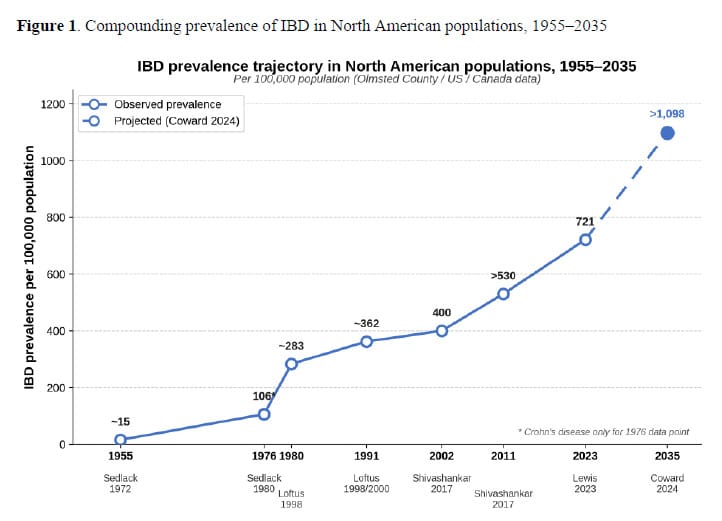
Compounding prevalence of IBD in North American populations, 1955–2035. Source: Dech and Saleeby, Journal of Independent Medicine.
2. What the Antibodies Are Actually Pointing At
Autoimmunity is a technical claim with a bar attached, set by Rose and Bona in 1993. It takes three tiers of evidence: pathogenic transfer reproduces the disease in a naive recipient, a defined autoantigen reproduces it in animals, and circumstantial markers such as HLA associations are present.
Myasthenia gravis and Graves’ disease clear the demanding tiers, which is why nobody argues about them. IBD clears only the circumstantial tier, the same tier occupied by tennis elbow and every other chronic inflammatory injury. The autoimmune label, they argue, has held for decades on the weakest evidence the framework allows.
“Autoimmunity, the immune system is aiming at your tissue, like a sniper rifle locked onto a target. In immune-mediated diseases, it’s aiming around the tissue, and the tissue takes damage from being too close.” — Josh Dech
Pathogenic transfer of IBD has never been demonstrated. Where animal models do produce colitis, the trigger is barrier disruption, dysbiosis, or disrupted regulatory immunity rather than a defined autoantigen. The paper treats that as a real failure of the criterion, not a technical limitation.
Then comes the sharpest finding in the pillar. The serologic markers long cited as evidence of IBD autoimmunity turn out to recognize microbial and fungal targets:
- ASCA recognizes mannan, a fungal cell-wall glycan
- Anti-OmpC and anti-CBir1 target outer membrane porin C from E. coli and commensal bacterial flagellin
- Anti-glycan ALCA, ACCA, and AMCA target carbohydrate epitopes of fungal cell walls
None of them, the authors conclude, are autoantibodies in the classical sense. Which is their point: patients have spent years being told their immune system attacks their own tissue, while the antibodies cited as evidence read fungal cell walls and E. coli. And as Dech pointed out, improving on immunosuppression settles nothing either way. A sunburn cools down under topical cortisone too.

3. What Accumulates
Ruling out determinism does not identify a cause, which is where the third label, in their reading, starts to look less like a finding than an admission. Drawing on an umbrella review of 53 meta-analyses across 71 risk factors, the paper assembles a panel of exposures that are quantified and, more to the point, modifiable:
- Antibiotic exposure: OR 1.74 for Crohn’s, ranging from 1.7 to 2.8 depending on timing and drug class
- Oral contraceptives: OR 1.28 to 1.46
- Breastfeeding: protective at 0.67 for Crohn’s and 0.77 for colitis, though a recent multi-cohort analysis found no association with duration alone
Ultra-processed food intake carries significant association with increased IBD risk and promotes dysbiosis alongside altered ATG16L1 and IRGM expression. Air pollution and psychological stress fill out the confirmed panel, with Mendelian randomization supporting causal inference for pollution.
None of that arrives in a patient’s life as a table of odds ratios.
“We have to look at the body like a cup of water. Over all the years, what are the things that filled your cup until it finally was ready to overflow?” — Josh Dech
Mold and mycotoxins sit in a different evidence class, and the paper says so plainly: no meta-analysis quantifies the relationship to IBD onset, and the authors label their own analysis hypothesis-generating. The support is mechanistic convergence. Deoxynivalenol and ochratoxin A drive Th17 and Th1 differentiation and compromise barrier integrity, CARD9 is a top IBD risk locus governing antifungal immunity, and the anti-glycan antibodies from the serologic panel are fungal responses themselves.
“We’re talking mycotoxins, those chemicals. They’re almost like forever chemicals. They can’t be destroyed very easily.” — Dr. JP Saleeby
4. Where Medication Fits
Nothing in the environmental model argues against drug therapy. Dech described clients at fifty bowel movements a day, wearing diapers, keeping buckets in the car, and one man at five foot nine and ninety-nine pounds who was started on Rinvoq because the inflammation in front of him was the emergency.
The paper also explains why those drugs work without the disease being autoimmune. The pathways that mycotoxins, chronic stress, dysbiosis, and ultra-processed diet activate are the same pathways existing therapies target, Th17 and TNF-alpha among them. Suppressing them relieves the inflammation. It does not locate what switched them on, and since prednisone came into use in 1955, Dech argues, the field has largely kept asking the first question, which is why a patient asking what caused this still tends to leave without an answer.
Dech’s objection concerns duration rather than category. Acute treatments get applied indefinitely.
“They complement, but the drug model ignores the environmental model.” — Josh Dech
Under the immune-mediated reframing, the goal shifts from suppressing self-reactivity to restoring tolerance to luminal antigens, which makes barrier repair, microbiome restoration, and trigger removal primary interventions rather than additions to a drug regimen. Both authors pointed to history a clinician can take alongside a standard workup:
- Birth mode and feeding history
- Early antibiotic courses, particularly before age five
- Water damage and mold exposure at home, at work, and in vehicles
- Adolescent diet, stressors, and infections
Dr. Saleeby’s published case report describes one patient that kind of investigation reached: a 14-year-old whose Crohn’s had progressed far enough that surgeons planned to remove most of his intestines and place a colostomy. Testing pointed to chronic Lyme disease as the suspected trigger, and three months into treatment a repeat scope found no lesions. A single published case establishes no protocol, and he offered it as a reason to keep infection on the differential.
Both authors were candid about the failure mode on their own side of the aisle: handing a patient twenty supplements to manage symptoms indefinitely reproduces the problem they are describing.
“So you go from pharmaceutical polypharmacy to nutraceutical polypharmacy.” — Dr. JP Saleeby
A Weak Link Doesn’t Break Itself
The paper closes on what its reframing offers a patient in an exam room: genes raised the risk, environmental exposures activated it, and the immune system is reacting to microbial and environmental antigens in the gut rather than attacking the body. Every clause points at something to do, which is exactly what the three labels foreclose. It also lets a parent set down the belief that they handed their child an unavoidable disease, a belief the determinist framing manufactured and the evidence never warranted. Scaled up, the authors argue, the same logic becomes antibiotic stewardship, breastfeeding support, reducing ultra-processed food, and remediating indoor mold, a prevention agenda unreachable for as long as the disease is called inherited, self-directed, and unexplained.
“A weak link doesn’t break itself. And with the right approach, you can find out what did.” — Josh Dech