
Host: Dr. Kat Lindley | Guest: Dr. Kimberly Biss
Why are so many couples struggling to conceive, and what can fertility tell us about whole-body health? For many, the path to pregnancy is getting longer and more confusing. But fertility is not just about reproduction. It can be one of the clearest signals that the body needs deeper support.
Host Dr. Kat Lindley is joined by Dr. Kimberly Biss for a hopeful, practical conversation on infertility, declining birth rates, and the many factors that shape reproductive health in both women and men.
Birth rates in the United States are in decline, down roughly 23% since 2007. The most alarming reason is the one nobody wants to say out loud: more and more people who want children can’t get pregnant. The problem is reaching crisis levels. For the first time in modern history, deaths now outnumber births in America.
Dr. Kimberly Biss joins host Dr. Kat Lindley to have the conversation so few health experts are having. An OB-GYN with three decades in practice, Dr. Biss walks through what infertility really means, what drives it in both women and men, and what she started seeing in her own exam room after 2021.
Meet the Experts

Dr. Kimberly Biss, MD
Senior Fellow, Obstetrics and Gynecology, IMA. An OB-GYN with three decades caring for women and families, she focuses on patient safety, informed consent, and a close reading of reproductive and pregnancy data. She was appointed to the ACIP committee that advises the CDC on childhood vaccines.

Dr. Kat Lindley, DO, FACOFP
Director of the IMA Fellowship Program; Senior Fellow, Family Medicine. A family physician who hosts IMA’s weekly conversations, she brought both clinical and personal perspective to this one.
1. A Crisis Hiding in the Birth Data
Just how bad is the fertility crisis in America? Here are the numbers:
- The US general fertility rate has fallen to 53.1 births per 1,000 women aged 15 to 44
- Births totaled roughly 3.61 million in 2025, down about 23% since 2007
- Births are down 5.7% since 2021 alone
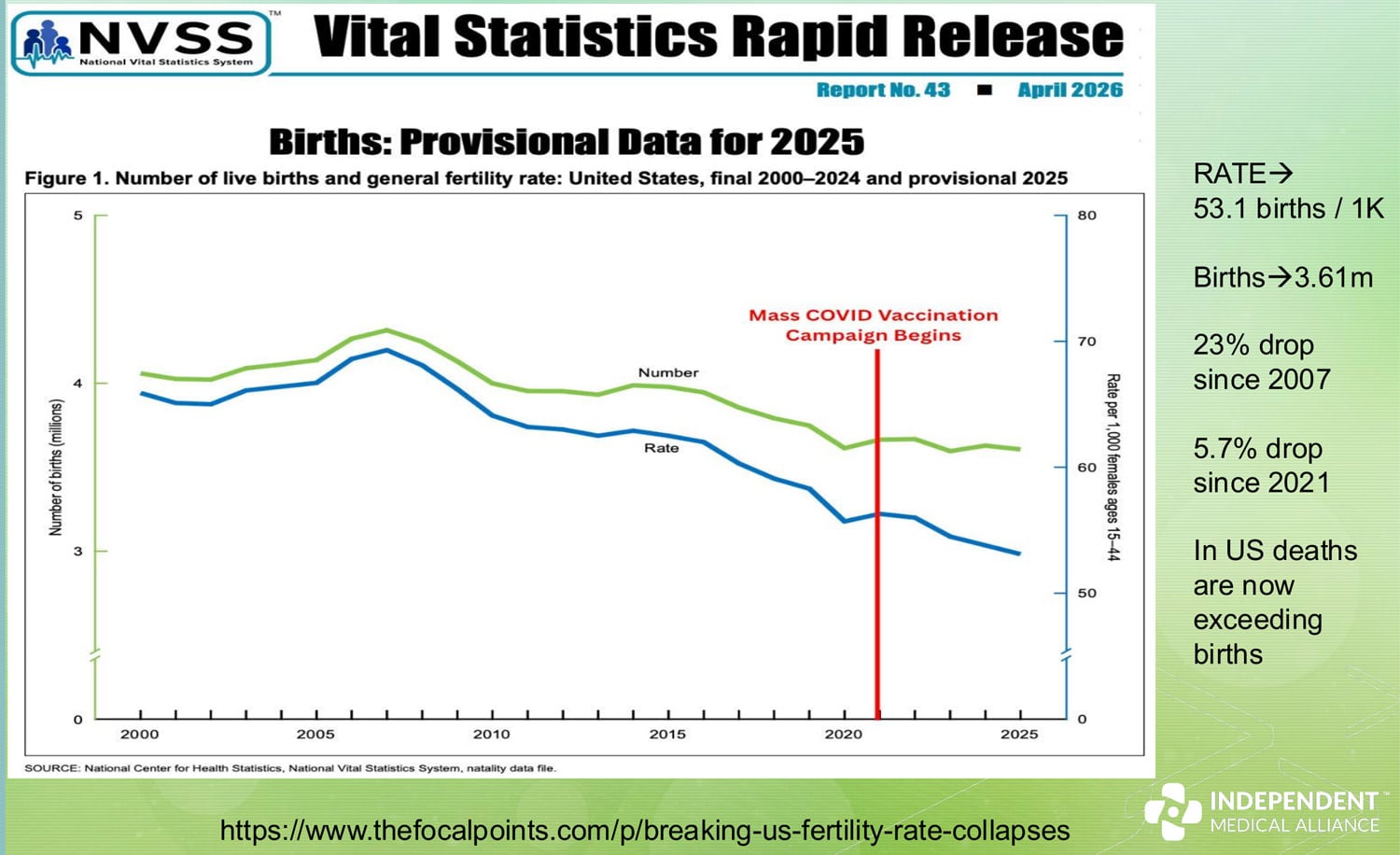
“Our births are not exceeding our death rates. So the United States of America now is starting to depopulate.” — Dr. Kimberly Biss
2. What “Infertility” Actually Means
Infertility is defined as no pregnancy after 12 months of trying for women under 35, or six months for women over 35.
The cause is split far more evenly than most couples expect:
- About a third of cases trace to female factors
- About a third trace to male factors
- Roughly 20% involve both partners
- The rest stay unexplained even after a full workup
One thing that struggling couples can find surprising: it takes most people at least six months to conceive. Most people who feel like they are failing are really just early. Miscarriage is common too, and a single loss rarely predicts the next.
Dr. Kat Lindley addressed this early:
“Our goal tonight is to make the conversation practical, honest, and helpful, not fear-based, not shame-based.” — Dr. Kat Lindley
3. A Whole-Body Map of What Can Go Wrong
Fertility draws on the whole body: hormones, anatomy, metabolism, immune function, and the exposures of daily life, in both partners. You can’t reduce it to a single broken part or you may miss the cause.
Dr. Biss sorts the possibilities into five buckets: anatomical, systemic, genetic, lifestyle and exposures, and the genuinely unexplained.
“We’re also focused on our own organ system. We just can’t think out of the box sometimes.” — Dr. Kimberly Biss
In women, common causes include:
- The ovaries account for about a quarter of cases, through ovulatory dysfunction or diminished reserve
- Blocked or damaged fallopian tubes account for roughly another fifth
- Fibroids, polyps, and structural anomalies of the uterus
- Endometriosis, present in around 15% of cases
PCOS is the most common ovulation issue, and it is rooted in metabolic and insulin health, not just the ovary. Age matters too. A baby girl is born with one to two million eggs, down from seven million before birth; that pool falls to about 300,000 by puberty, with roughly 12% left by 30 and around 3% by 40.
In men, the picture is similar:
- Testicular problems account for 70 to 80% of male cases
- Sperm quantity and motility both matter, and both can fall
- Heat is an underrated culprit: briefs, long bike rides, hot tubs
- A varicocele, a varicose vein in the scrotum, is a common and treatable cause
- Obesity, diabetes, and sleep apnea, all of which pull testosterone down
Dr. Biss is also seeing something unexpected in young men.
“It’s younger and younger men, they’re having extremely low testosterone, which I’ve never seen before.” — Dr. Kimberly Biss

4. The 2021 Question
Then there is the question Dr. Biss will not drop, even though most of her field steps around it. After the COVID-19 vaccine rollout, something changed in her own practice.
“Right after these injections started, women were having issues getting pregnant, even though prior to COVID or the injections they didn’t have any issues.” — Dr. Kimberly Biss
Many of those patients, she noted, ended up needing IVF to conceive. She points to a growing body of published research. Here are the key studies, strongest evidence first:
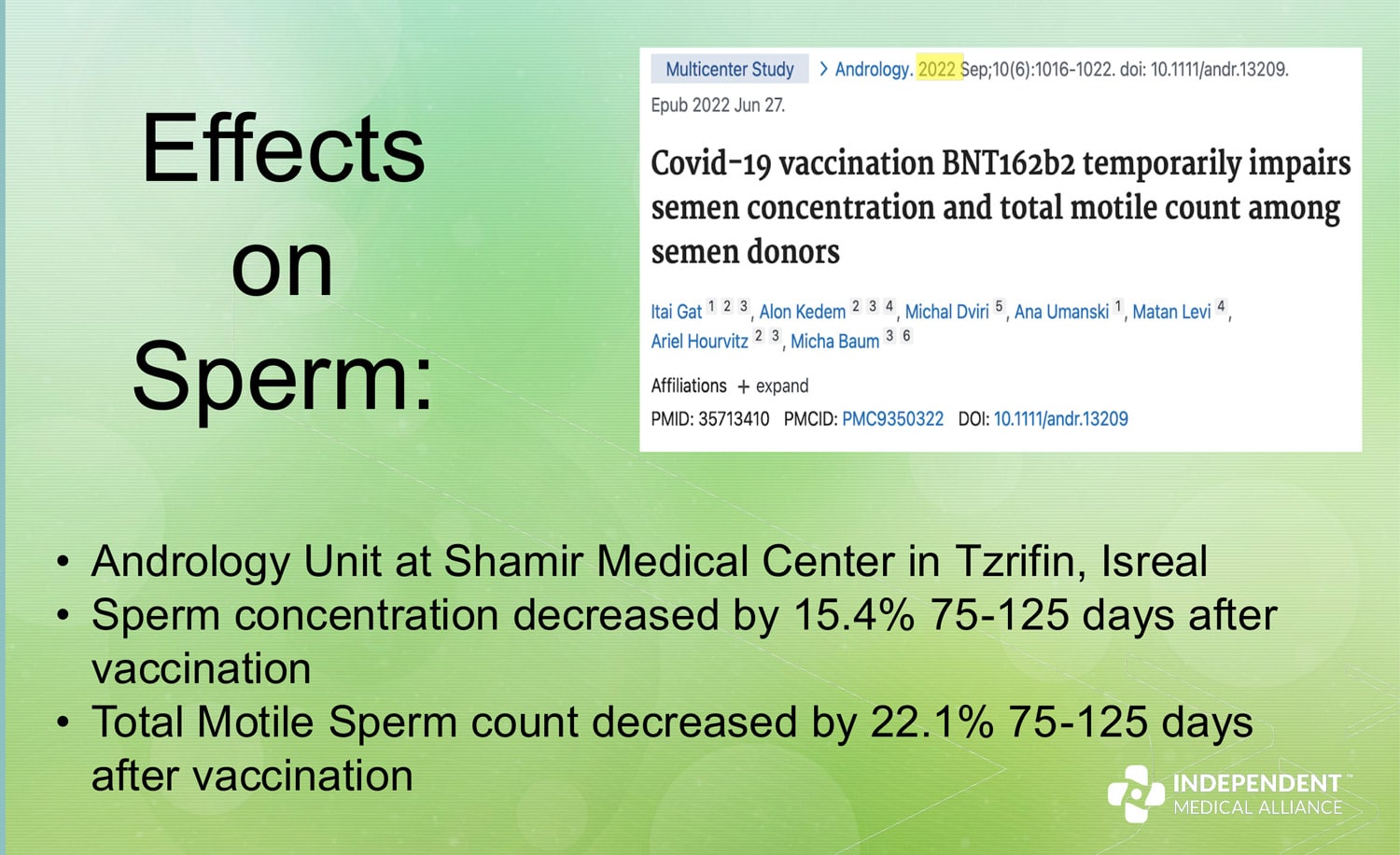
- Sperm: a 2022 study in Andrology (Gat and colleagues) reported sperm concentration down about 15.4% and total motile count down about 22.1% at 75 to 125 days after vaccination
- Ovarian reserve: a rat study by Karaman and colleagues reported abnormal AMH and a loss of more than 60% of primordial follicles after the mRNA product
- Conception rates: IMA Senior Fellow Dr. Vibeke Manniche’s analysis of Czech data found lower conception and live-birth rates among vaccinated women
- Biodistribution: Pfizer’s own rat data showed the vaccine’s lipid nanoparticles concentrating in the ovaries and testes, and later work reported vaccine mRNA reaching the placenta and cord blood
Dr. Biss also cited infant-mortality trends, though those come from less rigorous sources and she frames them as open questions, not conclusions.
These findings have, predictably, barely registered in mainstream medicine.
5. What You Can Actually Do
What does all of this mean for someone trying to conceive right now? Here’s what Dr. Biss and Dr. Lindley say:
- If you are under 35 and have been trying for a year, or six months at 35 and older, see a reproductive endocrinologist who evaluates both partners, not just the woman
- Timing beats any app or gadget. The fertile window runs roughly from cycle day 10 to 20, and having sex every single day can actually lower the odds, since sperm take 64 to 74 days to mature
- Treat AMH testing with care. It was built to predict how a woman will respond to IVF stimulation, not to tell a healthy woman she is running out of eggs
- Cover the whole-body basics: a healthy body composition, a Mediterranean-style diet, and less caffeine, alcohol, and tobacco
- Take the mental load seriously, because the stress of trying can work against a couple
A Reason for Hope
The whole-body lens changes the picture. Infertility, seen this way, gives a couple questions they can work through: what to test, who to see, what to change. The numbers are alarming at scale, but for any one couple, the path forward starts with finding clinicians who listen and asking the right questions. Dr. Lindley closed with this:
“Find healthcare professionals that are on the same page, that listen to you and your concerns, and don’t blame yourself.” — Dr. Kat Lindley
Related Reading
- Guide: Fertility and Nutrition: How a Fertility Diet Can Boost Your Chances
- Guide: Understanding Men’s Reproductive Health: Sperm Health, Testing, Nutrition, and Natural Support
- Post: How Everyday Chemicals Disrupt Your Hormones—and How Bioremediation Can Fight Back
- Webinar: The Urgent Call to Stop the mRNA Shots
- Post: Are COVID Vaccines Truly “Safe for Pregnancy”?
- Post: Why Doctors Oppose mRNA Shots for Kids & Pregnancy
- Video: An Honest Conversation on Vaccines and Pregnancy