
Host: Dr. Ryan Cole | Guest: Dr. Josef Witt-Doerring
Mental health care is undergoing a necessary rethink, led in part by physicians like Dr. Josef Witt-Doerring. In this episode of the IMA Weekly Show, Dr. Ryan Cole is joined by psychiatrist Dr. Josef Witt-Doerring, both IMA Senior Fellows, for an in-depth discussion on the forces shaping modern mental health care and what that means for patients moving forward.
They explore pharmaceutical involvement in mental health guidelines, ethical concerns surrounding informed consent, and the effects of screen time and emerging AI-based mental health tools. The conversation also addresses seasonal depression and mental health struggles common during winter months.
More people are medicated than ever. Children are turning to AI for emotional support. And in some countries, psychological suffering is being met with assisted suicide. Mental health care is undergoing a necessary rethink—and tonight’s conversation asks the central question: How did we get here, and what must change going forward?
IMA Senior Fellow Dr. Ryan Cole is joined by psychiatrist and former FDA medical officer Dr. Josef Witt-Doerring for an honest, wide-ranging discussion on the forces shaping mental health care today—from pharmaceutical influence on treatment guidelines to the rise of AI therapy bots, from screen time’s toll on developing brains to the ethical collapse represented by psychiatric euthanasia. They also address seasonal depression, the limits of the 15-minute visit, and why non-drug approaches remain underused despite strong evidence.
This isn’t about quick fixes. It’s about stepping back, asking deeper questions, and reclaiming an approach to mental health that puts patients before billing codes.
Meet the Expert

IMA Senior Fellow, Psychiatry. Former medical officer with the U.S. Food and Drug Administration. CEO and Medical Director of TAPER Clinic, the world’s most extensive medical practice dedicated to psychiatric deprescribing. Dr. Witt-Doerring advocates globally for transparency, informed consent, and meaningful reform in mental health care. For more of his work with IMA, check out Non-Drug Treatments for Depression and Anxiety.
How We Got Here: Diagnosis by Committee
Dr. Witt-Doerring’s path into psychiatric reform began with a simple observation: what he saw in training didn’t match what he expected at all.
“I had assumed that we would be spending time with our patients, understanding their lives and their health, and then helping them with non-drug approaches—and then using medications if we really needed to. But that’s not what I saw at all.”
Instead, he encountered 15-minute visits, symptom checklists, and an algorithmic approach to diagnosis. Five out of nine symptoms? You meet criteria for depression. Here’s a prescription.
“A lot of us think there’s a chemical imbalance or a genetic thing, and maybe one day we’ll find it. And so that’s the training right now—instead of understanding the multitude of things that make someone anxious and depressed.”
The deeper problem, he explains, is that psychiatry’s diagnostic categories aren’t grounded in biology at all. They’re voted on by committee:
“You dive into the history of psychiatry and you realize it’s just voted on. It’s just a bunch of psychiatrists that get together in a room and they say, ‘Well, what do you guys think depression is?’ And then someone says, ‘How about five symptoms?’ And someone else says, ‘What about six?’ And then they all agree, ‘Well, five sounds about right.’ It’s the same with every single condition.”
This matters because diagnoses should map to something real. They should help clinicians understand why a patient is unwell and predict what will help. The current system does neither.
“This diagnostic classification system serves everyone but the patients. It serves insurance companies because they need an operationalized way to categorize things for billing. It serves the pharmaceutical industry because in order to develop a drug, it has to be for a certain condition. And it serves doctors in our current model of care.”
The result is a system optimized for throughput, not healing.
Screens, Social Media & the AI Therapist Problem
The conversation turns to environmental factors—specifically, the role of screens and social media in the mental health crisis affecting younger generations.
Dr. Witt-Doerring frames the issue in two parts. First: lost time.
“On average, teenagers are spending three and a half hours on social media a day now. That’s three and a half hours where you used to be goofing off with your friends, exercising, sleeping, engaging with one another. A lot of people feel like watching social media is relaxing, but it really isn’t. It’s quite a stimulating activity. It does not rest the mind.”
Second: corrupted values.
“You get this impression that you have to be this wealthy, entrepreneurial guy with a nice car at these fancy parties—or if you’re getting content geared towards women, it’s about your looks and your beauty. We see a lot of these very superficial values coming out, which really make a lot of people feel less than.”
He draws a parallel to the decline in religious attendance, which peaked around 50% in the 1970s and now sits near 30%.
“When there was more religious service attendance, you would be getting different kinds of values—values that are attainable to everyone, not just the wealthy or the very attractive. Live a life in service of others. Wisdom. Charity. I think we’re losing that and we’re picking up all of this garbage.”
The newest frontier is AI companionship—chatbots offering therapy, friendship, even emotional intimacy. Dr. Witt-Doerring is blunt about the risks.
“AI just tends to be kind of an ass kisser. It’s designed to get you to keep engaging with it. A lot of times the AI will just go along with you instead of being like a real person who has skin in the game and might actually call you out and say, ‘Hey, I really think you’re actually the asshole in this situation.'”
The concern isn’t just bad advice. It’s retreat from life itself.
“I feel like ChatGPT and AI and engaging with these bots really just serves as a way to retreat from the world. And we don’t need that. We need to be pushed out there. We need to be engaging with people and overcoming difficult things. That’s the most important part of growing up—to be out there and make mistakes.”
Reports of AI chatbots encouraging self-harm in children only sharpen the concern. And as AI systems are approved to deliver basic medical care, including potentially psychiatric advice, the stakes rise further.
When the System Gives Up: MAID and the Ethics of Psychiatric Euthanasia
Perhaps the darkest manifestation of systemic failure is the expansion of medical assistance in dying (MAID) to include psychiatric conditions—a policy now active in Canada.
Dr. Witt-Doerring doesn’t mince words.
“We have people who are diagnosed with treatment-resistant depression and they’re told, ‘Hey, you’ve done ECT, you’ve done all these things, and really we don’t have anything else that can help you.’ And then the doctors will say, ‘We’ll sign off for this medical euthanasia because you have the right to die and we think you have this terminal psychiatric condition.'”
To some, this may sound compassionate. To Dr. Witt-Doerring, it’s the final stop on a dysfunctional conveyor belt.
“If you’re in my seat and you work with people who have drug injuries, I contend that the majority of people who are diagnosed with treatment-resistant depression are actually made worse by the drugs they’re on.”
The problem is compounded by a lack of long-term evidence. No psychiatric medication has been studied in a double-blind, placebo-controlled trial lasting longer than a year—yet 70% of patients remain on these drugs for two years or more.
“We’re using more drugs than ever before and the suicide rate continues to go higher and higher, almost perfectly tracking the two over the last 20 years. There seems to be very little appetite in mainstream psychiatry to contend with that issue. And we’re moving towards essentially killing people who don’t get better.”
The alternative? Slow down. Ask why the drugs aren’t working. Consider whether the drugs themselves are part of the problem.
“Let’s slow down and try and find out why this person is still ill—instead of saying, ‘Okay, fill out this stack of paperwork, get a reference from your doctor and a family member, and then in six months’ time you can take your life.'”
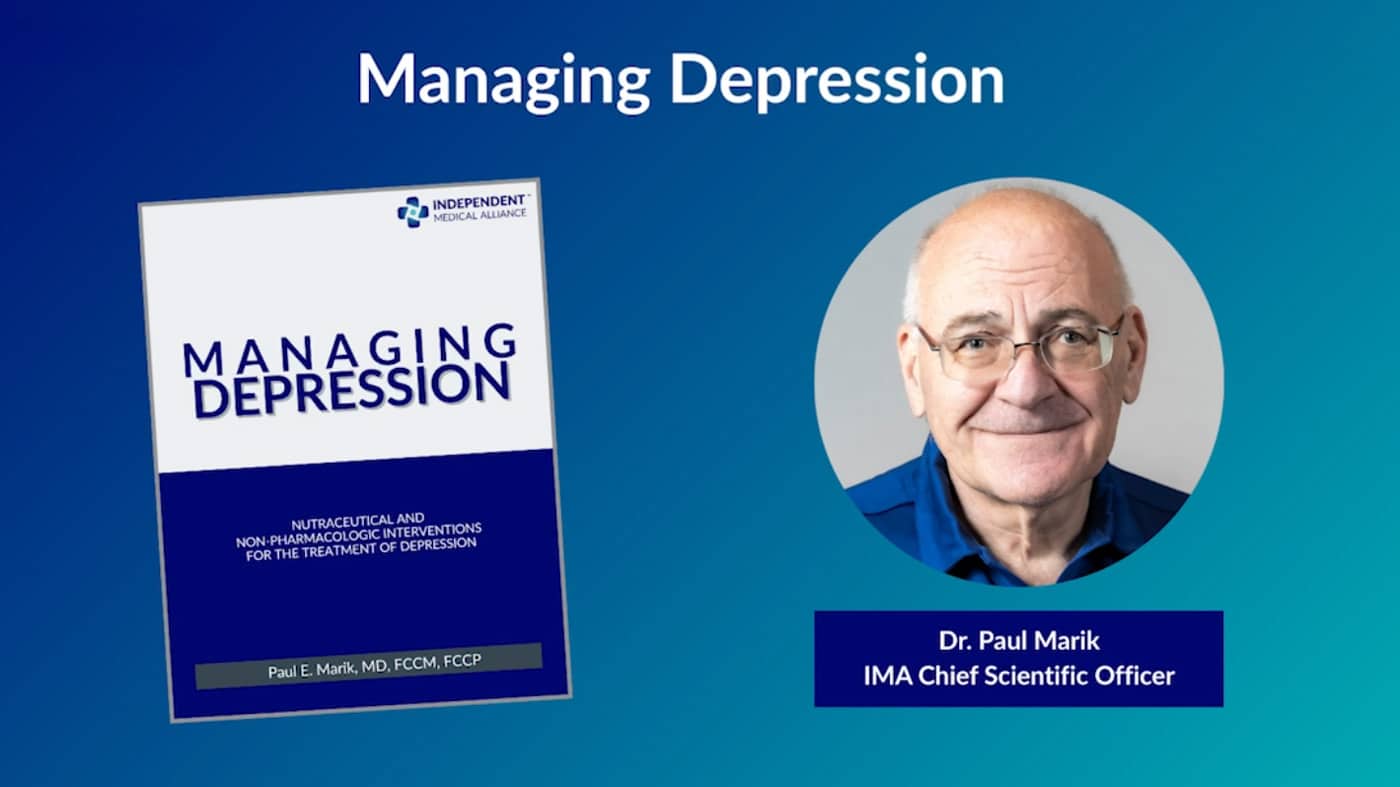
👉 Learn more: Managing Depression: An IMA Research Monograph
What Actually Works: Non-Drug Approaches and Finding the Right Help
So what should patients do? Dr. Witt-Doerring’s answer may surprise some: don’t start with your doctor.
“This may sound kind of crazy, but I don’t know if you should be asking—at least not your PCP. If you go to your PCP and say, ‘Hey, I’m having problems with anxiety and depression,’ what do you get on average? Maybe seven to eight minutes of face time. They’d probably spend half the time talking about cardiovascular disease. How helpful is that going to be?”
Instead, he recommends patients take ownership of understanding their symptoms and match the type of help to the type of problem.
“If it makes sense to you that there’s definitely some things going on in your life—whether it’s relationships or sense of meaning or purpose—you’re going to be best served by finding a therapist that you mesh with, someone that can really dig into that and help you find clarity.”
For patients whose symptoms don’t map to life circumstances (those who say “things in my life are pretty good, so why do I feel so bad?”) the answer may lie elsewhere.
“That’s when you should go and see a functional medicine doctor, or any doctor who takes a much more holistic look at your health. They’re going to look at diet, exercise, sleep, side effects of medications you’re using, substances. They can also look at medical conditions like thyroid problems and your gut health.”
Sleep, in particular, gets special attention. Insomnia is one of the most common complaints Dr. Witt-Doerring treats, and often it’s one of the most mishandled.
“It’s quite easy to get put on a sedative medication. Again, this is a drug that has no evidence of long-term helpfulness. There’s actually a lot of evidence that it makes people more anxious and more agoraphobic and even causes memory problems long-term. And they’re some of the hardest drugs to stop.”
The better approach treats insomnia as a whole-life problem, not just a nighttime one.
“It’s cutting down stimulants and certain medications. It’s moving your body. It’s diet—if you’re eating ultra-processed foods and things that are inflammatory, that’s going to increase your arousal. You can break it down into all the little things that cause hyperarousal. You can give your patients hope again.”
👉 Related resources:
- Tapering Off SSRIs Safely
- Men’s Mental Health: Root Causes, Resilience & Real-World Tools
- Long-Term Antidepressant Use and the Risk of Bleeding (Journal of Independent Medicine)
Hope for Mental Health in 2026
Despite the weight of the problems discussed, Dr. Witt-Doerring is optimistic.
“I’m so hopeful going into this new year. Never before has there been more interest in things like diet and exercise. People are starting to realize that the reason we’re not hearing about all of these non-drug approaches is just because doctors really aren’t trained or reimbursed to do that.”
He sees change coming from two directions: grassroots practitioners building alternatives outside the conventional system, and a shifting research agenda at the federal level that’s finally looking beyond biological targets and pharmaceutical solutions.
“We cannot wait for anyone else to fix these problems. We have to start doing it now in our practices.”
For patients seeking help now, Dr. Witt-Doerring offers practical guidance. TAPER Clinic operates in the 15 most populous U.S. states. For those outside that footprint, his YouTube channel offers a comprehensive free drug-tapering course, and the Benzodiazepine Information Coalition directory lists providers specializing in deprescribing nationwide.