


Tenth issue examines emerging evidence, repurposed treatments, patient autonomy and the scientific humility required to move medicine forward
The Independent Medical Alliance (IMA) today announced the publication of Volume 2, Issue 6 of the Journal of Independent Medicine (JIM), marking the journal’s tenth issue to date and closing its second year with research and perspectives that challenge established assumptions, revisit familiar treatments and emphasize a more individualized approach to patient care.
The new issue brings together editorials, reviews, original research and perspectives spanning influenza treatment, medical reversals, metabolic health, pediatric vaccine policy, stroke therapy, healthcare access, informed consent and vaccine-injury research.
A common theme runs throughout the issue: medicine advances not by defending what has always been done, but by continually testing assumptions against new evidence and asking whether existing approaches are truly serving the individual patient.
That principle is captured directly in Editor-in-Chief of the Journal of Independent Medicine Joseph Varon, MD’s editorial, “When Medicine Refuses to Admit It Was Wrong,” which examines why ineffective or outdated medical practices can persist even as evidence evolves—and argues that scientific humility and a willingness to correct course are essential to progress.
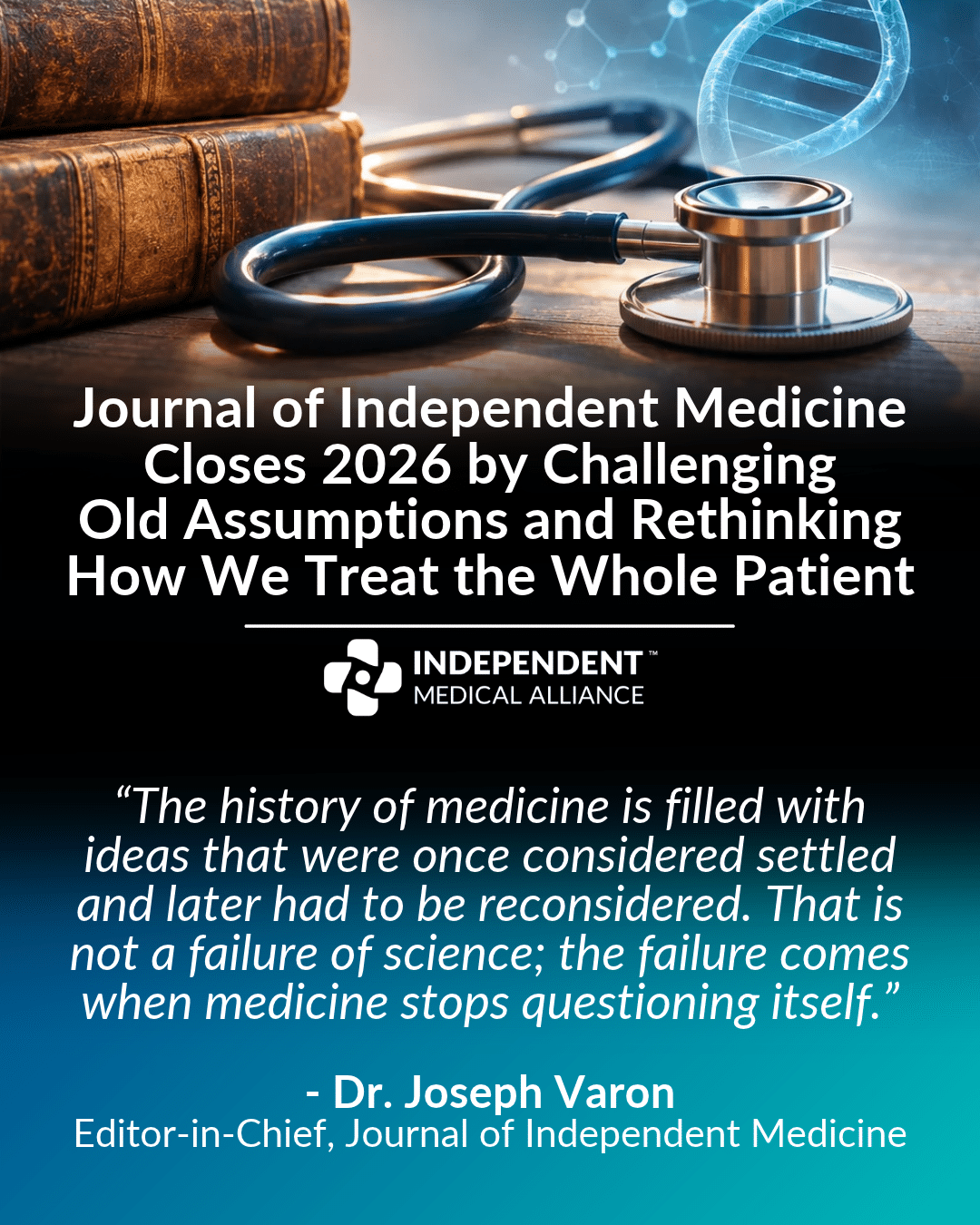
“The history of medicine is filled with ideas that were once considered settled and later had to be reconsidered,” said Dr. Varon, President and Chief Medical Officer of IMA. “That is not a failure of science; the failure comes when medicine stops questioning itself. Our responsibility as physicians is to follow the evidence, remain willing to rethink what we believe we know, and treat the person in front of us—not simply a diagnosis, protocol or institutional standard. Independent thinking, informed consent and the doctor-patient relationship must remain at the heart of good medicine.”
The theme is echoed in Dr. Paul Marik’s “Treat the Patient, Not Just the Virus: Rethinking Influenza Treatment,” which examines influenza care beyond antiviral therapy alone and considers a broader framework incorporating inflammation, immune response, supportive care and potential adjunctive treatments.
The issue also includes a systematic review of minocycline as a repurposed therapy for acute stroke, an original study examining a paleolithic ketogenic diet and metabolic outcomes, research into socioeconomic differences in access to advanced cardiac resuscitation, and perspectives on informed consent and the recognition and study of suspected vaccine-related injuries.
Looking Back at 250 Years as well as Forward
The issue arrives as IMA concludes its year-long reflection on 250 years of American medicine—a project examining both the extraordinary achievements of medical science and the foundational principles that should guide its next chapter.
At America’s 250-year mark, IMA has emphasized the importance of restoring many of medicine’s enduring roots: independent clinical judgment, scientific curiosity, informed consent, individualized treatment and a strong relationship between physician and patient.
“As we reflect on 250 years of American medicine, one of the most important lessons is that progress has always depended on physicians willing to observe carefully, think independently and reconsider accepted wisdom when the evidence demanded it,” Varon added. “Modern medicine has extraordinary tools, but those tools are most powerful when paired with the fundamentals of doctoring: listening to patients, understanding the whole person, exercising clinical judgment and remaining humble enough to keep asking questions. That is the kind of medicine this Journal exists to advance.”
Featured Articles in Volume 2, Issue 6
Treat the Patient, Not Just the Virus: Rethinking Influenza Treatment
Paul E. Marik | Editorial
Challenges conventional influenza treatment strategies and examines a broader, individualized approach incorporating early intervention, supportive care, immune and inflammatory responses, and potential adjunctive and repurposed therapies.
When Medicine Refuses to Admit It Was Wrong
Joseph Varon | Editorial
Explores why outdated or ineffective practices can persist in medicine and argues that scientific humility, rigorous reassessment and a willingness to correct course are essential to improving patient care.
Urogynecology, Urology, and Coloproctology: Historical Development, Shared Pelvic Floor Disorders, and Competency-Based Surgical Limits
Francisco Javier Castro-Apodaca et al. | Review
Examines overlapping pelvic-floor disorders and surgical responsibilities across three specialties, proposing a competency-based framework that prioritizes documented expertise, collaboration and patient-centered care.
Historical, Legal and Scientific Issues of Paediatric Vaccine Mandates
Paolo Bellavite; Alberto Donzelli; Eugenio Serravalle | Review
Reviews the historical, scientific and legal foundations of childhood vaccine mandates, with particular attention to Italy, and argues for disease-specific evaluation, transparent evidence review and informed consent.
The Effect of the Paleolithic Ketogenic Diet (PKD) on Metabolic Parameters, Fatigue, and Sleep
Zsófia Clemens et al. | Original Article
A retrospective study of 274 adults reports short-term improvements in metabolic measures, fatigue and sleep during a medically supervised paleolithic ketogenic diet program, while calling for longer-term controlled research.
Health Correlates of Vaccination: Lessons from Florida’s Medicaid Data
Josh Mitteldorf; Brian Hooker | Original Article
Examines associations between vaccination histories and selected health diagnoses among 14,235 children in Florida Medicaid data; because the study is observational, the reported correlations do not establish causation.
Social and Structural Correlates of ECPR Utilization After Cardiac Arrest in the United States
Francesca Martinez-Nachon; Michelle G. Ortiz | Original Article
Analyzes more than 243,000 hospitalizations to explore how insurance, income, geography and other structural factors are associated with access to extracorporeal cardiopulmonary resuscitation after cardiac arrest.
Platform Medicine and Patient Autonomy: A Socio-Epistemological Analysis of Taxonomic Shifts and Informed Consent in mRNA Deployments
Dietmar Kabelka | Perspective
Examines how terminology, regulatory classification and scientific uncertainty surrounding mRNA technologies may affect patient understanding and argues for more transparent, platform-specific approaches to informed consent.
Vaccine Injury: Recognition, Research and Re-establishing Trust
Elizabeth Mumper; Lawrence B. Palevsky; Suzanne K. Gazda | Perspective
Draws on physician perspectives and patient testimony to examine challenges in recognizing and studying suspected vaccine-related injuries and calls for stronger surveillance, research, diagnostic frameworks and multidisciplinary care.
Minocycline for Acute Stroke: A Systematic Review of Clinical Efficacy, Safety, and Translational Context
Adela Bazbaz; Joseph Varon | Repurposed Drugs
Reviews clinical evidence for repurposing the antibiotic minocycline as an adjunctive acute stroke therapy, finding signals of modest functional benefit that warrant continued investigation before broader clinical adoption.
Volume 2, Issue 6 and previous issues of the Journal of Independent Medicine are available free of charge at www.JIndepMed.org.