

✍️ By Jenna McCarthy
If Gary Brecka or Jillian Michaels or Dave Asprey announced that there was a simple health hack that could lower your stress, improve your mood, sharpen your thinking, and dramatically reduce your risk of dying early—oh, and it costs absolutely nothing—there’d be a half-mile waitlist to sign up.
Unless, of course, it required putting on pants.
It’s no secret that we have become a nation addicted to convenience. Why get dressed, drive across town, circle the parking lot like a starving vulture, spend an hour squeezing peaches and waiting in line at the deli counter, and then have to lug home the entire haul ourselves when we can enlist a very nice stranger (for a small fee) to deposit our provisions directly on our doorstep? Why pay money to join a tennis club when there’s a perfectly good simulator in the basement? Why commute to an office when we can get the job done from our cozy Tempur-Pedic beds?
The problem is, convenience comes with a cost—and I’m not talking about the “lazy tax” you pay to have someone else run through the Taco Bell drive-thru. In our quest for efficiency (or “timemaxxing,” as the kids would call it), we’ve accidentally lost sight of one of the most powerful predictors of long-term health and longevity: each other.
According to experts who make a living studying this stuff, chronic loneliness can be as deadly as smoking fifteen cigarettes a day. The U.S. Surgeon General—the guy who’s typically harping about seatbelts and telling pregnant women to avoid alcohol—has warned that social isolation increases the risk of premature death by nearly thirty percent and almost doubles older adults’ chances of developing dementia. Which means who you eat with may have more impact on your lifespan than what’s on your plate.
The answer isn’t “make more friends.” It’s literally “leave the house.” Because while we’ve been busy saving time and avoiding inconvenience, we’ve systematically engineered nearly all human interaction out of everyday life.
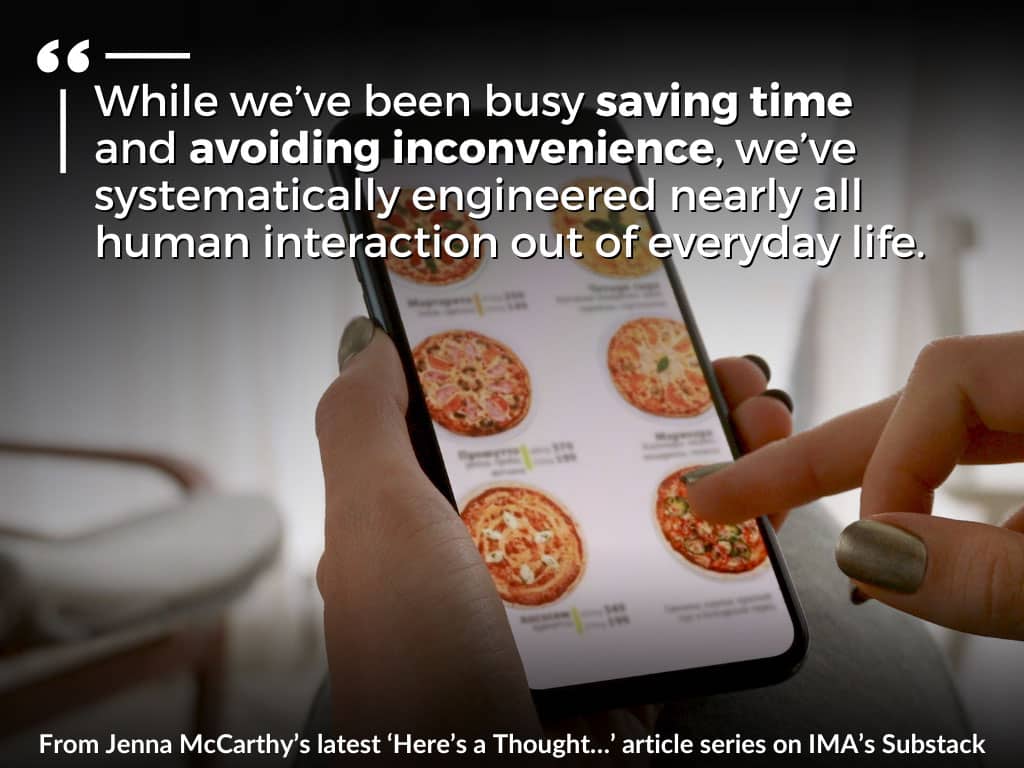
Remember when going to the bank required talking to a teller? When grocery shopping involved chatting with a cashier instead of scanning your own avocados while a machine accuses you of “an unexpected item in the bagging area”? When picking out a juicy new novel meant browsing a bookstore instead of clicking buy now? Movie theaters have given way to Netflix. Malls have been replaced by Amazon. Do bowling leagues even exist anymore? I actually worry my unborn grandkids will never know the joys of awkward interaction with strangers.
The pandemic didn’t light this fire—but it certainly poured gasoline on it. Restaurants became QR codes and delivery apps. Doctor visits became Zoom calls. Churches livestreamed. “Remote work” became… work. It turned out, there were very few things that couldn’t be accomplished from our couches. And because Americans love efficiency almost as much as we love pretending we’re going to start using that treadmill in the guest room tomorrow, we never really went back.
Efficiency might make us feel more productive, but it does very little to boost well-being. Researchers studying what they call “third places”—coffee shops, libraries, parks, diners, bowling alleys, neighborhood bars, community centers, all the places outside of home and work where people casually exist together—have found that they matter far more than we ever realized. Which is scientist-speak for “for the love of God, put down your phone and go be annoying near other carbon-based life forms.”

Not because you’re destined to meet your soulmate at Starbucks—but because your nervous system craves connection and belonging, two things no amount of screen time can give you.
The amazing part is, our brains don’t distinguish quite as dramatically as we do between our childhood best friend and the barista who remembers our order. Each familiar face is a reminder that you’re part of a community, not just passing through it. The guy you see walking his dog every morning at 7 a.m. The woman who—like you—never misses that one Pilates class. The dry cleaner who’s been pressing your shirts for decades. Those tiny interactions—relationships sociologists call “weak ties”—may seem meaningless, but in reality they’re the supporting cast of your life. Take them away and existence becomes less Mamma Mia! on the big screen and more a sad, grainy PBS production of Our Town.
Which brings me to what might be the least sexy health recommendation I’ve ever made: stop optimizing everything. Once a week, intentionally choose the inefficient option. Walk into Target instead of ordering through the app. Pick up your takeout instead of using Uber Eats. Browse Home Depot instead of scheduling another Amazon delivery. Work from your neighborhood cafe instead of your couch. Wait in line for the single checkout lane that has the human cashier. The goal isn’t to make a new best friend, it’s simply to become a familiar face somewhere.
Because eventually, familiarity becomes conversation. Conversation becomes community. And community—according to a growing stack of peer-reviewed receipts—may do more for your lifespan than downloading another fitness app or chasing the next wellness fad ever could.