
✍️ By Jenna McCarthy
A few weeks after my dad died, I had an OB-GYN appointment. I’d also just given birth to my first daughter, so I was an emotional, hormonal mess. Somewhere between the scale and the stirrups, my doctor casually asked how everything was going.
I burst into tears.
“Would you like me to write you a prescription for an antidepressant?” she asked gently.
I was sincerely taken aback. For context, I’m the least depressed person you’ll ever meet. That’s not a flex; it’s a fact. I regularly wake up at 4 a.m. not because I don’t enjoy sleep but because I love what I do in my waking hours so much that I can’t wait to get to it. My glass isn’t half-full; it’s pretty much overflowing. Sure, I have bad moods and bad days. I’ve cried over things that mattered and lost my temper over things that didn’t. (I once slammed a solid wood door so hard it split down the middle. True story.) But even when grief and postpartum hormones hit me all at once, I knew I wasn’t depressed. I was heartbroken.
It turns out, losing a parent can have that effect.
My dad was the first person I called from the delivery room. He was my friend, my idol, my landing pad, my biggest cheerleader. And then he was gone. That last part did not come with an instruction manual.
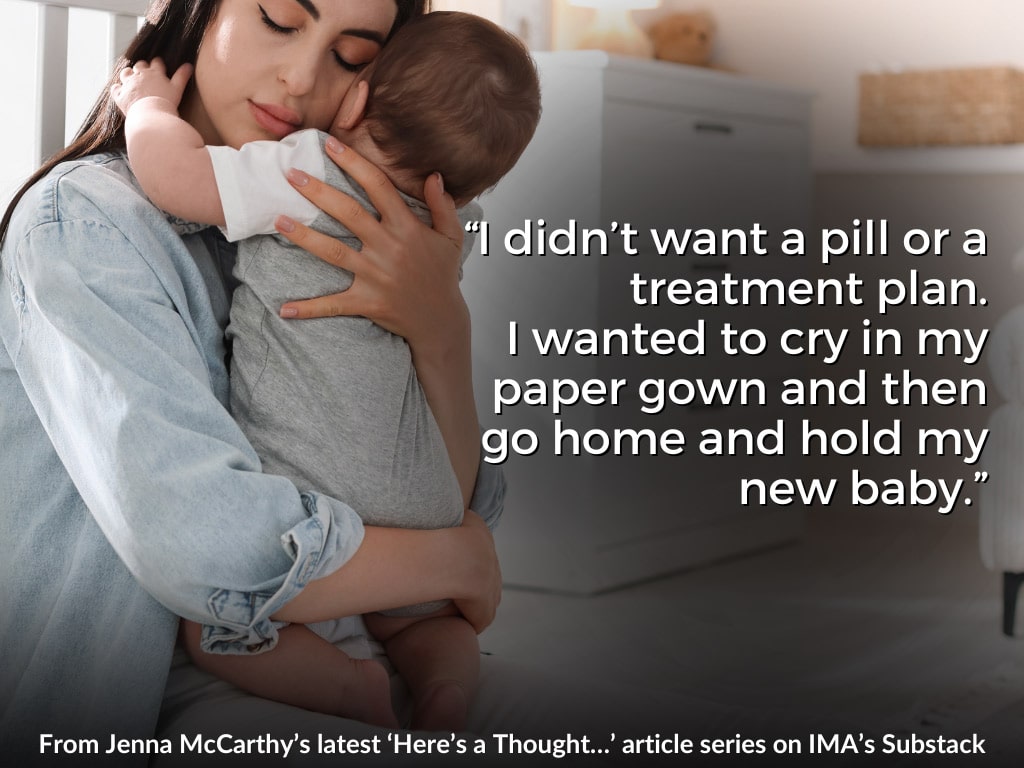
I didn’t want a pill or a treatment plan. I wanted to cry in my paper gown and then go home and hold my new baby. I wanted to understand how birth and death could press up against one another and not suffocate you. I wanted to miss my father and marvel at my daughter and I didn’t know how to do those things at the same time. I wanted to feel all the things, as contradictory and overwhelming and messy as they were.
My OB wasn’t one of those pill mills you hear about, either. She was a genuinely caring physician. She’d delivered my daughter mere weeks before this exchange. We’d been through a lot together. But she was practicing medicine in a culture that’s become remarkably uncomfortable with normal human suffering. And when the only tool in your medical kit is a prescription pad, every emotion becomes a diagnosis.
I’m not talking about catastrophic or debilitating suffering here. Just… life. If you can’t sleep, take this pill. Can’t focus? Try that one. If you’re anxious, you’re obviously undermedicated. Bored in the bedroom? Just supplement harder! Lonely? Sorry, you’re on your own—we don’t have a med for that yet. (Maybe try Tinder?)
Every generation before ours expected life to include grief, rejection, boredom, awkwardness, menopause, memory lapses, nervousness, and the occasional existential crisis in the Costco checkout line. They didn’t enjoy these things any more than we do. They just didn’t assume they required medical intervention.
Today it’s: Worried or stressed? Here’s a benzo. Feeling extra tense? Try a muscle relaxant. Fidgety kid? There’s an ADHD drug for that. Before long, you’re being held together with adhesive strips and subscription services, wondering why the relief never lasts.
Our grandmothers didn’t have a name for half of what we medicate now. They learned how to cope the old-fashioned way: by coping. A hyperactive child got sent outside to run laps around the block. A breakup got you a casserole and orders to get out of the house. If you were bored, somebody handed you a rake. In the name of progress, we traded those skills for pills, apps, and appointments, which certainly have their place when those skills aren’t enough. But if we stop teaching resilience, patience, perspective, faith, friendship, and the ability to be the tiniest bit uncomfortable, what replaces them? A muscle you never use doesn’t get weak—it disappears. And if the only wisdom we have to pass down is “IDK, ask ChatGPT,” we’re all doomed.
The irony is that many of the emotions and experiences we’re hell-bent on eliminating are our bodies’ brilliant and innate way of communicating with us. Grief is powerful proof of how much we loved someone. Loneliness reminds us that we need other people. Boredom nudges us toward change. Anxiety is like an overzealous security system—prone to false alarms, but ultimately there to keep us safe. Not every unpleasant feeling is a bug. Sometimes it’s a feature.

Grief, when you don’t try to outrun it, does something subtle over time. It stops ambushing you quite so often. The waves don’t disappear, but they come with a little more space between them, a little less force behind them. You learn the difference between drowning and floating. You cry, a lot, and then one day you laugh—really laugh—without immediately feeling like you’ve betrayed something sacred. The pain doesn’t vanish; it changes shape. It becomes a quiet companion instead of a relentless intruder. And if you don’t let yourself go through that—if you numb it, rush it, or pathologize it—you don’t skip the pain. You just postpone it. And like an unpaid bill, grief has a way of collecting interest.
Modern medicine, to be clear, is one of humanity’s greatest achievements. We replace failing heart valves. We cure cancers that would have been death sentences twenty years ago. We transplant organs. We edit genes. The power and promise of science is literally astonishing. But that success has changed our expectations. Once medicine could cure so much, we began expecting it to cure everything. The result is that benign human experiences like forgetting where you left your keys or feeling nervous before a presentation are treated like five-alarm emergencies.
This is not a categorical diss on Pharma either. (I co-wrote The War on Ivermectin, which last time I checked is still a pharmaceutical product.) I have people I love dearly who swear they literally would be unable to get out of bed without their antidepressants. That’s what makes the distinction so important. Those medications exist for people whose brains are lying to them, telling them nothing will ever be okay again, even when that isn’t true. That wasn’t what was happening to me. My brain wasn’t lying. Losing someone you love hurts. Overwhelming sadness is the perfectly reasonable response to that pain.
Sometimes what we need isn’t a prescription—it’s permission. Permission to be sad without it being a diagnosis. Permission to let grief run its painful, unpredictable course instead of getting managed, medicated, or referred to a specialist. The reality is, we’ve gotten remarkably good at treating symptoms, and considerably less good at trusting signals. Sometimes the most appropriate response isn’t intervention—it’s attention. And the recognition that not every feeling needs to be fixed.