Host: Dr. Ryan Cole | Guests: Dr. Clayton Baker and Nicole Pearson
Informed consent is a bedrock principle of medicine: nothing should be done to your body without your knowledge and agreement. So who signs the consent form when the intervention is the air, water, and sunlight we all share?
In this episode, host Dr. Ryan Cole, IMA Head of Medical & Scientific Affairs, sits down with Dr. Clayton Baker, IMA Senior Fellow, and attorney Nicole Pearson for Geoengineering: The Science, the Debate, and Our Health. It’s a frank look at efforts to alter the weather and climate, and at what they could mean for those of us on the ground.
Most of us have heard of cloud seeding, weather control, and other efforts to engineer the climate. To many, it sounds like weird science. But this episode’s guests warn of a darker trend, with consequences for our health, our food supply, and the air we breathe. They say these activities are moving ahead without the public’s knowledge or consent.
Dr. Ryan Cole welcomes IMA Senior Fellow Dr. Clayton Baker and constitutional attorney Nicole Pearson to discuss geoengineering, a broad category that extends well beyond efforts to make it rain. The conversation explores what these methods involve, the health concerns they raise, and why the guests are pushing for greater public scrutiny.
Meet the Experts

Dr. Clayton Baker
IMA Senior Fellow, Internal Medicine. An internal medicine physician with more than 25 years of clinical experience, Dr. Baker has served as clinical associate professor of medical humanities and bioethics at the University of Rochester. His work has appeared in JAMA and the New England Journal of Medicine. He writes on medical reform, medical freedom, and public policy for Brownstone Institute and hosts America Out Loud PULSE.
Nicole Pearson
Constitutional Attorney and Founder, Facts Law Truth Justice. With more than 15 years of litigation experience, Pearson has brought cases against government leaders, universities, school boards, and other institutions to protect children and defend constitutional rights. She founded Facts Law Truth Justice and is one of the attorneys behind The GeoFight.
What Counts as Geoengineering?
Geoengineering casts a wider net than most people realize. Here’s how Dr. Baker defines it:
“Geoengineering can be defined as the sum total of all the weather and climate manipulation methods that humans employ to deliberately and unnaturally change, control, and weaponize weather and climate.” — Dr. Clayton Baker
The episode covered several geoengineering methods, including:
- Cloud seeding: using substances such as silver iodide to encourage rain or snowfall.
- Stratospheric aerosol injection: introducing particles high in the atmosphere to reflect sunlight, as a form of solar radiation management.
- Marine cloud brightening: spraying sea-salt particles to make clouds more reflective.
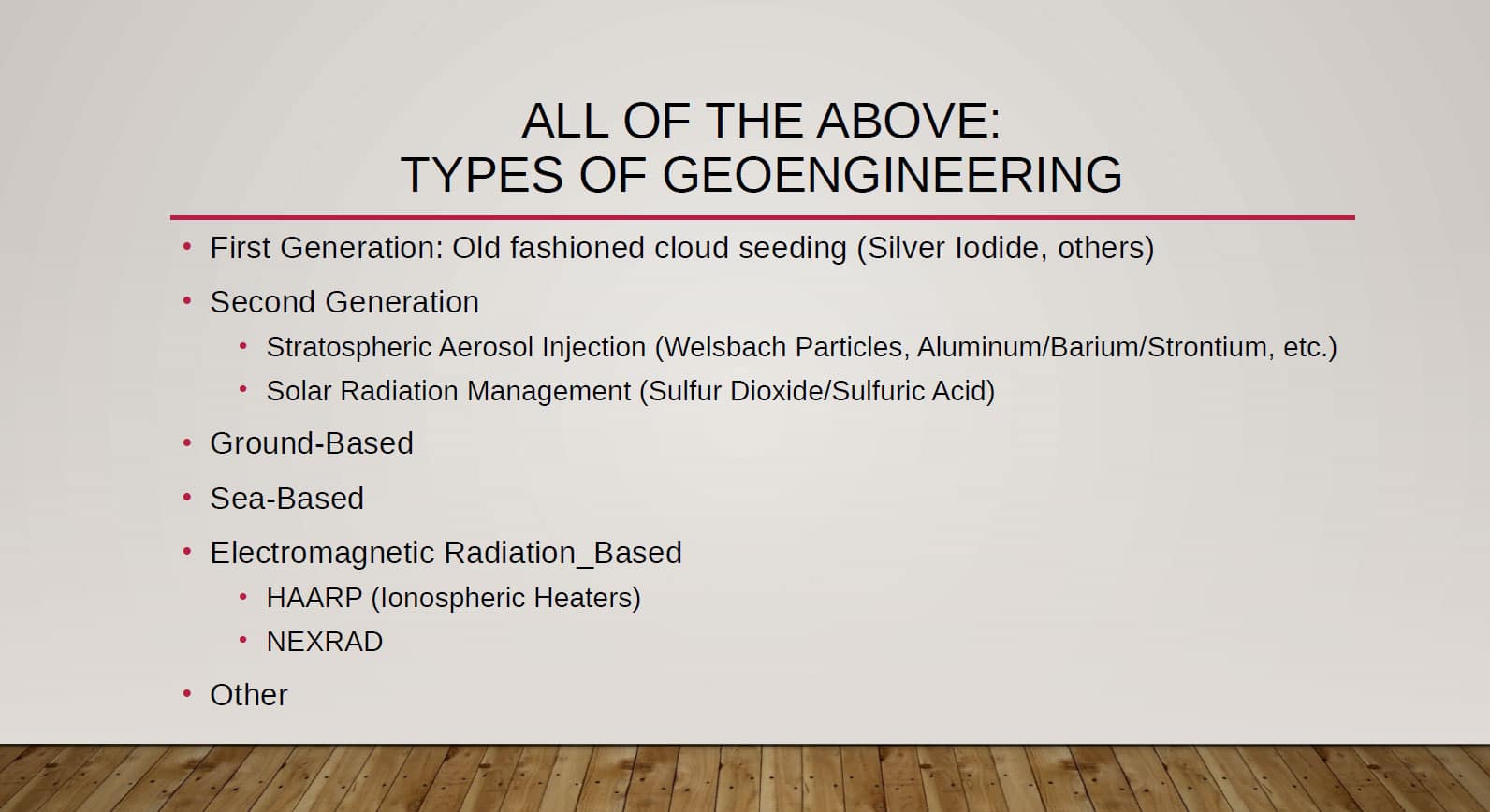
Types of geoengineering, from Dr. Baker’s presentation.
These methods differ in scale and purpose. Cloud seeding usually targets local conditions, such as a ski resort seeking more snow. Climate interventions aim to affect the broader climate. Those differences matter when assessing an activity and deciding which laws apply.
Dr. Baker argues that widespread atmospheric spraying is already occurring, largely through government activity. He wants greater public scrutiny of those activities and the institutions behind them.
States are already taking action: Florida, Louisiana, and Tennessee have passed laws banning geoengineering, and many more have considered similar bills.

The Questions for Our Health
Why try to change the climate in the first place? Some geoengineering approaches aim to cool the planet by reflecting sunlight back into space. That means deliberately reducing the sunlight reaching Earth’s surface. Dr. Baker and Nicole Pearson see serious health and environmental risks in that goal.
“Blocking out the sun is about the most insane thing anybody could do.” — Dr. Clayton Baker
Plants depend on sunlight. The concerns include how much light would be reduced and what that would mean for crops and food production. The guests also question how anyone would decide what level of reduction was acceptable.
Dr. Cole connects sunlight to the body’s daily rhythms:
“You need that morning sunshine to set your clock genes in the body.” — Dr. Ryan Cole
The substances used in atmospheric interventions raise a separate question about exposure: how would their effects on people and the environment be assessed?
Who Gets to Give Consent?
An atmospheric release can affect people who had no role in authorizing it. They share the air and cannot individually opt out. For Dr. Cole, that raises the same question of informed consent that matters in medicine: people should know what is being proposed and have a say in decisions that affect their health.
“I think the bigger issue here is we as citizens being exposed to something against our will.” — Dr. Ryan Cole
Dr. Baker extends that objection to people’s property, livelihoods, and family health. Government involvement does not change his objection.
Pearson compares atmospheric releases to pollution from a factory, where the operator must account for the effects on the surrounding community. Her question is why atmospheric activities should receive different treatment.
Following the Money
Who is paying for weather and climate research, and what activities does that money support? Dr. Baker would start by tracing the money: Department of Defense spending and the funding that goes to universities for geoengineering research.
“We need a forensic accounting of who’s paying for this stuff.” — Dr. Clayton Baker
He also wants the funding for the activities he opposes to be cut off.
Legal Action and Public Participation
Pearson says The GeoFight is obtaining financial data through discovery in its litigation. Planned legal action also involves private operators such as Rainmaker and Stardust Solutions. Her advice is to act locally before litigation becomes the only option.
“Litigation is the last resort. We do not want to wait for these judges to try and give us a good ruling.” — Nicole Pearson
Project Popeye, a U.S. weather modification campaign during the Vietnam War, is one historical example of military involvement. Dr. Baker points to state and federal legislation as a way to restrict these activities and strengthen public oversight.
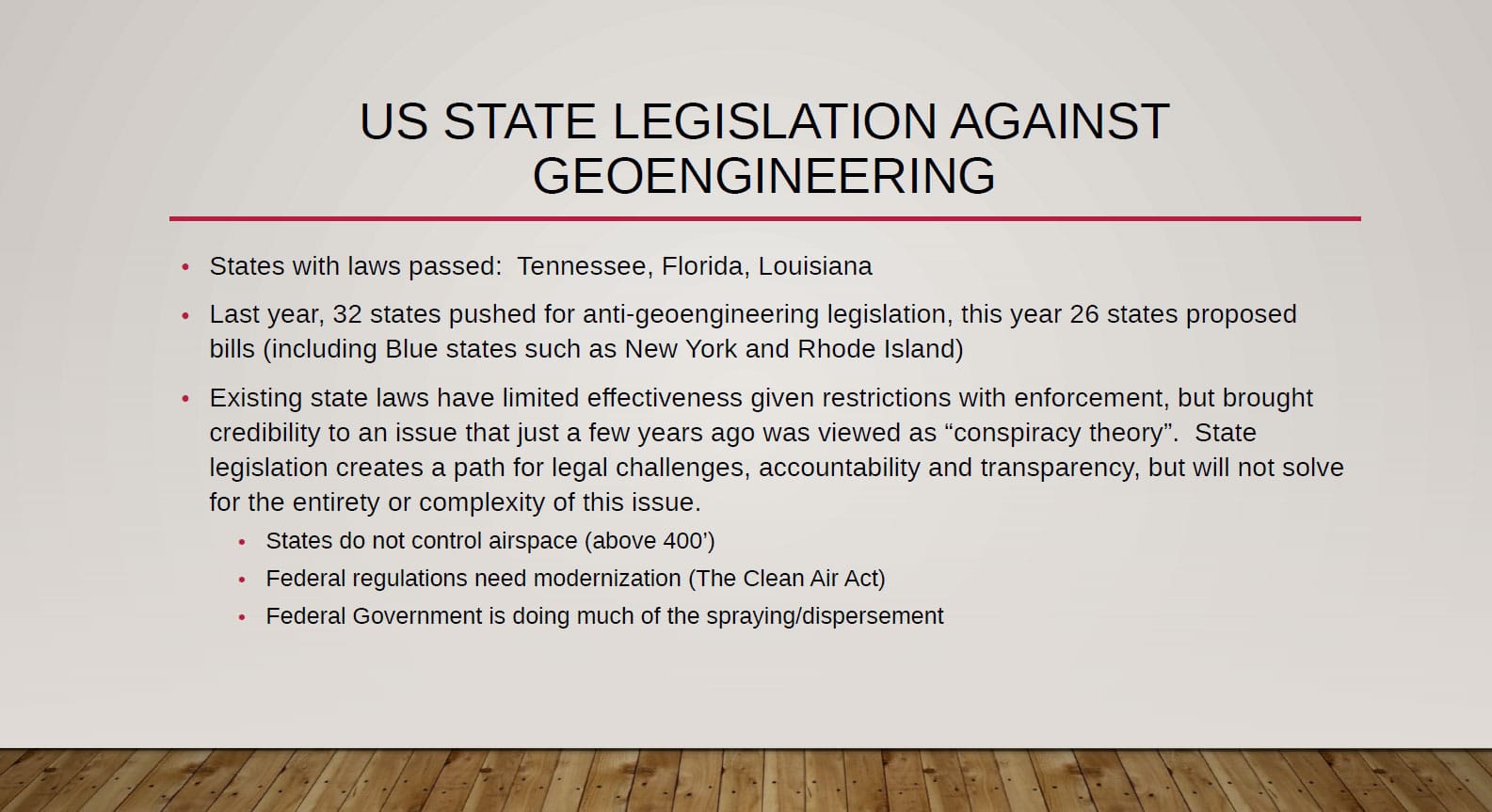
Dr. Baker’s overview of state legislation.
For people who want to get involved, the guests point to several options:
- Local organizing: The GeoFight’s free weekend meetings cover obtaining contracts, working with county boards, and approaching representatives.
- Evidence gathering: Workshops cover identifying aircraft and operators, recording altitude and direction, and collecting samples without contamination.
- Legislation and advocacy: Dr. Baker highlights state legislative efforts, Rep. Greg Steube’s proposed Air Quality Act, and the Clear Skies Declaration, which he helped write with Global Wellness Forum.
The organizations, tools, and further reading mentioned in the episode are collected below.