✍️ By Lynne Kristensen, IMA Senior Director of Communications & International Fellowship Program
American medicine has always lived with tension.
Patients need hope. They want answers. They seek relief from pain, fear, fatigue, infection, disability, and disease. When people are suffering, they are vulnerable to anyone who promises a cure.
That vulnerability has shaped the history of American medicine from the beginning.
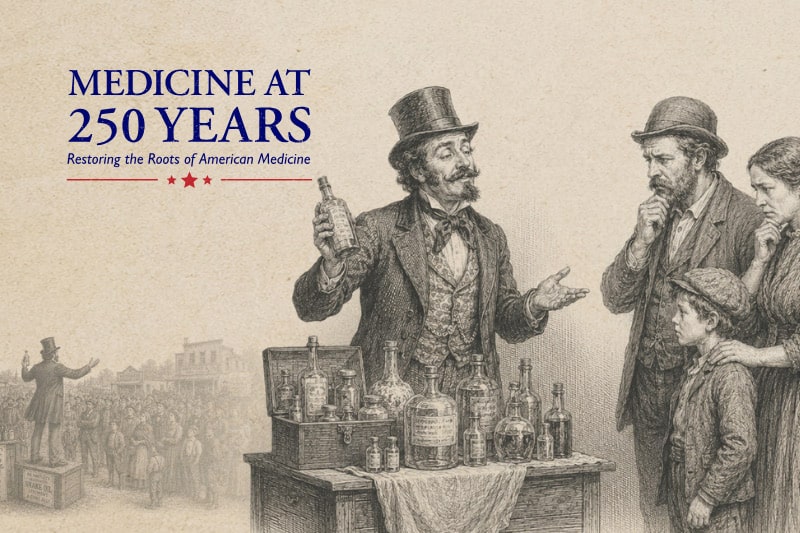
In the 19th century, patent medicines and cure-alls flooded the marketplace. Patent medicines were the over-the-counter remedies of their day: bottled tonics, syrups, pills and liniments sold directly to the public, often with secret formulas and sweeping cure-all claims before modern drug regulation required clearer labeling, safety standards or proof of effectiveness.
These “cures” were sold in newspapers, traveling shows, storefronts, and mail-order catalogs. They promised relief for nearly every complaint. Some contained alcohol, opium, morphine, cocaine, mercury, or other powerful substances. Many contained little that would actually heal. [1]
Some were harmless. Some were addictive. Some were dangerous. Many were advertised with confidence that far exceeded the evidence behind them.
America has always had to protect patients from false promises.
But the story does not end with snake oil.
As medicine became more scientific, the old patent medicine world gave way to a more regulated pharmaceutical industry. That shift brought extraordinary advances. It also created new problems. The bottles changed. The advertising changed. The science became more sophisticated. The stakes became higher.
But the central question remained the same.
Who is medicine really serving?
Where “Snake Oil” Came From
The phrase “snake oil” did not begin as a symbol of fraud.
Its origins can be traced to Chinese laborers in the American West in the 19th century, including railroad workers who used traditional medicinal oils for sore muscles and aching joints. These preparations were reportedly made with oil from the Chinese water snake, which contained fatty acids that may have offered some anti-inflammatory benefit.[3]
Over time, American traveling salesmen began selling their own versions of “snake oil,” often claiming it could treat pain, headaches and a wide range of other complaints. Many of these products contained little or no actual snake oil. The most famous example was Clark Stanley, the self-proclaimed “Rattlesnake King,” whose Snake Oil Liniment was later found by federal authorities to contain mineral oil, beef fat, red pepper and turpentine, but no snake oil.[4]
That is how a term connected to a real traditional remedy became shorthand for deception and fraud. “Snake oil” came to represent the kind of medical marketing that exploits suffering by promising cures it cannot deliver.
This history matters because it reminds us that not every traditional remedy begins as fraud, and not every official-looking product deserves trust. The deeper issue is whether patients are being told the truth.
The Age of Patent Medicines
Before modern drug regulation, the American public had little protection from exaggerated medical claims.
Patent medicines were not always patented in the modern sense. The term often referred to proprietary formulas marketed directly to the public. Companies guarded their recipes and promoted them as secret remedies. Labels could be vague. Ingredients were often undisclosed. Advertising was emotional, persuasive, and often wildly misleading.
A bottle might claim to treat cough, nerves, pain, digestive trouble, women’s discomfort, weakness, or nearly any ailment of daily life. Testimonials were common. So were dramatic before-and-after claims. The public did not always know what it was buying.
For many families, these medicines were accessible in a way physicians were not. A doctor cost money. A clinic might be far away. A bottle on a shelf promised control.
That matters because the rise of patent medicines was not only a story of fraud. It was also a story of access, fear, and unmet need for the average American.
One of the most shocking examples was Mrs. Winslow’s Soothing Syrup, a popular 19th-century “cure” marketed to mothers for teething babies and fussy children. Advertisements claimed it could soothe the child, soften the gums, ease pain, cure wind colic and relieve diarrhea. What many parents did not know or understand was that the syrup contained morphine. It quieted children because it sedated them, placing infants at risk of poisoning, addiction and death. [2]
When people could not get clear answers or what we call informed consent today, they looked elsewhere.
When medicine feels distant, expensive, or dismissive, patients become more vulnerable to promises from outside the system.
That lesson still applies today.
Why Regulation Became Necessary
By the late 19th and early 20th centuries, public concern over adulterated drugs, mislabeled products, unsafe foods, and deceptive claims was growing. Investigative journalism helped expose abuses. Reformers pushed for federal oversight.
In 1906, Congress passed the Pure Food and Drugs Act. It prohibited interstate commerce in misbranded and adulterated foods and drugs and helped lay the foundation for modern federal drug regulation. [5]
This was a major turning point.
The law did not solve every problem, but it marked a shift in public expectations. Patients had a right to know what they were consuming. Companies could not be left entirely to police themselves. Medical products needed standards. Claims needed accountability.
Regulation, at its best, protects the vulnerable.
It helps ensure that medicines are what they claim to be. It creates consequences for deception and false advertising. It provides a framework for safety, labeling, manufacturing, and evidence.
This is the part of the story that must be acknowledged clearly. A free market without truth is not freedom for the patient. It is a marketplace of risk.
The Rise of the Pharmaceutical Era
As the 20th century progressed, pharmaceutical science changed medicine.
Drugs became more targeted. Manufacturing improved. Clinical research expanded. Antibiotics changed the treatment of infection. Insulin transformed diabetes from a rapidly fatal disease into a manageable condition for many patients. Anesthetics, pain medicines, cardiac drugs, anticoagulants, cancer therapies, psychiatric medications, and countless other treatments reshaped how medicine was practiced.
No doubt, these advances saved lives.
There is no honest history of medicine that denies the value of pharmaceutical innovation. Many patients are alive today because of drugs that did not exist a century ago. Many conditions once considered hopeless became treatable. Many surgeries became safer. Many infections became survivable.
The problem is not medicine in a bottle.
The problem is what happens when the bottle becomes the center of medicine.
A drug can be lifesaving. It can also be overused. It can be necessary. It can also become a substitute for asking why the patient became sick in the first place.
The history of pharmaceuticals is a history of both breakthrough and temptation.
Advertising, Influence, and the Patient
As the pharmaceutical industry grew, so did its influence.
Companies funded research, supported medical education, promoted drugs to physicians, advertised to consumers, and shaped public understanding of disease. Direct-to-consumer advertising became especially powerful in the United States, where patients could be encouraged to ask their doctors about specific medications by name.
This changed the exam room.
A patient might arrive having already been taught what condition to suspect and what drug to request. A physician might be asked to respond not only to symptoms, but also to marketing. The encounter could become shaped by messages designed outside the doctor-patient relationship.
The United States is one of only two high-income countries, along with New Zealand, that permits direct-to-consumer advertising of prescription drugs.[6] In 2024, pharmaceutical companies spent more than $10 billion on U.S. drug advertising, including more than $5 billion on television ads alone.[7] One analysis found that pharmaceutical ads made up nearly one-quarter of evening ad minutes on major news networks during the first five months of 2025.[7] That level of spending raises an important question for patients: when Big Pharma is such a powerful advertiser, how does that influence the health stories the public sees, the questions reporters ask and the facts that receive sustained attention?
Advertising is not the same as education.
Education seeks to inform. Advertising seeks to persuade.
That distinction matters in medicine because the patient is often anxious, uncomfortable, and searching for hope. When drug marketing reaches the patient before a physician has had time to listen, the balance can shift.
The patient deserves truth, not manipulation.
The Opioid Lesson
Few modern examples reveal the danger of pharmaceutical overreach more clearly than the opioid crisis.
Pain is real. For many patients, it is devastating. Physicians needed better ways to treat it, and patients deserved compassion.
But aggressive promotion of opioid pain medications helped create a public health catastrophe. Claims about safety and addiction risk were too often minimized. Prescribing increased dramatically. Communities across the country suffered the consequences. [8]
The opioid crisis is not a lesson against treating pain.
It is a lesson against allowing commercial and financial incentives, institutional pressure, and incomplete evidence to drive care beyond what patients can safely bear.
It is also a lesson in humility.
Medical systems can embrace a message, repeat it, reward it, defend it, and later discover that the human cost was enormous.
Patients remember that.
Families remember that.
Trust is damaged when institutions refuse to admit how harm happened.
The New Snake Oil
Modern medicine may no longer come in the form a traveling salesman with a wagon full of miracle tonics. But the temptation is still familiar.
There are still exaggerated promises. There are still selective evidence and incentives that can distort judgment. There are still products marketed as simple answers to complex human problems.
Sometimes the false promise comes from outside mainstream medicine.
Sometimes it comes from inside it.
Today, the “new snake oil” also moves through social media feeds, where influencers can promote health and wellness products, protocols, supplements, devices and services with little meaningful oversight. For patients living with chronic pain, autoimmune symptoms, fatigue, metabolic dysfunction, hormone issues or other unresolved conditions, these messages can feel like long-awaited answers, especially when the institutional and corporatized medical system has failed to listen or help.
In that sense, the marketplace has come almost full circle. Once again, the average patient has direct access to a flood of health claims outside the exam room. Some may point people toward helpful ideas. Others are unverified, exaggerated or financially motivated.
Pew Research Center found that 36% of U.S. adults get health information from social media at least sometimes, while KFF found that 55% of adults use social media for health information and advice at least occasionally.[9][10]
The problem is not that patients are searching.
The problem is that suffering people are often left to sort truth from marketing alone.
That is why IMA’s message is not simply anti-fraud in one direction. It is pro-truth in every direction.
Patients should be protected from dangerous claims, whether those claims come from a fringe salesman, a corporate campaign, a government-approved message, an influencer with financial motivations or an institutional protocol that ignores the complexity of the individual patient.
The standard should not be who has authority.
The standard should be truth, transparency, evidence, informed consent and respect for the doctor-patient relationship.
Innovation Without Idolatry
Pharmaceutical innovation is one of the major achievements of modern medicine. While it should be recognized and acknowledged, it should not be idolized either.
A healthy medical culture can be grateful for drugs without becoming dependent on them as the first and only answer. It can use medication wisely while still asking about nutrition, movement, sleep, stress, toxins, infection, metabolism, hormones, inflammation, environment, and family context.
This is where whole-person medicine becomes essential.
A patient is not a prescription waiting to be written. A diagnosis is not always a drug deficiency. Symptoms are not always the deepest story.
Sometimes medication is exactly what is needed.
Sometimes it is only one part of the answer.
Sometimes the better question is not, “What drug matches this symptom?”
It is, “Why is this person sick?”
Remember the Roots, Tell the Truth
From snake oil to Big Pharma, the lesson is not that all medicine outside the system is fraudulent or that all medicine inside the system is trustworthy.
The lesson is that patients need protection from deception wherever it appears.
They need physicians who are free to ask hard questions. They need honest evidence. They need full disclosure of risks and benefits. They need informed consent that is more than a signature on a form. They need care that does not reduce suffering to a sales opportunity.
American medicine at its best has always fought to separate healing from exploitation.
That fight is far from over and the enemy is often hard to clearly detect.
The next 250 years of medicine must protect innovation while resisting corruption. It must welcome discovery while refusing manipulation. It must use powerful tools without allowing profit to replace judgment.
Medicine should never be built on fear, pressure, or false promises.
It should be built on trust.
Source Notes
- Oregon Health & Science University Historical Collections and Archives, “There’s a Cure for That: Historic Medicines and Cure-alls in America.” Used for historical context on patent medicines, cure-alls, aggressive advertising, consumer access before modern regulation and harmful ingredients including alcohol, morphine, opium, cocaine and mercury.
- Smithsonian National Museum of American History, “Rule Advertising Mrs. Winslow’s Soothing Syrup.” Used for background on the product’s marketing claims and documentation that it contained 65 mg of morphine per fluid ounce.
- Smithsonian Magazine, “How Snake Oil Became a Symbol of Fraud and Deception,” 2024. Used for background on the history of snake oil, Chinese laborers’ use of traditional medicinal oils and the term’s later association with fraud.
- Smithsonian Institution / National Museum of American History, “Clark Stanley’s Snake Oil Liniment.” Used for documentation of federal testing that found Stanley’s product contained mineral oil, a fatty compound thought to be from beef, capsaicin and turpentine, but no actual snake oil.
- U.S. Food and Drug Administration, “Part I: The 1906 Food and Drugs Act and Its Enforcement.” Used for historical background on the 1906 Pure Food and Drugs Act, early federal food and drug regulation, misbranding, adulteration, labeling requirements and enforcement challenges.
- Johns, L., “Patients as Consumers: Reflections on the FDA’s New Rule on Direct-to-Consumer Prescription Drug Advertisements,” PubMed Central, 2024. Used for background on direct-to-consumer prescription drug advertising being permitted in the United States and New Zealand among high-income countries, and for context on FDA advertising rules.
- Wisconsin Watch, “Did drug companies spend $10 billion on consumer ads?” 2025. Used for reported 2024 U.S. pharmaceutical advertising spending, TV ad spending and the analysis of pharmaceutical advertising minutes on major evening news programs.
- American Journal of Public Health / PubMed Central, “The Promotion and Marketing of OxyContin: Commercial Triumph, Public Health Tragedy,” by Art Van Zee, 2009. Used for background on the marketing of OxyContin, including promotional strategies and efforts to minimize addiction risk.
- Pew Research Center, “Health information from social media and AI rated more convenient than accurate,” 2026. Used for survey data showing that 36% of U.S. adults get health information from social media at least sometimes.
- KFF, “KFF Tracking Poll on Health Information and Trust: Health Information and Advice on Social Media,” 2025. Used for survey data showing that 55% of adults use social media to find health information and advice at least occasionally.
Additional Sources Consulted
- U.S. Food and Drug Administration, “How Chemists Pushed for Consumer Protection: The Food and Drugs Act of 1906,” by John P. Swann. Used for background on dangerous ingredients in early medicines and the law’s labeling requirements for substances such as alcohol, morphine, heroin and cocaine.
- National Library of Medicine, “Pure Food and Drugs.” Used for historical background on public concern over adulterated foods and medicines, the growth of federal drug controls, and the early history of U.S. food and drug regulation.
- AMA Journal of Ethics, “How FDA Failures Contributed to the Opioid Crisis,” by Andrew Kolodny, 2020. Used for context on opioid regulation, pharmaceutical promotion, prescribing patterns and the role of misleading opioid marketing in the broader public health crisis.
- U.S. Government Accountability Office, “OxyContin Abuse and Diversion and Efforts to Address the Problem,” 2003. Used for federal context on Purdue Pharma’s marketing of OxyContin, expanded sales efforts, prescribing for noncancer pain and early concerns about abuse and diversion.
- U.S. Food and Drug Administration, “80 Years of the Federal Food, Drug, and Cosmetic Act.” Used for context on the limitations of the 1906 law and the evolution of stronger federal drug oversight under later legislation.