

By Dr. Kat Lindley (originally published on X)
“If you like your health care plan, you can keep it.”
Millions of Americans heard that promise and believed it. Then the cancellation letters came. PolitiFact named it the Lie of the Year in 2013, and the trust it cost has never really come back.
Now a new message is going viral: let’s finish what we started and guarantee healthcare for every American. I understand why that speaks to people. I have sat across from patients who were scared, sick, and unsure how they would pay. Every American deserves good care. On that, we agree.
Where we disagree is on what got us here and what will get us out.
A card in your wallet is not a doctor
The Affordable Care Act was built on one idea: get more people an insurance card, and care will follow. More people did get cards. But care did not follow the way we were told it would.
Look at the newest Commonwealth Fund survey of working-age adults. Nearly half, 46%, were inadequately insured in 2026. 11% had no insurance. 12% had a gap in coverage during the year.
And here is the number I want everyone to sit with: 23% had insurance all year long and were still underinsured. They paid their premiums every month, and their deductibles and out-of-pocket costs were still so high compared to their income that their plan didn’t give them affordable access to care.
That is nearly 1 in 4 working-age adults doing everything they were told to do and still not able to afford to use what they paid for.
It gets harder to defend from there. Among people in ACA marketplace plans who were insured all year, half were underinsured. The law’s own flagship product leaves half of its customers unable to afford their care.
Half of working-age adults said they delayed or went without needed care because of cost in 2026, up from 46% in 2022. Nearly a third are paying off medical bills or medical debt over time.
The uninsured rate also climbed, from 8.9% in 2024 to 11.2% in 2026. The survey’s authors tie part of that to the expiration of the enhanced ACA subsidies. I won’t pretend otherwise. But think about what that tells us. More than a decade into the ACA, after years of massive taxpayer subsidies, coverage starts eroding the moment the money slows down, and the people who do have coverage still can’t afford to see their doctor.
That is not a system that needs to be finished. It is a system that needs to be rethought.
Who the system actually rewards
If patients are struggling and doctors are burning out, someone is doing well. Follow the money.
Consider “nonprofit” hospitals. Nonprofit is a tax status, not a business model. These hospitals pay no income tax and no property tax. In exchange, they are supposed to give back to their communities through charity care and community benefit.
But research published in the Journal of Marketing Research in 2020 found that nonprofit hospitals achieve higher output, higher prices, and higher profits than for-profit hospitals. They do it largely by expanding high-priced premium specialty services and running national advertising campaigns.
The tax break was meant to serve the community. Too often it buys new specialty wings and marketing aimed at the best-insured patients.
Meanwhile, the independent doctor down the street pays taxes, follows the same rules, and tries to compete. Every layer of regulation, reporting, and paperwork falls hardest on the small practice and the solo physician. Big systems can hire armies of administrators to handle it. Independent doctors can’t, so many sell out or close.
I know this from experience. I left the employed system in 2017 because I wanted to answer to my patients, not to a billing department. Every year I watch more colleagues get absorbed into large systems, and every year patients have fewer real choices.
More government involvement doesn’t reverse that. It speeds it up. The bigger and more complicated the rules, the more the biggest players win.
Waste, fraud, and the money that never reaches patients
When one payer controls the checkbook, the incentive is to pay quickly and ask questions later. For years, Medicare and Medicaid have worked on a “pay and chase” model: send the money out, then try to recover it after the fraud is discovered. By then, the money and the people who stole it are often long gone.
I’m glad to see CMS under Dr. Oz shifting toward stopping fraudulent payments before the money goes out. That is common sense, and it is overdue.
But it should also be a warning. Every dollar lost to fraud is a dollar that didn’t go to a disabled child, a nursing home resident, or a struggling mom. A single government payer for the whole country would be an enormous target for fraud.
What actually works
If the ACA got us into this mess, more government in our care won’t get us out. The answer is to put patients and their doctors back in charge.
Start with clear, upfront prices. People should know what something costs before they agree to it, the same way they do for almost everything else they buy. When prices are visible, patients can compare, and providers have to compete.
Let insurance be insurance again. Pair health savings accounts with catastrophic coverage, so people own their health dollars for everyday care and are protected from the true disasters. Insurance should cover catastrophes, not your sore throat.
Make room for direct primary care or other models of independent practice of medicine that advocates for the patient. When patients pay their doctor directly, the insurance middleman steps out of the exam room. The visit gets longer, the relationship gets deeper, and the doctor’s attention goes back where it belongs: on the patient.
And train more doctors. We cannot promise care to every American without enough physicians to provide it. That means more residency slots for the doctors we are already graduating here at home.
None of this requires a bigger bureaucracy. It requires trusting patients to make their own decisions and trusting doctors to care for them.
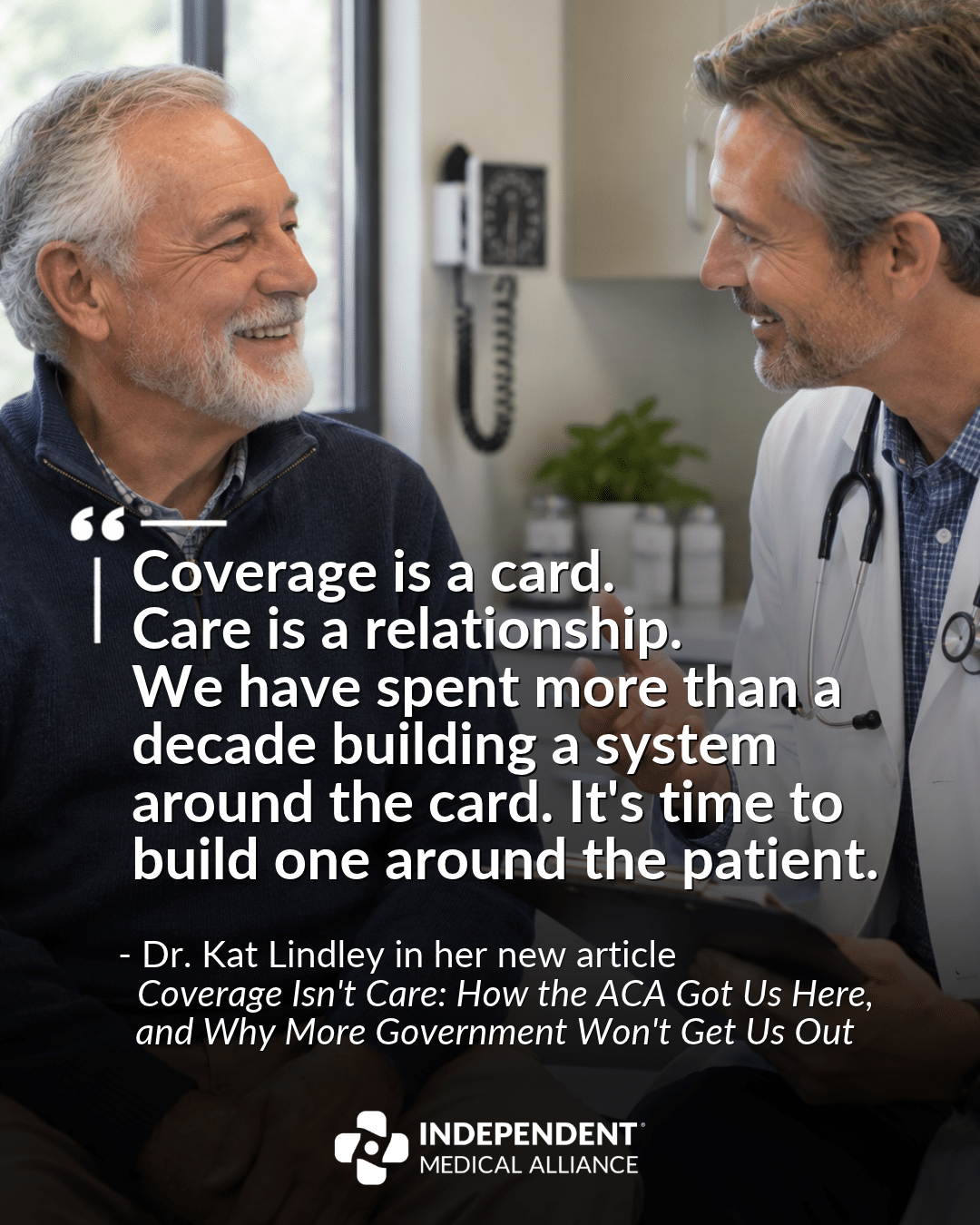
Coverage is a card. Care is a relationship. We have spent more than a decade building a system around the card. It’s time to build one around the patient.
— Dr. Kat Lindley is a Board Certified Family Physician and Director of the International Fellowship Program at the Independent Medical Alliance