
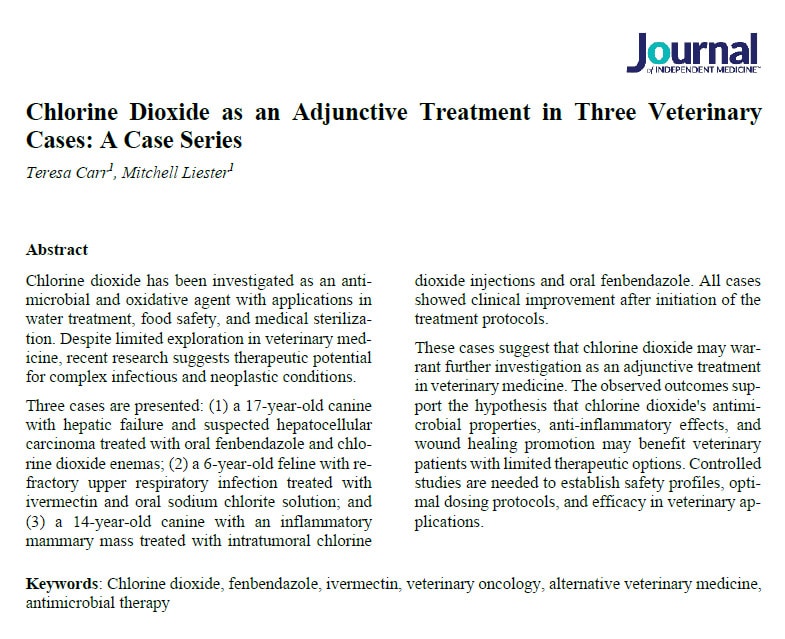
Three animals with limited options improved after treatment with chlorine dioxide. A new case series in the Journal of Independent Medicine documents what happened.
The FDA calls chlorine dioxide “a dangerous bleach.” Millions of people drink low doses of it every day in treated tap water. And clinicians and veterinarians have been quietly using it for years to treat conditions that conventional medicine couldn’t resolve.
A new case series in the Journal of Independent Medicine puts clinical outcomes on the record for the first time in veterinary medicine.
Teresa Carr, a veterinarian with 30 years of clinical experience, and Mitchell Liester, MD, an adjoint assistant professor in the Department of Psychiatry at the University of Colorado School of Medicine, documented what happened when they used chlorine dioxide protocols on three animals that had run out of conventional options. A dog with suspected liver cancer. A cat with an infection that wouldn’t respond to antibiotics. A dog with a large, painful mammary tumor. All three improved.
“I began independently researching alternative therapies for patients with more complex conditions.” — Teresa Carr
📖 Read and Download the Full Paper
Chlorine Dioxide as an Adjunctive Treatment in Three Veterinary Cases: A Case Series (JIM Vol. 2, No. 3, 2026) — Authors: Teresa Carr and Mitchell Liester
👉 Visit the Journal of Independent Medicine to create a free account and download the full article.
What Chlorine Dioxide Is
Chlorine dioxide is a selective oxidant first synthesized in 1811. This is not the stuff you accidentally gulped at the swimming pool as a kid. It is a distinct molecule with a different mechanism of action: it selectively oxidizes specific amino acids in microbial proteins, disrupting their function and replication. That gives it broad-spectrum antimicrobial activity against bacteria, viruses, fungi, and parasites.
“Chlorine dioxide was synthesized over 200 years ago, but was primarily used as a water treatment agent. It also has broad spectrum antimicrobial activity against bacteria, viruses, fungi, and parasites.” — Mitchell Liester
Regulatory agencies have approved it for water treatment, food safety, and medical equipment sterilization. The antimicrobial properties are not in dispute. What’s been missing is formal clinical investigation.
The human data that does exist is promising. Studies have documented improved glucose control, reduced inflammation, enhanced wound healing, and activity against antibiotic-resistant pathogens. A case series showed complete resolution of treatment-refractory diabetic foot ulcers, with one patient achieving sustained medication-free glycemic control for three years.
Three Cases, Three Conditions
All three animals in this case series were treated with multimodal protocols, so no single agent can take the credit. But the pattern is hard to ignore: three different conditions, three favorable outcomes, and zero adverse effects from chlorine dioxide across every route of administration.
- Case 1: A 17-year-old Shih Tzu with suspected liver carcinoma. Her ALT (a liver enzyme) was at 7,788 U/L, more than 60 times the normal upper limit. Dr. Carr treated her with oral fenbendazole and chlorine dioxide enemas alongside supportive care. Within seven days, ALT dropped 89%. By week five, it normalized. The dog maintained quality of life for eight months. For the elderly owner, those were eight months with a beloved companion that no one expected.
- Case 2: A 6-year-old cat with refractory upper respiratory infection. The cat had feline herpesvirus and mycoplasma, and conventional antibiotics had failed. Dr. Carr treated her with ivermectin and oral sodium chlorite. The cat improved within 24 hours, with fever resolving and appetite returning. Complete recovery by day five.
- Case 3: A 14-year-old golden retriever with an inflammatory mammary mass. The mass was approximately 20 centimeters in diameter and actively painful. Surgery was ruled out. Dr. Carr began intratumoral chlorine dioxide injections every two weeks. The dog tolerated them so well that no sedation was required. Fenbendazole was added at month three. Over eight months, the mass shrank from 20cm to approximately 5cm. The dog was eventually euthanized due to severe osteoarthritis, not tumor progression.
“I was very encouraged by the outcomes of these cases and have continued exploring alternative therapies and additional patients.” — Teresa Carr

The Safety Question
The FDA labeled chlorine dioxide “a dangerous bleach” during the COVID pandemic and pursued criminal enforcement against people promoting its use. Carr and Liester argue that label was based on high-dose misuse, not on the low-dose therapeutic protocols practitioners are actually using.
“The FDA during the COVID pandemic labeled chlorine dioxide a dangerous bleach. Now, this was based on very high doses being misused, not on the low doses that have been demonstrated to be safe.” — Mitchell Liester
The safety data at low doses tells a different story:
- The EPA established a no-observed-adverse-effect level of 3 mg/kg/day for oral chlorine dioxide
- Phase I and II clinical trials for ALS confirmed that IV sodium chlorite at doses up to 3.2 mg/kg/day was safe and well-tolerated, with no serious adverse events
- Millions of people consume low-dose chlorine dioxide daily in municipal drinking water
- In these three veterinary cases, no adverse effects across enema, oral, and intratumoral routes over treatment periods ranging from 10 days to 8 months
Calling this compound “a dangerous bleach” while millions drink it daily is, as the authors put it, like labeling chemotherapy a poison based solely on high-dose toxicity.
Why the Evidence Stays Thin
If the safety data is there and practitioners are already using it, why does the evidence base remain so limited?
The answer is structural. Chlorine dioxide cannot be patented. That means no pharmaceutical company has a financial incentive to fund the controlled trials that regulators require for approval. Regulators prohibit its therapeutic use because those trials don’t exist. And the prohibition makes it harder for researchers to generate the data that would justify lifting it.
“This compound is not patentable, and therefore it’s unlikely that pharmaceutical companies will want to fund further research.” — Mitchell Liester
Carr and Liester are direct about what this case series is and what it is not. It is hypothesis-generating. It does not prove that chlorine dioxide works as a veterinary treatment. What it does is put documented clinical outcomes into the peer-reviewed literature and make the case that controlled research is long overdue.
“At the same time, I believe controlled studies will be important to help clinicians better understand the safe and appropriate use of these compounds in practice.” — Teresa Carr
That is exactly the kind of work the Journal of Independent Medicine exists to publish. The full study is available open-access at journalofindependentmedicine.org.