


Public Forum
Default group for all members. Biological family sometimes get you down? Come join your logical family!
Organizers:
- Organized by
-
-


What really is ‘Normal’ Blood Pressure?
-
What really is ‘Normal’ Blood Pressure?
A friend of mine has been put on blood pressure meds to reduce her blood pressure. So I asked what was her blood pressure, and why was it considered high?
She said she didn’t know, but is feeling better.
So I noted that the Normal Blood pressure has been lowered consistently.
I also sent info from the Mid Western doctor https://www.midwesterndoctor.com/p/unmasking-the-great-blood-pressure I thought this line in the article pertinent – “As I was pondering this, a long-time Eastern spiritual teacher shared with me their belief that the West’s relentless focus on blood pressure was due to it being much easier to measure than blood perfusion (healthy blood flow).”
There is a discussion here about hypertension – https://imahealth.org/forums/groups/public-forum/forum/discussion/hypertension-after-2021-2022/ and here’s our search on our website – https://imahealth.org/search/?q=blood+pressure.
But here today, again, I see normal blood pressure has been lowered again.
https://x.com/ValerieAnne1970/status/1974351778750627956?t=5gQvYk3TnUf0AqoMEJdDXw&s=08
So this is a different discussion: What should be normal? And how to overcome the “easy to instill” fear, but at the same time taking high and low blood pressure seriously?
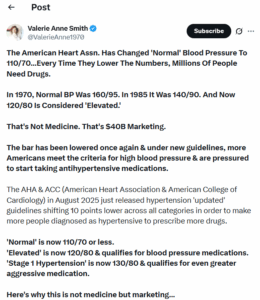
Just for ease, here’s the full text on x –
Valerie Anne Smith
@ValerieAnne1970
The American Heart Assn. Has Changed ‘Normal’ Blood Pressure To 110/70…Every Time They Lower The Numbers, Millions Of People Need Drugs.In 1970, Normal BP Was 160/95. In 1985 It Was 140/90. And Now 120/80 Is Considered ‘Elevated.’
That’s Not Medicine. That’s $40B Marketing.
The bar has been lowered once again & under new guidelines, more Americans meet the criteria for high blood pressure & are pressured to start taking antihypertensive medications.
The AHA & ACC (American Heart Association & American College of Cardiology) in August 2025 just released hypertension ‘updated’ guidelines shifting 10 points lower across all categories in order to make more people diagnosed as hypertensive to prescribe more drugs.
‘Normal’ is now 110/70 or less.
‘Elevated’ is now 120/80 & qualifies for blood pressure medications.
‘Stage 1 Hypertension’ is now 130/80 & qualifies for even greater aggressive medication.Here’s why this is not medicine but marketing…
The new guidelines are based on results of a large, federally funded study called SPRINT, backed by pharmaceutical giants & stockholders…which found a 25% ‘relative risk’ reduction in cardiovascular events using a lower blood pressure target.
25% reduction was the ‘relative risk reduction’ not the ‘absolute risk reduction.’ Relative risk reduction is useless & misleading, whereas absolute risk reduction is the actual percent helped by an intervention.
The absolute reduction in cardiovascular events was only 2% – SPRINT also used an especially high-risk population, so patients with low or average risk for cardiovascular events had 0% benefit or absolute reduction.
Is lower blood pressure always better? definitely not…
The AHA & ACC assume that a lower blood pressure is always better, but some primary care doctors challenge that doctrine. “Once you get to a certain point, if you lower blood pressure further, your rate of stroke & heart attack increases,” says Dr Andy Lazris, primary care doctor & Right Care Alliance council chair.
Doctors are graded on how well they get patients to the new hypertension target. These grades affect doctors’ pay.
Dr. Andy Lazris admits, “If I lower my patient’s blood pressure & they fall and break their hip due to the medication causing dizziness & fainting…I still get paid.”
“Treating blood pressure with medicine is a risky intervention,” says Dr. Ronald Adler, associate professor of family medicine & community health at the University of Massachusetts Medical School.
“BP medications cause adverse effects such as kidney & electrolyte abnormalities, not to mention the increased risks of complications such as dizziness & falls that inevitably result when BP is lowered too much,” says Adler, “Because the new guidelines suggest that people be treated initially with 2 drugs, such experiences will be even more common.”
Side Effects of Blood Pressure Medications:
Heart palpitations
Fainting
Kidney dysfunction
Angioedema (swelling of face/tongue)
Joint pain
Chronic cough
Low sodium & potassium
Dizziness
Headache
Dehydration
Muscle cramps
Gout
Insomnia
Constipation
Tiredness
Depression
Slow heartbeat
Symptoms of asthma
Sexual dysfunctionYour own unique optimal blood pressure can be obtained thru diet & lifestyle interventions:
A whole foods diet consisting of low sugar, no seed oils, no processed foods & including abundant nutrient dense animal sourced foods will normalize blood pressure for you.
Prioritizing the minerals Potassium & Magnesium is crucial. Both are involved in the body’s Sodium Potassium Pump System. Supporting these important minerals by using unrefined mineral salt & in supplements when needed to heal deficiency will also yield your own normal Blood Pressure.
Bioavailable Magnesium needs are at least 600 mg per day & Potassium guidelines are at minimum 4,700 mg per day. Most people do not even get 50% of these minimums, leaving their heart & blood vessels to work harder than our physiology is intended to.
Dr Gilbert Welch, Dartmouth professor, “focusing on the number 110/70 not only will involve millions of people but also will involve millions of new prescriptions & millions of dollars.”
“It distracts doctors & their patients from activities that aren’t easily measured by numbers, yet are more important to health — real food, regular movement & finding meaning in life. These matter whatever your blood pressure is.”
👇New Guidelines Mean More Hypertension Meds👇
https://pbs.org/newshour/health/under-new-guidelines-more-americans-meet-the-criteria-for-high-blood-pressure
👇40 Year Blood Pressure Normal Numbers Shift👇
https://ahajournals.org/doi/10.1161/CIRCULATIONAHA.120.048063
👇Higher BP In Older Adults Live Longer👇
https://evidence.nihr.ac.uk/alert/new-research-supports-the-move-to-raise-the-blood-pressure-target-for-frail-older-people/
Speaker: Dr Adam J Story



Log in to reply.