Host: Dr. Ryan Cole | Guests: Dr. Kristina Carman, Dr. Adylle Varon
Ancient herbs. Acupuncture. Thousands of years of observation are now meeting modern clinical evidence.
Can centuries-old medical wisdom shape modern clinical care? Join host Dr. Ryan Cole for a focused, clinician-led discussion on how Traditional Chinese Medicine (TCM) is being applied in clinical practice.
He is joined by Dr. Kristina Carman, IMA Senior Fellow of Nutritional and Holistic Health, and Dr. Adylle Varon, IMA Senior Fellow of Acupuncture and Oriental Medicine. Together, they’ll explore how ancient principles can support complex, chronic conditions in practical, measurable ways.
For thousands of years, physicians didn’t have CT scanners, hormone panels, or inflammatory markers. What they had was observation. They watched patterns, studied how stress reshaped the body, how digestion affected mood, and how seasons influenced physiology. From that, they built a structured system of diagnosis and treatment that persists today.
This week on the IMA Weekly Webinar, host Dr. Ryan Cole sat down with Dr. Kristina Carman and Dr. Adylle Varon to ask a pointed question: What happens when that ancient system meets the modern exam room? Not as nostalgia, not as mysticism, but as clinical strategy.
Meet the Experts

IMA Senior Fellow, Nutritional and Holistic Health. Dr. Carman integrates functional medicine, nutrition, and whole-systems approaches to chronic disease, drawing on training in both naturopathic and Ayurvedic traditions. Her practice emphasizes deep patient intake, individualized herbal protocols, and specialized diagnostics including organic acid testing, hair tissue mineral analysis, and GI mapping. She is the author of IMA’s tools & guides, covering topics from cancer to women’s health.
IMA Senior Fellow, Acupuncture and Oriental Medicine. Dr. Varon is a nationally certified and Texas board-licensed acupuncturist and Doctor of Oriental Medicine. She is the founder of Ambrozia Integrative Healthcare in Houston, where she integrates Traditional Chinese Medicine, acupuncture, and herbal medicine with evidence-based wellness practices. She works clinically alongside IMA Co-Founder and Chief Medical Officer Dr. Joseph Varon, and serves as Secretary of the Texas Association of Acupuncture and Oriental Medicine (TAAOM).
1. What is Traditional Chinese Medicine (TCM)?
Dr. Varon put it simply from the start:
“I can tell you it’s not woo-woo, that’s the first thing I can tell you.”
Traditional Chinese Medicine is a system built on observation and palpation, developed over thousands of years. It views the body through a different lens than conventional Western medicine, focusing on where energy (Qi) is flowing, where it’s excessive, and where it’s deficient. It encompasses multiple theories and therapeutic tools, but at its core, it’s about identifying and restoring balance.
Dr. Carman highlighted what she sees as one of the biggest contrasts with conventional care: the fragmentation of the body into siloed specialties.
“We’ve also forgotten that the body is actually fundamentally a whole being and everything that we are is interconnected.”
She pointed to how Eastern medicine traditions, including TCM, Ayurvedic medicine, and Yunani medicine, all share this emphasis on treating the whole person rather than isolated symptoms. The five elements framework (Wood, Fire, Earth, Metal, Water) offers patients and clinicians alike a way to understand inherent strengths, weaknesses, and how the body connects to the natural world.
2. Diagnosis Beyond the Lab: The Body Tells the Story
Both practitioners emphasized that the diagnostic process in TCM starts long before any lab panel. Dr. Carman described her initial intake as an hour-long deep dive into a patient’s birth story, childhood patterns, family dynamics, traumas, and eating habits. This comprehensive case history is central to understanding the “life force within this being” and whether the patient’s terrain is ready to receive treatment.
Dr. Varon took it a step further, noting that patient self-reporting has limits:
“Not everybody’s going to be honest on inquiry. So I go to the pulse, I go to the tongue, and I go to the body—and the body holds memory. As we know, cellular memory is very real.”
TCM practitioners classify conditions along several axes:
- Hot vs. Cold
- Excess vs. Deficiency
- Interior vs. Exterior
- Yin vs. Yang
The pulse, read at the radial wrist, can reveal conditions at different depths of the body. The tongue maps internal organ function. Even the tone of someone’s voice provides diagnostic information. Dr. Varon described how palpating the body’s meridian channels can reveal exactly where stagnation and blockages reside, often connected to physical or emotional trauma.
Dr. Cole observed that the physical, hands-on nature of this diagnostic approach stands in sharp contrast to modern medicine, where physicians often spend appointments staring at a computer screen rather than examining the patient in front of them.
3. Herbs With Purpose, Not Hype
Dr. Carman walked through several key herbs she uses in practice:
- Ginseng (Ren Shen): Fatigue, immune support, stress resilience, male fertility
- Astragalus (Huang Qi): Immune modulation, kidney tonification, energy enhancement
- Reishi (Ling Zhi): Sleep support, stress, longevity
- Turmeric/Curcumin (Jiang Huang): Inflammation, circulation, liver support
- Ginger (Sheng Jiang): Digestion, gut motility, immune support (particularly useful in children)
She also covered targeted herbs for hormonal, thyroid, and adrenal support:
- Dong Quai (Dang Gui): Menstrual health, menopause, PMS
- Rhodiola: Adrenal support, fatigue, mood
- Ashwagandha: Thyroid function, stress, energy
- Schisandra (Wu Wei Zi): Detoxification, hormones, stamina
- Licorice (Gan Cao): HPA axis support, cortisol balance, digestion (comes with contraindications)
- Shatavari: Female reproductive health, stress
But her overriding message was caution:
“Herbs and supplements can be as dangerous or as potent as medications. And if you are on polypharmacy, you do have to be very cautious.”
She shared a practical example from her Ayurvedic training: ashwagandha, widely popular as an adaptogen, is energetically drying and was traditionally reserved for men or postmenopausal women rather than given to cycling women, whose physiology requires cooling and moistening support. This kind of nuance gets lost in the social media supplement culture she cautioned against.
Dr. Carman caps her herbal protocols at roughly three herbs at a time so she can track what’s actually working. Both practitioners stressed the importance of quality sourcing, noting that poorly sourced herbs can carry sulfites, heavy metals, and other contaminants. Dr. Varon recommended finding practitioners certified in Oriental Medicine (not just acupuncture) and using reputable herbal lines with strong manufacturing standards.
4. The Full Toolkit: Acupuncture, Moxibustion, and More
Acupuncture may be the most recognized TCM modality, but Dr. Varon explained it’s just one tool in a much larger kit. She described how filiform needles inserted at specific points trigger the body’s natural healing response on a microscopic level.
She was particularly enthusiastic about moxibustion, a warming technique using dried Artemisia (mugwort) applied to acupuncture points or along the spine. It comes in many forms:
- Loose herb: Rolled into small balls and placed on or near the skin
- Compressed sticks: Held near acupuncture points to warm and activate channels
- Warm needle technique: Moxa placed on an inserted acupuncture needle and lit
- Ginger moxa: Layered on slices of ginger along the spine, particularly for autoimmune support
- Sprays and balms: Topical forms that activate with heat
“Whenever we have a season transition, especially from winter into the spring, we like to use this warming technique because it is said to enhance the immune function and also to protect us for the winter time.”
Dr. Varon noted that moxibustion is especially effective for:
- Chronic fatigue
- Arthritis
- Fertility and reproductive health
- Cognitive conditions (Alzheimer’s, ALS)
- Shingles
Beyond acupuncture and moxa, TCM practitioners also employ:
- Cupping and Gua Sha: Fascial release, moving stagnation
- Tui Na: Manual therapy similar to lymphatic drainage
- Bloodletting: Clearing excess heat
- Plum Flower Needling: Seven-needle hammer technique to promote circulation
The full TCM toolkit also includes dietary therapy. Dr. Varon emphasized that food comes first, always, before herbs. Traditional Chinese dietary therapy classifies foods by their energetic properties (warming, cooling, damp-clearing) and matches them to the patient’s condition and the season. Both guests noted that eating seasonally and locally matters, and that cold, raw salads in winter may be counterproductive for many people.
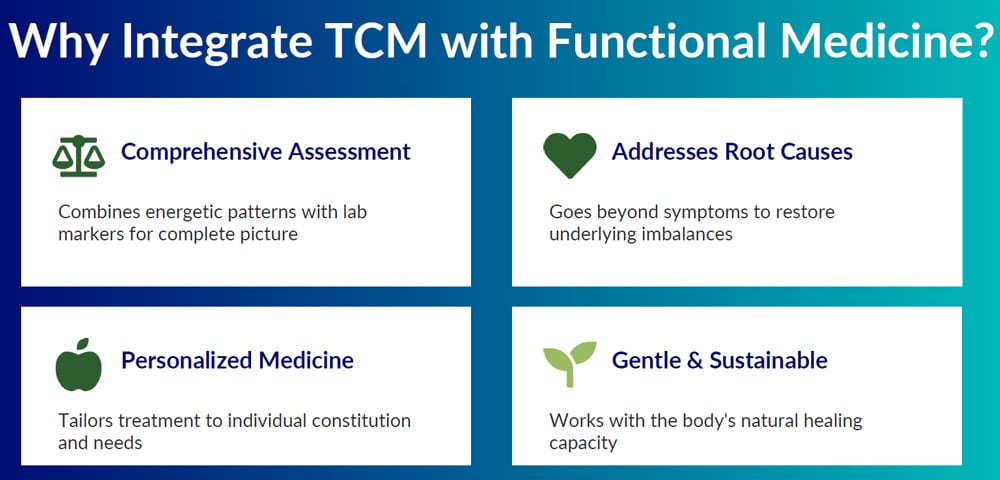
5. Integration, Complexity, and Finding the Right Practitioner
A recurring theme throughout the discussion was the growing complexity of modern chronic illness. Dr. Carman relayed a colleague’s observation that captures the challenge:
“We don’t have vanilla patients anymore. We have really complex, really ill people that are coming constantly.”
This complexity often demands an integrative approach. Dr. Varon described her working dynamic with Dr. Joseph Varon (“Big Varon”), where they regularly bounce cases off each other, with her hands-on TCM assessment sometimes catching what lab work missed and his diagnostics providing context her treatment doesn’t require but benefits from.
Both practitioners stressed the importance of practitioner humility. When treatment isn’t working, the clinician needs to reassess rather than assume the patient isn’t compliant. Dr. Carman also acknowledged the reality of the healing process in natural medicine: patients may feel worse before they improve as the body works through layers of accumulated imbalance.
For those seeking a TCM practitioner, Dr. Varon recommended the NCCAOM (now NCBAHM) database, where you can search by zip code and look for the “OM” designation, indicating board certification in both acupuncture and herbal medicine.
Dr. Cole closed with a thought that framed the entire conversation:
“Ancient wisdom—it’s not about nostalgia. It’s about accumulated clinical observation, and this is centuries of it. And when we combine centuries of pattern recognition with our modern tools, we can care for complex illnesses.”
Related Reading
- Webinar: Sleep Matters: Clinical Perspectives from Western and Eastern Medicine
- Blog Post: Can Herbal Medicine Help End the Opioid Crisis? IMA Researchers Propose a Clinical Trial
- Webinar: Combining Eastern and Western Medicine
- Blog Post: Western vs. Eastern Medicine: The Best of Both Worlds
- Journal Article: Traditional Chinese Medicine (TCM): A Review, Part 1
- Journal Article: Traditional Chinese Medicine (TCM): A Review, Part 2